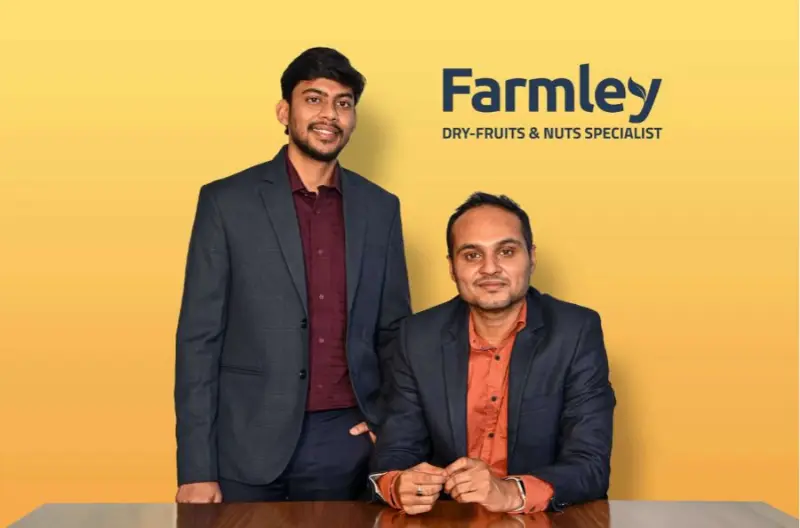
Akash Sharma and Abhishek Agarwal, IIT graduates, founded Farmley in 2017 as a B2B dry fruits processor before pivoting to D2C in 2020. India's fastest-growing healthy snacking brand, Farmley reached ₹394 crore revenue in FY25, targets ₹600-700 crore in FY26 and ₹1,000 crore in 2.5 years, raised $56.9 million including a $42 million Series C led by L Catterton, and is endorsed by Rahul Dravid.
Four Years of Backend, Then One Pivot That Changed Everything
• Farmley was founded in 2017 under Connedit Business Solutions Private Limited in Noida, initially operating as a B2B wholesale supplier. For the first three to four years, the founders built something invisible to consumers but invaluable to the business: a fully backward-integrated supply chain.
• They established five dedicated processing units near sourcing and import hubs for almonds, cashews, and other dry fruits. They built direct linkages with over 5,000 farmers across multiple domestic and international farming communities. They mastered quality control, traceability, and adulteration-free processing at a scale the unorganised market had never attempted.
• "The Indian dry fruits and nuts market is valued at ₹50,000 crore, growing at 9% CAGR. The unorganised market makes up 95% of the market. Products from the unorganised market suffer from quality, hygiene, and adulteration issues. The full backward integration at Farmley ensures premium quality produce," Hariharan Premkumar of DSG Consumer Partners explained at the time of investment.
• In 2020, with the supply chain fully operational, Farmley raised $2 million in seed funding from Omnivore and Insitor Partners and pivoted to D2C retail. The timing was precise: COVID-19 had accelerated India's shift to online grocery shopping and heightened consumer awareness about clean, quality food.
Farm-to-Palm, World-First Makhana Pasta, and Rahul Dravid
• The boldest product decision Farmley made was to treat dry fruits and nuts not as a commodity category but as an innovation platform.
• While every other brand sold the same almonds in the same packaging, Farmley launched India's first makhana pasta, flavoured roasted nuts, date bites, trail mixes, and seed products that transformed a traditional ingredient into a modern snacking experience. Every product carried the credibility of a supply chain that the founders had spent four years building before a single consumer-facing rupee was spent.
• The brand ambassador decision was equally precise. Former Indian cricket captain Rahul Dravid, whose identity is built entirely on discipline, trust, and long-term thinking, was chosen to represent Farmley at a national scale. The alignment between Dravid's personal brand and Farmley's founding philosophy of patient, quality-first building was strategic rather than coincidental.
• The company is now channelling resources into AI-powered personalisation, product innovation, and advanced food technology, positioning the brand at the intersection of nutrition science and consumer convenience. The distribution strategy expanded from pure e-commerce to 22,000-plus offline retail touchpoints across India, with focused expansion into untapped regions in South and East India using Series C capital.
The Funding Journey — $56.9 Million Across Six Rounds in Eight Years
• Farmley's funding trajectory reflects the methodical, stage-by-stage building that defines everything about the company. The $2 million seed in 2020 from Omnivore and Insitor established the D2C foundation. The $6 million Series A in August 2022 led by DSG Consumer Partners and Alkemi Growth Capital validated the 10x revenue growth in 18 months. A $6.7 million pre-Series B in December 2023 led by BC Jindal Group bridged the brand's rapid scale. And in May 2025, L Catterton, which manages approximately $37 billion in equity across private equity, credit, and real estate, led the $42 million Series C with participation from DSG Consumer Partners and BC Jindal Group.
• The round included a small secondary component where early-stage angel investors exited, and proceeds are being deployed toward capital expenditure, distribution expansion across India, enhanced exports, product formulations, and the new ₹40 to ₹50 crore manufacturing facility in Noida targeting operations by FY27.
Scale and Real-World Impact
• Farmley reached ₹394 crore in operating revenue in FY25, up from ₹230 crore in FY24, a 71% year-on-year growth. "We aim for ₹600-700 crore revenue in the current fiscal with expansion of our presence in both offline and online channels," CEO Akash Sharma said. The long-term target is ₹1,000 crore in turnover within the next 2.5 years. Net loss narrowed to ₹22.5 crore in FY25 from ₹26.5 crore in FY24, with the company inching toward EBITDA profitability. Total funding raised is $56.9 million across six rounds from 19 investors. Co-founders hold 52% equity with a combined net worth of ₹304 crore. The company employs 408 people as of August 2025, up 92% year-on-year. International markets include the US, Canada, Singapore, and Dubai. India's dry fruits and nuts healthy snacking market is projected to reach $8.5 billion by 2031 at 14% CAGR.
The Founders Who Build the Foundation First Build the Most Defensible Brands
• The sharpest lesson from Farmley's journey is this: in categories where the product is a commodity, the founders who control the supply chain control the category.
• Akash and Abhishek spent four years building five processing units and farming linkages with 5,000-plus farmers before they spent a single rupee on consumer marketing. That patience gave Farmley something no D2C brand built purely on marketing could replicate: genuine, supply-chain-level quality that showed up in every product, every time.
• “We are committed to reimagining snacking for the modern Indian consumer, transforming what was once considered mere convenience food into a wholesome delightful experience," Akash and Abhishek say.
• Two IIT graduates. Four years of backend. One pivot. ₹394 crore in FY25. ₹1,000 crore in sight. And a brand that Rahul Dravid trusts his name to. That is what patience looks like when it compounds.
Sources: Indian Retailer, Agro Food Processing, FoodBev Media, Entrackr, PR Newswire, DSG Consumer Partners, StartupPedia, Tracxn