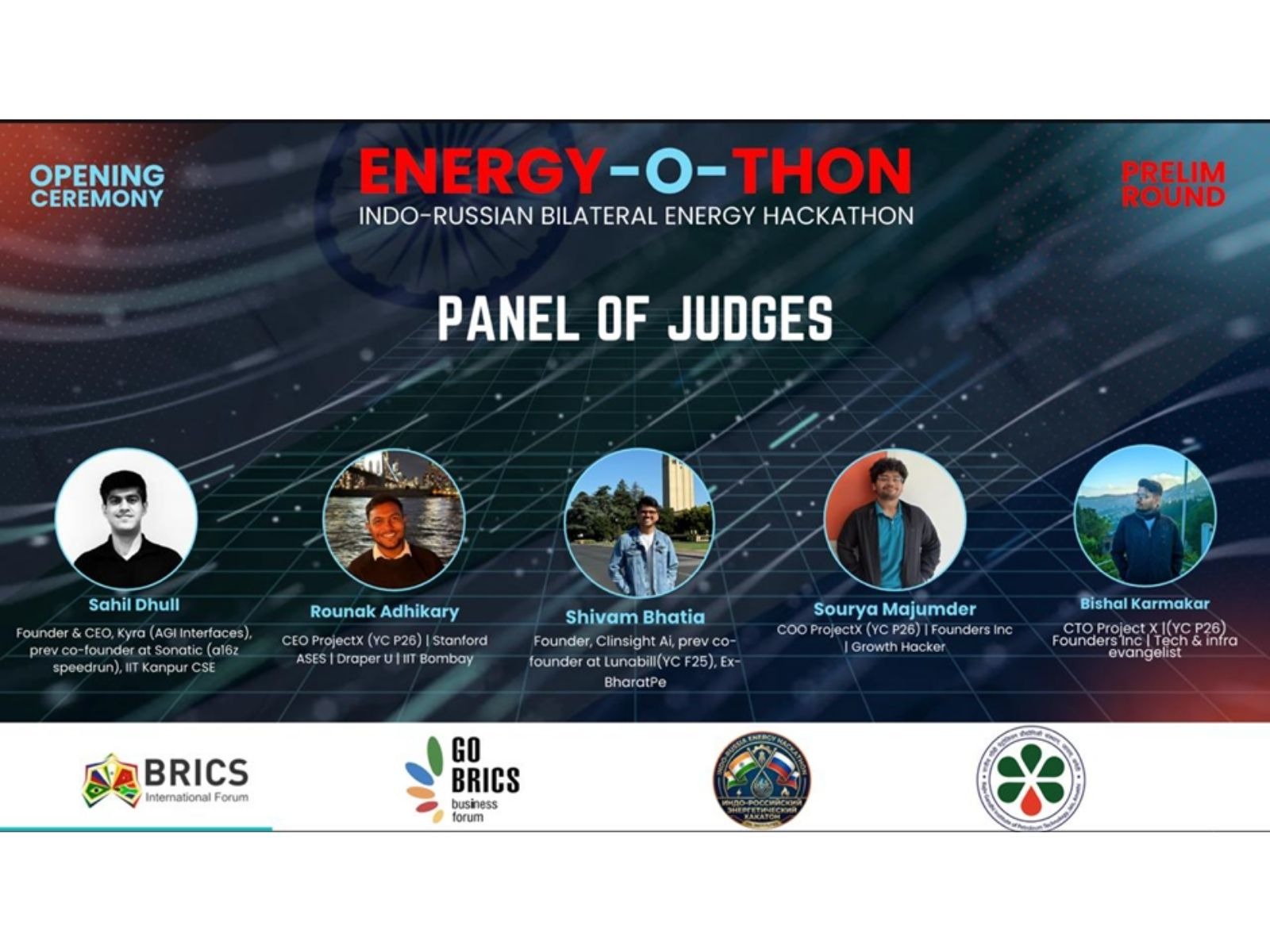
The inaugural GO-BRICS India-Russia Energy-o-thon 2026 launched today, engaging 17,000 engineering students in a high-stakes AI challenge. Coordinated by RGIPT, the hackathon seeks to solve complex energy grid deficits, fostering technological cooperation and innovation between India and Russia to address critical sustainability goals and future energy security.
The inaugural GO-BRICS India-Russia Energy-o-thon 2026 has launched, challenging thousands of students to solve complex power grid issues using artificial intelligence.
The GO-BRICS India-Russia Energy-o-thon 2026 officially commenced today with a virtual opening ceremony, marking the debut of the world's first hackathon organized under the BRICS nations' framework. With over 17,000 registrations, the competition brings together engineering talent from India and Russia to address critical challenges in energy production and sustainability. Coordinated by the Rajiv Gandhi Institute of Petroleum Technology (RGIPT), the event seeks to foster cross-border technological cooperation as member nations look to modernize their energy grids and meet ambitious ESG (Environmental, Social, and Governance) targets.
A High-Stakes Technical Challenge
The hackathon centers on a practical, industrial-scale problem titled "AI Dispatcher for the Energy Transition: Balancing Production and ESG under Uncertainty." Teams are tasked with developing artificial intelligence models capable of managing a hypothetical 90 MW power deficit within a hybrid industrial energy system. Participants must ensure the solution maintains operational efficiency while strictly adhering to sustainability constraints.
According to organizers, the event is hosted on the DION digital platform, where teams work through an intensive 72-hour window. The competition requires participants to move beyond conceptual pitches, mandating the submission of mathematical models, economic feasibility studies, and implementation scenarios.
Bridging Academic Talent and Industry Needs
The competition has attracted significant interest from elite technical institutions. In India, participants include students from various IITs, NITs, and IIITs. Russian counterparts joined from prominent institutions, including the Peter the Great St. Petersburg Polytechnic University and the Moscow Polytechnic University. Notably, organizers reported that over 40% of the participants are women, representing a significant shift in diversity for energy and technology-focused competitions.
The initiative is steered by the BRICS International Forum, led by President Purnima Anand, with academic oversight provided by the RGIPT. Technical vision and guidance for the hackathon were provided by experts Victor Kokushkin and Dr. Akash Yadav, supported by faculty members from RGIPT specializing in energy storage, advanced materials, and sustainable energy conversion.
Structure and Future Impact
The Energy-o-thon is structured as a three-stage contest designed to bridge the gap between academic research and industrial application:
Qualifying Round: The current online phase involves thousands of teams, which will be narrowed down to the top 60 participants.
Semi-Finals: The selected teams will compete in offline rounds hosted in India.
Grand Finale: The strongest teams will receive fully sponsored invitations to a final round in Russia, scheduled to align with the upcoming BRICS Heads of State Summit.
This format is intended to create a recurring platform for scientific collaboration. Organizers have signaled that if the current edition proves successful in generating actionable industrial solutions, they plan to expand the model to include other BRICS member nations in future years.
Why It Matters
For energy stakeholders and investors, this hackathon represents a pivot toward data-driven energy management. By utilizing AI to balance power deficits under strict ESG mandates, these innovations provide a blueprint for how developing economies can optimize grid resilience. The collaboration serves as a strategic pilot for international scientific partnership, aiming to standardize how member nations tackle the energy transition collectively.
Key Facts at a Glance
Scale: Over 17,000 student innovators registered from across India and Russia.
Theme: "AI and Digital Technologies in Energy for Advancing the ESG Agenda."
Challenge: Using AI to manage a 90 MW power deficit in hybrid energy systems.
Participation: Over 40% of participants are women, highlighting increased engagement in energy-tech fields.
Execution: A three-stage format culminating in a grand finale in Russia alongside the BRICS Heads of State Summit.
Frequently Asked Questions
What is the objective of the Energy-o-thon?
The event aims to find scalable AI-driven solutions to real-world energy deficits while maintaining sustainability and environmental standards.
Who is participating in the hackathon?
Engineering students from top-tier institutions in India (IITs, NITs) and Russia (e.g., Peter the Great St. Petersburg Polytechnic University) are collaborating in teams.
How does this impact the broader energy sector?
It provides a platform to test innovative, AI-based energy management strategies that could eventually be deployed to stabilize national grids and support the transition to green energy.
Official Sources