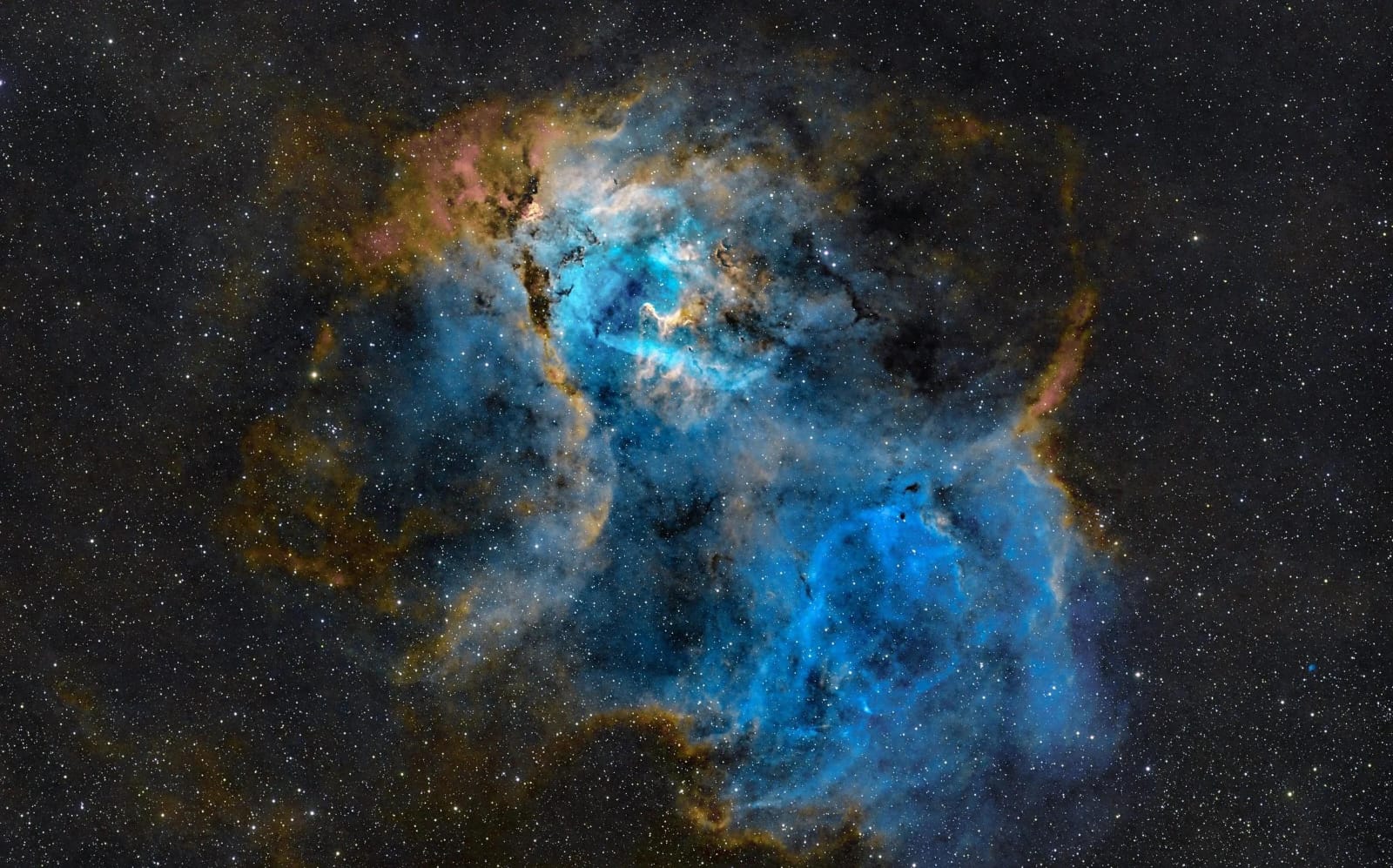
NASA, ESA, and CSA have released detailed Webb space telescope images of planetary nebula NGC 2392, known as the Lion Nebula. Utilizing NIRCam and MIRI instruments, the infrared observations reveal expanding ionized gas bubbles and surviving dust filaments around a dying white dwarf star, offering fresh insights into stellar mass loss.
WASHINGTON — NASA, the European Space Agency (ESA), and the Canadian Space Agency (CSA) on August 10, 2026, released high-resolution infrared imagery of planetary nebula NGC 2392, commonly known as the Lion Nebula. Captured by the James Webb Space Telescope's Near-Infrared Camera (NIRCam) and Mid-Infrared Instrument (MIRI), the observations reveal intricate dust structures, ionized gas shells, and radiation-resistant filaments generated by a dying central white dwarf star. The findings provide astronomers with critical insights into stellar mass-loss mechanisms, cosmic dust preservation, and the structural evolution of lower-mass stars near the end of their life cycles.
Infrared Capabilities Reveal Unprecedented Dust Structures
The new observations from NASA's Webb space observatory offer a dramatic technological leap over visible-light images taken by the Hubble Space Telescope in 2000. By operating in mid-infrared and near-infrared wavelengths, Webb pierces through obscuring cosmic haze to map compact clumps of dust and ionized gas within the Lion Nebula with exceptional clarity.
The images highlight how energetic radiation emitted by the central white dwarf star actively alters surrounding interstellar material. While extreme radiation destroys lighter dust particles along the interior boundary, denser filaments survive, forming comet-like structures that shade and protect material behind them. Astronomers refer to these dense features as the "mane" surrounding the lion-like central bubble.
Stellar Evolution and the Lifecycle of Lower-Mass Stars
Massive stars end their life cycles in supernova explosions, but lower-mass stars like the precursor of NGC 2392 undergo a slower, pulsational transition. When nuclear fusion reactions cease in the core, the unstable star sheds its outer layers into space over several thousand years. These expelled shells of gas and dust form planetary nebulae, serving as primary factories for heavy elements and cosmic dust across the universe.
The white dwarf core at the center of the Lion Nebula acts as a powerful energy driver, ionizing surrounding gases and driving the central gas bubble outward. Astrophysicists estimate that the planetary nebula will continue expanding until its material completely disperses into the interstellar medium in approximately 10,000 years.
Impact on Astrophysical Research and Cosmic Dust Models
The high-resolution spectral data gathered from the Lion Nebula provides researchers with precise empirical measurements regarding dust survival rates near hot stellar remnants. Understanding how dust grains withstand intense ultraviolet radiation helps scientists refine models predicting how chemical elements recycle into future star systems and planets.
For space agencies and research institutes globally, the success of Webb's MIRI and NIRCam instruments demonstrates the necessity of infrared observatories in studying transient astronomical phenomena that remain invisible to optical telescopes.
Official Sources Section
According to official releases published by participating international space organizations and science institutes:
NASA Science Mission Directorate: Official image release and scientific breakdown published on August 10, 2026.
European Space Agency (ESA): Technical observational notes detailing MIRI and NIRCam instrument configurations.
Space Telescope Science Institute (STScI): Image processing credits and spectral data archiving for NGC 2392.
Quote Section
"According to officials at NASA and the Space Telescope Science Institute, Webb’s high-resolution mid-infrared capabilities have allowed astronomers to observe for the first time how delicate dust filaments survive intense radiation inside the Lion Nebula," stated mission representatives during the official image unveiling. "Observatory scientists emphasized that these observations freeze a crucial phase of stellar death, providing vital data on how dying stars enrich the surrounding galactic medium with cosmic dust."
Why It Matters
The detailed mapping of planetary nebula NGC 2392 advances human understanding of stellar evolution and cosmic chemical recycling. Because the Sun will eventually undergo a similar transition into a white dwarf surrounded by ejected gas, studying the Lion Nebula offers a direct window into the far-future evolution of our own solar system.
Key Facts at a Glance
Target Object: Planetary nebula NGC 2392, designated the Lion Nebula.
Observating Instruments: James Webb Space Telescope's NIRCam and MIRI instruments.
Key Discovery: High-resolution mapping of surviving dust filaments and expanding ionized gas bubbles.
Estimated Lifespan: Nebular structures will fully disperse into space in approximately 10,000 years.
FAQ Section
Q1: What is the Lion Nebula?
The Lion Nebula (cataloged as NGC 2392) is a planetary nebula created by the outer gas and dust layers shed by a dying, lower-mass star surrounding a central white dwarf.
Q2: Which instruments on NASA's Webb captured these new images?
Webb imaged the target using its Near-Infrared Camera (NIRCam) and Mid-Infrared Instrument (MIRI).
Q3: How does Webb's view of the Lion Nebula differ from Hubble's view?
While Hubble observed NGC 2392 in visible light in 2000, Webb uses infrared vision to cut through cosmic dust, revealing compact dust clumps, fine filaments, and protected gas structures in unprecedented detail.
Q4: Will the Lion Nebula last forever?
No. Astronomers calculate that as the central white dwarf expands its ionized gas bubble, the nebula's gas and dust will fully disperse into the galaxy in about 10,000 years.
Source: Official scientific announcements and media releases from NASA Science, the European Space Agency, and the Space Telescope Science Institute.