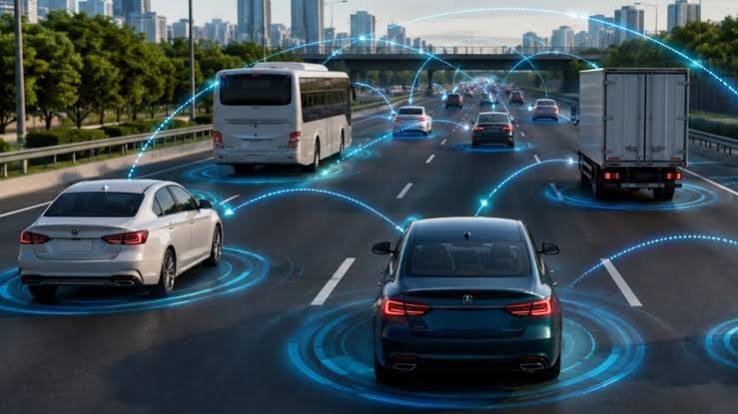
India's Ministry of Road Transport and Highways has issued draft rules proposing mandatory V2V communication systems in all newly manufactured two-wheelers, passenger cars, and commercial trucks starting October 1, 2028. Operating under the AIS-230 standard on a license-exempt 5.9 GHz radio band, the technology enables vehicles to wirelessly share real-time hazard data, mitigating collision risks beyond direct driver line-of-sight.
NEW DELHI — The Union Ministry of Road Transport and Highways (MoRTH) officially issued a draft notification on August 3, 2026, proposing amendments to the Central Motor Vehicles Rules (CMVR), 1989, to mandate vehicle-to-vehicle communication systems across all newly manufactured vehicles starting October 1, 2028. Under the proposed regulatory roadmap, mandatory V2V communication systems will apply to Category L (two- and three-wheelers), Category M (passenger vehicles including cars and buses), and Category N (goods vehicles and commercial trucks). The safety mandate is designed to enable real-time wireless transmission of speed, location, direction, and braking parameters between nearby vehicles, allowing electronic safety protocols to warn drivers of blind spots, sudden braking, and collision hazards beyond direct line-of-sight view.
Phased Rollout Schedule and Technical Standards Under AIS-230
According to draft amendments published by the road transport ministry, the government has structured a two-stage rollout to allow automobile original equipment manufacturers (OEMs), component suppliers, and technology vendors adequate development lead time.
Under the initial implementation milestone, any vehicle manufactured on or after October 1, 2027, that comes factory-fitted with V2V systems must strictly comply with the newly notified Automotive Industry Standard (AIS-230). Installation during this first stage remains optional for automakers. However, effective October 1, 2028, mandatory V2V communication systems meeting AIS-230 performance benchmarks will become a standard manufacturing requirement for every new road vehicle sold in India.
| Rollout Phase | Target Effective Date | Regulatory Mandate & Scope |
| Phase 1 (Compliance Standard) | October 1, 2027 | Voluntary fitment; all equipped vehicles must meet AIS-230 standards. |
| Phase 2 (Universal Mandate) | October 1, 2028 | Mandatory V2V communication systems on all new L, M, and N category vehicles. |
| Covered Vehicle Classes | L, M, and N | Two-wheelers, three-wheelers, cars, buses, and freight trucks. |
Technical Architecture, Frequency Band, and Safety Features
The technical framework underlying mandatory V2V communication systems relies on Cellular Vehicle-to-Everything (C-V2X) technology integrated into onboard radio units. To support seamless data exchange without commercial network dependencies or cellular subscription costs, the Department of Telecommunications (DoT) allocated the globally recognized 5.875 GHz to 5.925 GHz frequency band. This dedicated spectrum has been exempted from licensing requirements for intelligent transportation system (ITS) applications.
The system broadcasts small, encrypted radio packets multiple times per second containing precise positioning, acceleration, heading, and braking telemetry. Primary safety applications specified under the AIS-230 draft include:
Emergency Electronic Brake Light (EEBL): Warns trailing drivers when a vehicle ahead decelerates rapidly, even if hidden by large trucks or dense fog.
Forward Collision Warning (FCW): Alerts motorists to slowing or stationary traffic around sharp bends or blind corners.
Wrong-Way Driving Alert: Detects approaching vehicles traveling against the designated traffic flow on divided highways.
Emergency Vehicle Approaching: Informs drivers of incoming ambulances, fire engines, or police vehicles, enabling earlier lane clearing.
Impact on Automakers, Consumers, and Highway Safety
For automobile manufacturers and component suppliers, mandatory V2V communication systems require updating vehicle electrical architectures to host dedicated wireless communication modules, GNSS positioning chips, and cybersecurity authentication mechanisms. While integrating hardware will introduce marginal manufacturing costs across entry-level two-wheelers and small passenger cars, industry analysts note that standardized mass-scale adoption will lower component unit economics over time.
For everyday commuters, commercial fleet operators, and highway travelers, the introduction of mandatory V2V communication systems provides an additional safety buffer that complements existing camera and radar-based Advanced Driver Assistance Systems (ADAS). Unlike line-of-sight visual sensors that are hampered by poor weather, heavy rain, or physical obstructions, V2V radio transmissions penetrate physical barriers, providing advance warnings seconds before a potential crash occurs.
Official Sources Section
Regulatory proposals, technical specifications, and policy timelines cited in this news report were compiled from official draft notifications published by the Ministry of Road Transport and Highways (MoRTH), spectrum allocation guidelines issued by the Department of Telecommunications (DoT), technical directives from the Automotive Research Association of India (ARAI), and official releases via the Press Information Bureau (PIB).
Official Quote Section
According to official regulatory releases issued alongside the draft amendment, government authorities emphasized that the initiative serves as a core pillar for next-generation intelligent transport infrastructure.
Ministry officials stated that "the introduction of mandatory V2V communication systems is expected to complement Advanced Driver Assistance Systems (ADAS) and support proactive accident prevention, connected mobility, and future intelligent transport applications across Indian roads."
Why It Matters
Road accidents in India claim over 160,000 lives annually, with a significant proportion caused by head-on collisions, blind-curve overtakes, and sudden highway pile-ups. By enforcing mandatory V2V communication systems across every category of new vehicle, India establishes one of the world's most comprehensive connected vehicle safety mandates, establishing an electronic safety net that operates independently of commercial cellular networks or roadside physical infrastructure.
Key Facts at a Glance
Target Date: Ministry proposes mandatory V2V communication systems in all new vehicles from October 1, 2028.
Vehicle Scope: Covers Category L (two- and three-wheelers), M (passenger cars/buses), and N (goods trucks).
Transition Period: Factory-fitted V2V systems must conform to standard AIS-230 starting October 1, 2027, prior to the universal 2028 mandate.
Unlicensed Spectrum: Uses the 5.875 GHz to 5.925 GHz frequency band allocated license-free by the Department of Telecommunications.
Frequently Asked Questions (FAQ)
What are mandatory V2V communication systems?
Mandatory V2V communication systems are wireless electronic modules that continuously transmit real-time speed, direction, position, and braking data between nearby vehicles to issue early collision warnings to drivers.
Which vehicle categories must comply with the new regulation?
The regulation applies to Category L (motorcycles, scooters, three-wheelers), Category M (cars, SUVs, buses), and Category N (goods delivery vans, light commercial vehicles, and heavy trucks).
Does V2V technology require a active cellular network or internet data plan?
No, mandatory V2V communication systems utilize direct, peer-to-peer radio signals over the dedicated 5.9 GHz ITS spectrum band, allowing vehicles to exchange messages directly without relying on telecom towers or internet coverage.
Where can stakeholders submit feedback on the draft rules?
Public and industry comments on the draft CMVR amendment can be submitted to the Ministry of Road Transport and Highways (MoRTH) within 30 days of the notification date.
Source: Official draft notifications and statutory press statements published by the Ministry of Road Transport and Highways (MoRTH), the Department of Telecommunications (DoT), the Automotive Research Association of India (ARAI), and the Press Information Bureau (PIB).