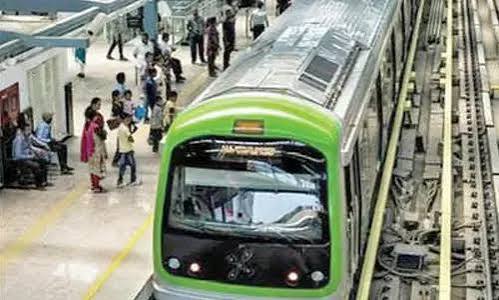
The Railway Board has granted in-principle approval for BMRCL's CBTC signalling system on Bengaluru Metro's Pink Line and the airport-bound Blue Line. This critical regulatory clearance paves the way for upcoming safety inspections, trial runs, and the eventual commissioning of these major urban transit corridors.
BENGALURU — In a major administrative milestone for urban transit expansion, the Railway Board has officially accorded in-principle approval for the Communications-Based Train Control (CBTC) signalling and train control system for the Bangalore Metro Rail Corporation Limited's (BMRCL) Pink Line and the entire Blue Line spanning Phase 2A and 2B.
Announced by metro officials in Bengaluru, the regulatory clearance covers the crucial Pink Line stretch connecting Kalena Agrahara to Nagawara, alongside the strategic Blue Line corridor extending up to the Kempegowda International Airport. The green light marks a pivotal step forward in advancing safety certifications and accelerating trial preparations for passenger operations.
Advancing Pink Line and Airport Corridor Readiness
The CBTC signalling framework serves as the digital backbone for modern high-frequency metro networks, allowing precise tracking and automated train operations. According to BMRCL project updates, securing this clearance follows intensive multi-agency coordination with the Railway Board and the Research Designs and Standards Organisation (RDSO).
With the foundational signalling framework cleared, BMRCL is positioned to fast-track subsequent statutory procedures for the initial operational segments:
Interim Speed Certification: Collaborative evaluations led by the RDSO to validate rolling stock velocity limits.
CRS Inspection: Scheduled statutory inspections of new train sets by the Commissioner of Railway Safety (CRS), slated for mid-August.
Proactive Blue Line Integration: While unlocking immediate opening steps for the Pink Line (initially focusing between Kalena Agrahara and Tavarekere), the approval provides advance clearance for the airport-linked Blue Line, ensuring seamless testing phases.
Official Sources Section
Quote Section
According to statements released by BMRCL metro officials regarding the regulatory progress:
"The Communications-Based Train Control (CBTC) system approval is an important milestone towards commissioning the Pink Line and guarantees that our upcoming airport and high-density corridors meet advanced safety and operational standards."
Why It Matters
For commuters, urban travelers, and businesses in Bengaluru, the operationalization of the Pink and Blue lines represents a vital leap toward alleviating severe road congestion. The airport-linked Blue Line and expanded Pink Line corridors will drastically reduce transit times to the Kempegowda International Airport and key IT hubs, transforming daily regional mobility.
Key Facts at a Glance
Approved Corridors: BMRCL Pink Line (Kalena Agrahara–Nagawara) and Blue Line Phase 2A/2B (Silk Board to Kempegowda International Airport).
Technology Cleared: Communications-Based Train Control (CBTC) automated signalling system.
Regulatory Body: Railway Board in coordination with RDSO and BMRCL.
Next Steps: CRS rolling stock inspection trials and final safety clearance.
FAQ Section
What is the significance of the Railway Board's approval for BMRCL?
The in-principle approval of the CBTC signalling system is a mandatory regulatory milestone required to legally commission and operate the new Pink and Blue metro lines in Bengaluru.
Which metro corridors are covered under this latest clearance?
The approval covers the entire Pink Line (Kalena Agrahara to Nagawara) and the Blue Line Phase 2A and 2B extending up to Kempegowda International Airport.
What are the immediate next steps before the lines open to the public?
BMRCL must complete RDSO speed certifications, undergo safety inspections by the Commissioner of Railway Safety (CRS), and execute successful trial runs.
How does the CBTC system benefit metro operations?
CBTC is an advanced digital signalling technology that allows precise train tracking, safe automated separation, and higher frequency headways to safely optimize passenger carrying capacity.
Source: BMRCL, Ministry of Railways, The Economic Times