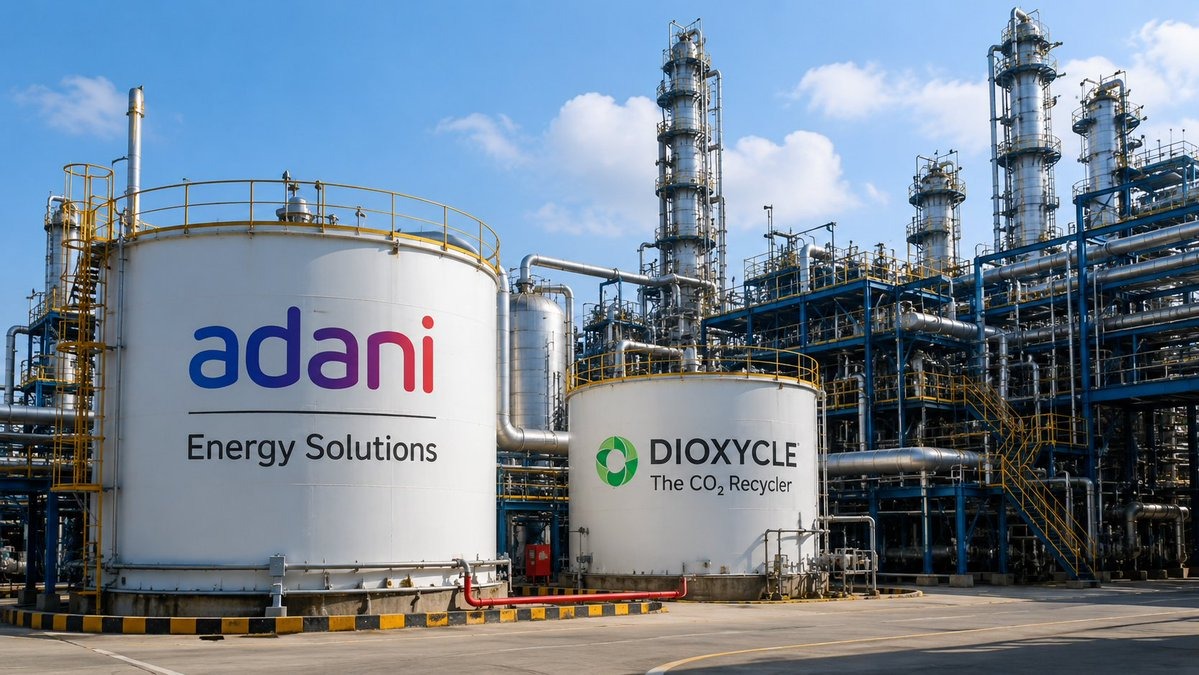
Adani Enterprises has partnered with French firm Dioxycle to manufacture low-carbon chemicals in India. The initiative will begin with a pilot plant producing formic acid from captured carbon dioxide and renewable energy, marking Adani’s entry into the chemicals sector and its commitment to advancing sustainable industrial manufacturing technologies.
Adani Enterprises has launched a strategic partnership with French firm Dioxycle to produce low-carbon chemicals in India, beginning with a pilot plant for formic acid.
AHMEDABAD/PARIS — Adani Enterprises Ltd (AEL), the flagship company of the Adani Group, announced on July 9, 2026, a long-term partnership with French clean-technology company Dioxycle to develop and scale low-carbon chemical production in India. This collaboration marks the Adani Group’s entry into the chemicals sector and highlights its commitment to industrial decarbonization through innovative carbon-capture technologies.
The partnership will initially focus on establishing a pilot facility at an Adani Group site to produce formic acid. The process will utilize captured carbon dioxide (CO₂) and renewable electricity, representing a significant shift from traditional, carbon-intensive manufacturing methods.
Transforming Emissions into Industrial Assets
The core of this collaboration is the deployment of Dioxycle’s electrically driven chemical manufacturing technology alongside Adani’s extensive clean-energy infrastructure. Formic acid, a versatile chemical intermediary used in sectors ranging from textiles and leather treatment to agriculture and rubber manufacturing, is traditionally produced through processes that emit greenhouse gases.
"We are proud to pilot India's first formic acid production facility powered entirely by renewable electricity and captured carbon," said Jeet Adani, Director, Adani Group. "This partnership is a testament to how strategic industrial synergies can turn carbon liabilities into sustainable, cost-effective economic assets."
By converting waste CO₂ into high-value chemicals, the venture aims to demonstrate the commercial viability of Carbon Capture and Utilisation (CCU) technologies. If the pilot project proves successful, the partners intend to scale the technology for broader commercial manufacturing.
Scaling Clean Manufacturing
Beyond the initial formic acid facility, Adani Enterprises and Dioxycle plan to evaluate opportunities to expand their portfolio to include other low-carbon chemicals. This initiative aligns with global efforts to decarbonize "hard-to-abate" sectors by integrating sustainability into the supply chain.
"This partnership demonstrates how clean technology and industrial scale can come together to reshape how essential chemicals are produced," said Dr. Sarah Lamaison, CEO and Co-Founder of Dioxycle. "India offers a unique combination of renewable energy, manufacturing capability, and ambition. Together with Adani, we aim to build a competitive and scalable model for low-carbon chemical production."
Strategic Diversification for Adani
For Adani Enterprises, this venture serves as a strategic extension of its ongoing diversification into clean-tech and sustainable infrastructure. As an incubator for new business ventures, AEL has been aggressively expanding into green hydrogen, solar module manufacturing, and renewable energy storage. By entering the low-carbon chemicals space, the company aims to position India as a global hub for sustainable industrial manufacturing.
Official Sources
Adani Enterprises Ltd (AEL): Official media release dated July 9, 2026, regarding the long-term partnership with Dioxycle.
National Stock Exchange (NSE): Regulatory filing confirming the corporate announcement on July 10, 2026.
Quote Section
"According to officials," the pilot project is designed to prove that industrial carbon emissions can be converted into valuable chemical products. Organizers stated that the collaboration is intended to broaden the application of low-carbon chemical technologies and support cleaner industrial processes across multiple sectors.
Why It Matters
This partnership represents a practical step toward a circular economy in India’s industrial sector. By utilizing CO₂ as a raw material rather than releasing it into the atmosphere, the project offers a blueprint for reducing the carbon footprint of essential chemical manufacturing. For consumers and industries, this could eventually lead to more sustainable supply chains for everyday products like textiles and agricultural inputs.
Key Facts at a Glance
Partnership: Adani Enterprises and Dioxycle collaborate on low-carbon chemical production.
Initial Product: A pilot facility will produce formic acid using renewable energy and captured CO₂.
Objective: To commercialize technology that converts industrial carbon emissions into valuable products.
Scope: Expansion plans include a broader portfolio of low-carbon chemicals for various industries.
FAQ
1. What is the primary goal of the Adani-Dioxycle partnership?
The partnership aims to develop and scale low-carbon chemical production in India, starting with a pilot plant for formic acid using captured CO₂.
2. Why is formic acid being chosen for the pilot project?
Formic acid is a critical industrial building block used in textiles, agriculture, and manufacturing, and its traditional production is carbon-intensive.
3. Will this partnership lead to full-scale commercial manufacturing?
Yes. The companies plan to validate the technology through the pilot facility before expanding to commercial-scale production.
Source: Adani Enterprises Media Release (NSE), The Economic Times (Chemicals)