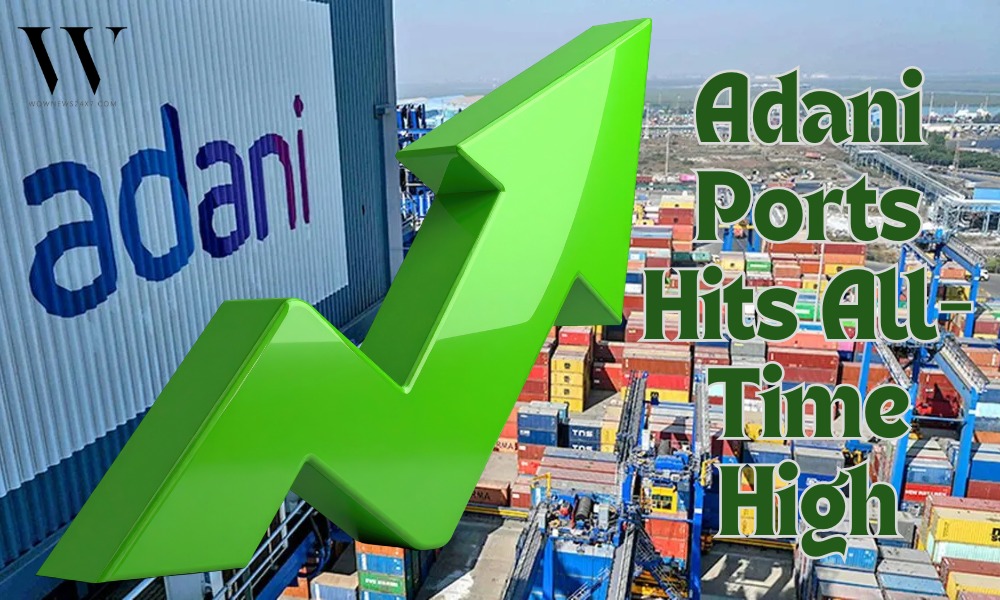
Adani Ports reached a record high on July 1, 2026, following a $1.4 billion investment from MSC’s terminal arm and positive government reforms to the SEZ policy. These developments strengthen the company's role as a global logistics leader, promising sustained growth in cargo volumes and diversified industrial revenue.
Adani Ports and Special Economic Zone Ltd. (APSEZ) saw its stock price extend gains on Wednesday, July 1, 2026, reaching a record high as investors responded to a flurry of positive developments. The company’s shares, traded under the ticker APSEZ, surged 2.6% in intraday trade, buoyed by a landmark international partnership and anticipated regulatory tailwinds in India’s logistics sector.
The rally reflects strong market confidence following the announcement of a $1.4 billion investment from Terminal Investment Limited (TiL), the container terminal arm of the Mediterranean Shipping Company (MSC) Group, for a 49% stake in Adani’s Vizhinjam Port. This capital injection underscores the strategic importance of the Vizhinjam facility as a burgeoning global transshipment hub.
Strategic Growth and MSC Partnership
The collaboration with MSC’s TiL is being hailed as a transformative moment for Adani Ports. According to company statements, the $1.4 billion investment values the Vizhinjam Port at approximately $2.85 billion. This partnership is expected to accelerate cargo throughput and integrate the port more deeply into the global container shipping network, particularly benefiting trade routes connecting India with East Africa and the Bay of Bengal.
Ashwani Gupta, Whole-time Director and CEO of APSEZ, noted that the expanded partnership with MSC would solidify the position of Vizhinjam as a premier transshipment node, enhancing India’s overall maritime connectivity.
Regulatory Tailwind: The SEZ Revamp
Beyond the international partnership, Adani Ports is also benefiting from a major shift in the Indian government’s Special Economic Zone (SEZ) framework. Reports indicate that the government is moving to transform SEZs from export-only zones into dual-use integrated industrial hubs.
The policy shift, which allows for duty-free domestic sales and permits Rupee-denominated transactions, is expected to unlock significant value in Adani’s 15,000-hectare Mundra facility. By removing the historical "export-only" mandate, the policy change is set to increase asset utilization and attract a broader range of manufacturing tenants, further diversifying the company’s revenue streams beyond traditional port-led cargo handling.
Strong Financial Foundation
The stock’s performance on Wednesday is anchored by the company’s robust financial showing in the 2025-26 fiscal year. Adani Ports recently reported an all-time high cargo volume of over 500 million metric tonnes (MMT) in FY26, cementing its status as India’s largest integrated transport operator. With a consolidated EBITDA that has remained resilient despite global trade volatility, analysts at major brokerages have maintained a "Buy" rating, citing consistent growth in both logistics and marine services.
Why It Matters
For investors, the record-breaking surge in Adani Ports shares signals a high-growth phase for the company as it executes its strategy to achieve 1 billion tonnes in throughput by 2030. The combination of foreign capital infusion and domestic policy reforms suggests a stable and expanding outlook for shareholders, as the firm continues to lead India's infrastructure development cycle.
Key Facts at a Glance
Record Performance: APSEZ shares hit an all-time high, rising 2.6% on July 1, 2026.
Strategic Investment: MSC’s terminal arm, TiL, is investing $1.4 billion for a 49% stake in Vizhinjam Port.
Infrastructure Milestone: The company successfully handled over 500 million tonnes of cargo in FY26.
Policy Catalyst: Proposed government SEZ reforms are expected to unlock value by allowing duty-free domestic sales at the Mundra facility.
FAQ
1. Why are Adani Ports shares hitting a record high?
Shares are rising due to the combination of a $1.4 billion investment from MSC’s terminal arm and the government’s move to modernize the SEZ framework, which provides significant growth potential for the company's land banks.
2. What is the significance of the Vizhinjam Port deal?
The $1.4 billion investment marks the largest foreign private investment in India’s port sector, accelerating the port's integration into global shipping routes.
3. How will the SEZ revamp affect Adani Ports?
By allowing duty-free domestic sales and Rupee-denominated transactions, the reform will lower operational costs and increase occupancy at Adani’s massive Mundra industrial zone.
4. Where can I find official information on the company’s performance?
Investors can access all regulatory filings and performance updates through the National Stock Exchange of India (NSE) website.
Source:
National Stock Exchange of India (NSE)
Adani Ports & Special Economic Zone Ltd.
The Economic Times Markets
Business Standard