Surging artificial intelligence workloads and cloud expansion are driving unprecedented electricity and water consumption across global data centres. As facility power demands climb into gigawatts and cooling water usage reaches millions of gallons daily, regulatory bodies are mandating energy-efficient closed-loop cooling and zero-carbon power integration.
DUBLIN / WASHINGTON — The rapid global expansion of artificial intelligence infrastructure and enterprise cloud computing is placing unprecedented strains on municipal power grids and localized water reserves, according to energy monitoring reports published on August 13, 2026. Data centres worldwide are consuming record levels of electricity—measured in gigawatts—while utilizing millions of gallons of fresh water daily for cooling operations. The dual resource demand has prompted regulatory scrutiny across major data centre hubs in Northern Virginia, Ireland, Singapore, and Western Europe, forcing municipal authorities to balance digital expansion against local environmental resources.
Power Grid Strains and Power Usage Effectiveness (PUE)
Data centres require uninterrupted electrical power to run compute servers, storage arrays, networking hardware, and climate control systems. Industry disclosures show that modern high-density AI clusters operate at power densities exceeding 40 to 100 kilowatts (kW) per server rack, compared to 5 to 10 kW for traditional enterprise cloud servers.
To evaluate environmental and operational efficiency, hyperscale operators rely on two primary metrics: Power Usage Effectiveness (PUE) and Water Usage Effectiveness (WUE). PUE measures the ratio of total energy used by a facility to the energy delivered strictly to computing equipment, with a theoretical ideal score of 1.0.
According to data published by the International Energy Agency (IEA), global data centre electricity consumption reached approximately 460 terawatt-hours (TWh) annually and is projected to double by 2030, driven almost entirely by generative AI models and high-performance compute workloads. In regions like Ireland, state power grid operators report that data centres currently consume over 21 percent of the nation's total metered electricity output.
Cooling Architectures and Water Consumption Risks
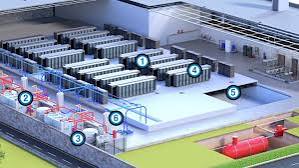
To keep high-performance microprocessors from overheating, data centre operators rely heavily on evaporative cooling towers. While evaporative cooling is energy-efficient—helping facilities maintain low PUE scores—it consumes immense volumes of potable fresh water. A standard 100-megawatt (MW) hyperscale facility can evaporate between 1.0 million and 5.0 million liters (260,000 to 1.3 million gallons) of fresh water daily.
| Cooling Technology | Primary Energy Impact | Primary Water Impact | Operational Context |
| Evaporative Cooling Towers | Low PUE (Higher Energy Efficiency) | High On-Site Water Consumption | Standard for large traditional cloud facilities. |
| Air-Cooled Chiller Systems | Higher PUE (Higher Power Demand) | Zero Direct On-Site Water Use | Common in water-scarce arid regions. |
| Direct-to-Chip Liquid Cooling | Very Low PUE (Optimized heat removal) | Closed-loop, Minimal Water Loss | Designed for high-density AI graphics processing units (GPUs). |
| Immersion Cooling | Optimized Thermal Efficiency | Closed-loop Non-Aqueous Liquids | Used in extreme-density supercomputing installations. |
The environmental impact is particularly pronounced in drought-prone markets across the American Southwest, Southern Europe, and parts of Asia, where local municipalities have instituted strict water extraction limits and mandatory recycling regulations for industrial cooling intake.
Regulatory Responses and Grid Policy Adjustments
In response to resource bottlenecks, state governments and utility commissions are enforcing strict grid allocation and environmental disclosure rules:
Moratoriums and Conditional Approvals: European and Asian technology hubs, including Dublin and Singapore, have enforced conditional building moratoriums requiring new facilities to prove net-zero carbon sourcing or generate on-site backup power.
Mandatory Liquid Cooling Retrofits: Municipalities are urging hyperscalers to transition from open evaporative towers to closed-loop direct-to-chip liquid cooling systems, which recycle cooling fluids continuously without consuming municipal water reserves.
PPA Mandates: Utilities in the United States increasingly require data centre developers to enter into long-term Power Purchase Agreements (PPAs) with renewable energy developers (solar, wind, and nuclear) before granting high-voltage grid connections.
Official Sources Section
Energy metrics, water usage data, and regulatory statistics detailed in this report are based on official research dispatches, sector reports, and policy updates released by the International Energy Agency (IEA), the U.S. Department of Energy (DOE), and environmental monitoring publications from the U.S. Environmental Protection Agency (EPA).
Quote Section
"According to official sector reports released by the International Energy Agency (IEA) and municipal utility authorities, managing the growing resource footprint of data centres requires a balanced alignment between grid capacity, zero-carbon power generation, and water-efficient cooling technology."
Why It Matters
The rapid growth of computing infrastructure directly affects global energy transitions, regional electricity utility rates, and local water security. For consumers, businesses, and municipal planners, understanding the watts and water consumed by data centres is essential for building sustainable digital infrastructure while safeguarding vital community resources.
Key Facts at a Glance
Power Demand: Global data centre electricity consumption is projected to exceed 1,000 TWh annually by 2030.
Water Intensity: A 100-megawatt hyperscale facility can consume up to 5 million liters of fresh water daily for cooling.
Key Metrics: Industry benchmarks focus on Power Usage Effectiveness (PUE) and Water Usage Effectiveness (WUE).
Technology Transition: Shift toward direct-to-chip liquid cooling to reduce water loss in high-density AI server deployment.
FAQ Section
How much electricity do modern data centres consume?
Globally, data centres consume roughly 460 terawatt-hours (TWh) of electricity per year, representing about 1 to 2 percent of worldwide power consumption, with regional concentrations reaching 20 percent or higher.
Why do data centres consume so much water?
Data centres use water in evaporative cooling systems to dissipate the intense heat generated by thousands of processing chips, preventing hardware failure and maintaining efficient thermal performance.
What is Power Usage Effectiveness (PUE)?
PUE is an efficiency metric calculated by dividing a data centre's total facility energy usage by the energy delivered directly to its IT equipment. Lower scores closer to 1.0 indicate higher energy efficiency.
What are operators doing to reduce water consumption in data centres?
Operators are adopting direct-to-chip liquid cooling and dielectric immersion cooling systems, which use closed-loop fluid systems that continuously recycle liquids without evaporating municipal fresh water.
Source: International Energy Agency (IEA), U.S. Department of Energy (DOE), U.S. Environmental Protection Agency (EPA), EirGrid Group Ireland.