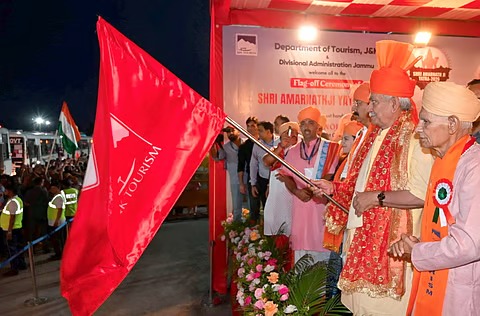
Jammu and Kashmir Lieutenant Governor Manoj Sinha flagged off the first batch of 4,822 Amarnath Yatra pilgrims from Jammu’s Bhagwati Nagar base camp. Moving under a tight, multi-tier security cover and RFID tracking, the devotees embarked toward the twin Himalayan trails to launch the 57-day annual pilgrimage.
JAMMU — The annual Amarnath Yatra officially commenced on Thursday morning, July 2, 2026, as Jammu and Kashmir Lieutenant Governor Manoj Sinha flagged off the first batch of pilgrims from the Bhagwati Nagar base camp under an extensive, multi-layered security grid.
Amid enthusiastic chants of "Bam Bam Bhole" and "Har Har Mahadev", a high-security convoy of 259 vehicles transporting 4,822 registered devotees departed from the Jammu terminal. The inaugural batch is split between the twin tracks leading to the 3,880-metre-high holy cave shrine of Baba Barfani in the south Kashmir Himalayas. The formal flag-off event, featuring traditional rituals and a special morning puja performed by L-G Sinha, marks the launch of the 57-day spiritual journey. The operational window will officially open for trail movement on Friday, July 3, and conclude on the festival of Raksha Bandhan on August 28, 2026.
Technical Allocation of the Inaugural Pilgrim Convoy
According to exact logistical ledgers released by the Shri Amarnathji Shrine Board (SASB), the initial 4,822-member deployment was tightly cataloged to optimize transport dispatch. The demographic footprint of the maiden batch consists of 3,707 adult males, 816 adult females, 16 children, 246 sadhus (male seers), and 37 sadhvis (female seers).
To transport this baseline contingent safely across the steep mountain passes, transit desks organized a multi-category convoy. The transit fleet included 106 heavy passenger buses, 39 medium motor vehicles (MMVs), 111 light motor vehicles (LMVs), and three emergency support two-wheelers. Route indicators show that 2,510 pilgrims chose the traditional but longer 48-kilometer Nunwan-Pahalgam track in Anantnag district. Concurrently, 2,312 travelers opted for the shorter, steeper 14-kilometer Baltal route in Ganderbal district to compress their overall foot travel timeline.
Multi-Layer Security Grid and Highway Restrictions
The launch follows a major security review conducted by the Union Territory's internal security council. Accompanied at the launch site by newly appointed Jammu and Kashmir Director General of Police Nalin Prabhat, L-G Sinha verified the activation of a high-tech area domination matrix. More than 3.90 lakh devotees have already registered for the 2026 edition, necessitating an extensive deployment of Central Armed Police Forces (CAPFs) along the main Jammu-Srinagar National Highway (NH-44).
The Ministry of Home Affairs has fortified transit choke points using automated Radio Frequency Identification (RFID) microchips attached to all pilgrim credentials and transport vehicles, allowing control rooms to monitor real-time convoy coordinates. Furthermore, the J&K Traffic Police department announced strict daily cut-off timings and rolling sector-wise vehicle restrictions along NH-44, effective from July 2 through August 28, to isolate pilgrim movements from standard commercial freight lines.
Structural Infrastructure and Healthcare Expansion
To mitigate historical weather-related vulnerabilities along the high-altitude Himalayan trails, the Ministry of Health and Family Welfare collaborated with the Indian Army to set up specialized medical infrastructure. Two fully equipped, 100-bed base hospitals have been made operational at Baltal and Chandanwari.
The emergency field units feature internal oxygen generation plants, automated hyperbaric chambers to treat acute mountain sickness, and round-the-clock cardiac care desks. Additionally, trail-widening projects executed by the Border Roads Organisation (BRO) have added reinforced handrails and concrete retaining walls along vulnerable sections of the Pahalgam route, optimizing safety parameters for elderly and specially-abled pilgrims.
Official Sources Section
The logistical statistics, data points, and operational parameters detailed in this report are verified by formal administrative records:
Shri Amarnathji Shrine Board (SASB) Bulletins: Registry logs tracking active pilgrim counts, track choices, and base camp allocations.
J&K Government Executive Orders: Official press statements and media streams released by the Lieutenant Governor’s Secretariat at Raj Bhavan.
J&K Traffic Police Department Advisories: Statutory highway transit notifications and cut-off timing schedules for NH-44.
Quote Section
"Shri Amarnath Ji Yatra is a sacred path where devotion meets spiritual awakening," stated Jammu and Kashmir Lieutenant Governor Manoj Sinha following the ceremony. "Every step taken on this holy path is a testament to unwavering faith and surrender to Baba Amarnath. I wish all devotees a safe, comfortable, blissful, and spiritually fulfilling journey."
Why It Matters
For millions of Hindu devotees and global travelers, the smooth execution of the Amarnath Yatra provides a reliable, secure framework to complete one of India's most revered spiritual pilgrimages. For the regional economy of Jammu and Kashmir, the massive influx of nearly four lakh visitors generates essential seasonal income for local hospitality vendors, horse operators, transport owners, and tour guides. On a security level, the seamless coordination of advanced tech-driven surveillance systems establishes a robust blueprint for managing safety lines during high-volume public gatherings.
Key Facts at a Glance
Yatra Initialized: L-G Manoj Sinha formally flagged off the first batch of 4,822 Amarnath Yatra pilgrims from Jammu's Bhagwati Nagar camp.
Trail Split: The initial cohort includes 2,510 devotees traveling via the traditional Pahalgam track and 2,312 opting for the steeper Baltal path.
Tech-Driven Shielding: All pilgrim vehicles and ID badges are being monitored via automated RFID tracking to ensure high-security oversight.
Extended Duration: The 2026 pilgrimage spans a total of 57 days, concluding on August 28 to coincide with Raksha Bandhan.
FAQ Section
When does the Amarnath Yatra 2026 officially start and end?
The pilgrimage formally flags off its first batch on July 2, 2026, with trail trekking beginning on July 3. The entire yatra will run for 57 days, concluding on August 28, 2026.
What are the two main travel routes to reach the Amarnath cave shrine?
Pilgrims can choose between the traditional 48-km Nunwan-Pahalgam route in Anantnag district or the steeper, shorter 14-km Baltal route in Ganderbal district.
What security arrangements have been implemented for the pilgrims?
The region features a multi-tiered security cover monitored by CAPFs and J&K Police, supported by mandatory RFID card tracking and strict highway cut-off timings.
How many people have registered for the pilgrimage this year?
Official database records from the Shri Amarnathji Shrine Board confirm that more than 3.90 lakh devotees have already completed their registration for this year's journey.
Source: Shri Amarnathji Shrine Board Official Portals, Ministry of Home Affairs Security Registries, J&K Directorate of Information and Public Relations.