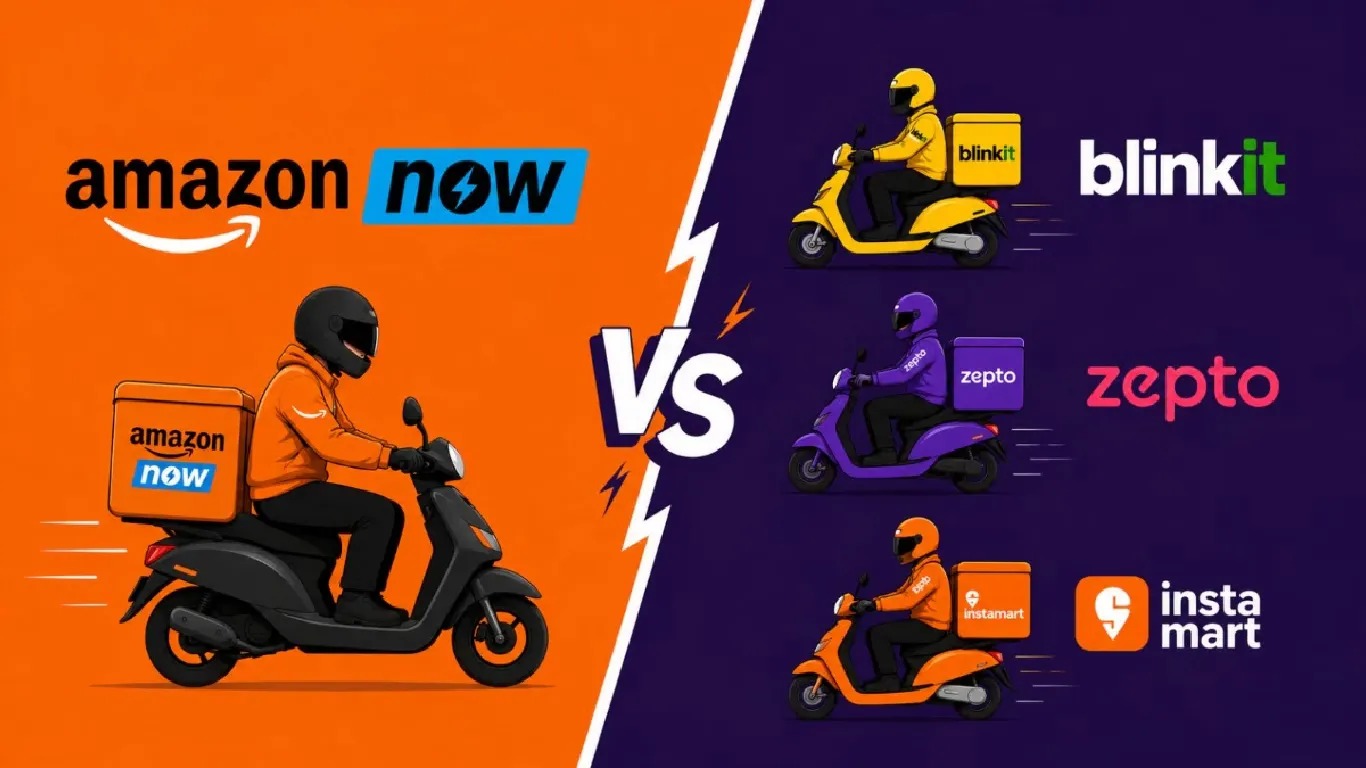
Amazon India has announced a massive $35 billion five-year investment plan to scale its quick commerce service, Amazon Now, across 100 cities. By constructing over 1,000 micro-fulfillment centers at a rate of three to four daily, the global e-commerce giant aims to directly challenge dominant local operators Blinkit, Swiggy, and Zepto.
BENGALURU — Amazon India announced a major strategic expansion on Sunday, June 7, 2026, confirming plans to invest an additional $35 billion over the next five years to scale its quick commerce presence across the country. The massive capital injection is explicitly structured to expand the company's dedicated sub-hourly delivery service, "Amazon Now," from its current 12-city footprint into 100 new Indian cities. The aggressive rollout marks a direct attempt by the global e-commerce titan to capture market share in the world’s most hyper-competitive sub-hourly delivery market.
The strategic escalation, detailed by top executives during a media brief in Bengaluru, aims to challenge the established dominance of native pure-play operators. Market data highlights an intense, six-way battle for neighborhood fulfillment supremacy, with Zomato’s Blinkit holding a commanding 46% market share, followed by Swiggy Instamart at 24%, and Zepto at 22%. By implementing a rapid infrastructure layout, Amazon expects to leverage its massive local supply network and Prime subscriber loyalty to alter the sector's current dynamics.
Deploying 1,000 Micro-Fulfillment Centers Coast-to-Coast
The operational core of Amazon’s quick commerce counteroffensive relies on the rapid construction of specialized, localized dark stores. According to Amazon India Country Manager Samir Kumar, the e-commerce giant is currently opening new micro-fulfillment centers at a rapid pace of three to four facilities every single day. The overarching roadmap mandates the activation of more than 1,000 fully operational micro-fulfillment centers across major and mid-tier metros within the coming months.
The geographic expansion will target vital regional commerce hubs including Pune, Hyderabad, Chennai, Kolkata, Jaipur, Lucknow, Ahmedabad, and Kochi. To support this infrastructure push, the enterprise has concurrently allocated a localized ₹2,800 crore fund designed to improve delivery associate safety architectures, establish network rest centers, and implement real-time route-optimization mapping. This capital matches a broader logistical push, including the recent launch of its third-party logistics platform, Amazon Shipping, which allows independent direct-to-consumer (D2C) brands to utilize Amazon's delivery network.
Capitalizing on Prime Ecosystem Frequency
While pure-play platforms like Blinkit and Zepto have spent substantial capital constructing independent supply networks, Amazon intends to fuel its sub-hourly growth by cross-selling to its pre-existing, highly active subscriber base. Internal data indicates that Amazon India’s Prime member base is on track to nearly double its 2023 levels by the end of 2026, with over 70% of new sign-ups emerging from non-metro Tier-2 and Tier-3 geographies.
The monetization benefits of this ecosystem integration are visible across key consumer shopping habits:
Prime Base Engagement: Active Prime subscribers place orders five times more frequently than standard, non-Prime digital shoppers on the main marketplace platform.
Adoption Velocity: Once an existing Prime member begins utilizing the integrated Amazon Now interface, their overall transaction frequency on the platform climbs by an average of three times.
Volumetric Scaling: Aggregated monthly order volumes routed through Amazon Now are currently sustaining a compounding growth pace of 25% month-on-month.
Navigating Unit Economics and Category Shifts
The entry of deep-pocketed giants like Amazon and Flipkart—which is scaling its own "Flipkart Minutes" dark store footprint—alters the underlying economics of the sub-hourly sector. For several years, critics questioned the long-term sustainability of 10-minute grocery delivery due to heavy real estate and delivery costs. However, data from Datum Intelligence values India’s quick commerce ecosystem at roughly $11.5 billion (₹95,500 crore), proving that the format has evolved into a permanent consumer habit.
Firms are now shifting their focus from low-margin groceries to higher-margin non-perishable categories. Blinkit’s average order value (AOV) is projected to reach ₹709, supported by instant deliveries of consumer electronics, beauty cosmetics, and apparel. Amazon Now plans to match this trajectory by pulling directly from its catalog of over one million same-day eligible items, while establishing fresh sourcing agreements with over 16,000 local farmers to maintain a steady supply of high-quality daily essentials.
Official Sources Section
The multi-year investment plans, city-wise distribution roadmaps, and localized fulfillment metrics were formally verified via strategic corporate announcements delivered by Amazon India Country Manager Samir Kumar and Harsh Goyal, Vice President of Everyday Essentials at Amazon India.
Quote Section
Addressing industry skepticism regarding whether a legacy e-commerce platform can successfully replicate the hyper-local speed of pure-play operators, country manager Samir Kumar projected complete operational confidence:
"We are in the quick commerce party and we are here to win. For us, it’s both growth and profitability hand in hand. We are hitting our profitability marks for Amazon India overall."
Why It Matters
For Indian consumers, the massive capital expansion ensures greater choice, better product availability, and lower delivery fees as platforms compete for loyalty. For local retail brands, agricultural suppliers, and independent merchants, Amazon’s 1,000-store dark network opens up a high-velocity sales channel to reach buyers in minutes without costly intermediate logistics. More broadly, the multi-billion dollar investment validates quick commerce as a structural shift in global retail, proving that sub-hourly speed is no longer an experimental niche, but a vital baseline for modern digital commerce.
Key Facts at a Glance
Financial Scope: Amazon is deploying a $35 billion five-year investment block covering e-commerce, cloud, and micro-fulfillment expansion in India.
Geographic Target: The Amazon Now sub-hourly delivery network will scale from 12 cities to 100 new domestic locations.
Dark Store Footprint: The company is opening three to four micro-fulfillment centers daily, targeting a network of over 1,000 facilities.
Order Acceleration: Consumer demand on the Amazon Now platform is expanding at a compounding rate of 25% month-on-month.
Agritech Integration: The expansion directly connects more than 16,000 local farmers to the platform's fresh produce supply lines.
FAQ Section
1. What is the difference between standard Amazon delivery and Amazon Now?
Standard Amazon delivery routes items via large suburban fulfillment centers over 24 to 48 hours. Amazon Now utilizes a hyper-local network of neighborhood dark stores to deliver daily essentials and electronics within minutes.
2. How much is Amazon investing into India's quick commerce ecosystem?
Amazon has committed to a broader $35 billion investment program over the next five years, which includes expanding Amazon Now infrastructure alongside parallel infusions like a dedicated ₹2,800 crore delivery wellness fund.
3. Who currently leads the quick commerce market share in India?
According to early 2026 data from Datum Intelligence, Zomato's Blinkit leads the market with a 46% share, followed by Swiggy Instamart at 24%, and Zepto at 22%. Amazon Now and Flipkart Minutes currently hold single-digit shares but are scaling rapidly.
4. Which new cities will gain access to Amazon Now services?
The rapid rollout will expand services into 100 cities across India, including prominent urban zones such as Pune, Hyderabad, Chennai, Kolkata, Jaipur, Lucknow, Ahmedabad, and Kochi.
Source: Press briefings from Amazon India Country Manager Samir Kumar, statutory logistics announcements from the Ministry of Commerce and Industry, and retail market share registers compiled by Datum Intelligence.