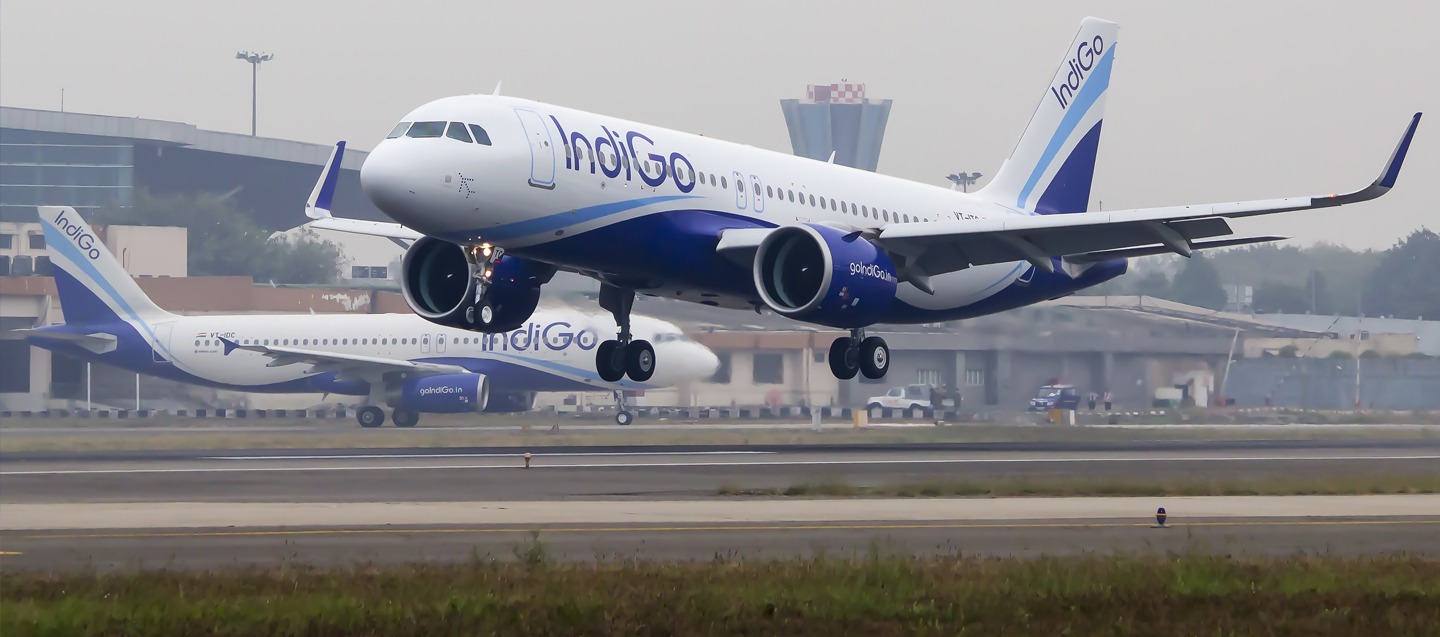
IndiGo plans to aggressively expand its mid- and long-haul international capacity share from 4% to 10–15% by FY2030, targeting a total overseas capacity share of 40%. Backed by an order book of nearly 900 Airbus aircraft and continuous weekly deliveries, the airline is introducing long-range Airbus A321XLR jets and a dual-class premium business tier ("IndiGoStretch"). This strategic pivot transitions the domestic low-cost carrier into a major global competitor, offering direct, cost-competitive routes from India to new destinations across Europe and Asia.
NEW DELHI — InterGlobe Aviation Limited, the operator of India’s dominant domestic carrier IndiGo, officially announced an aggressive global strategy to scale its mid- and long-haul international capacity share to between 10% and 15% by fiscal year 2030 (FY30). The regulatory disclosure, filed with the National Stock Exchange of India (NSE), underscores a dramatic shift for the airline, which currently allocates just 4% of its overall capacity to the mid- and long-haul international segment. The strategic pivot aligns with the airline's broader goal to source nearly 40% of its total operational capacity from overseas flights by the end of the decade, shifting its reliance away from a saturated domestic market.
Strategic Fleet Expansion Fueling Global Ambitions
To achieve its mid- and long-haul benchmarks, IndiGo is relying on a massive fleet overhaul and consecutive weekly deliveries. The carrier operates an existing fleet of approximately 440 aircraft and maintains an order book of nearly 900 pending deliveries from Airbus. According to company executives speaking at the Wings India aviation summit, the airline plans to induct approximately one new aircraft every single week for the next ten years.
Central to this long-range plan is the introduction of the Airbus A321XLR (Extra Long Range) and incoming wide-body aircraft. The airline expects to receive nine A321XLR deliveries within the fiscal year 2027 cycle, which will feature a dual-class configuration including 12 dedicated business class seats ("IndiGoStretch") and 183 economy seats. Boasting a flight range of up to 8.5 hours, these aircraft will allow IndiGo to establish direct, non-stop routes from Indian metro hubs to new global destinations such as Athens, Istanbul, Bali, and Seoul.
Transforming Premium Travel and In-Flight Services
The pivot to mid- and long-haul routes requires a fundamental adjustment to IndiGo's historically low-cost, single-class business model. The airline is actively rolling out "IndiGoStretch," a curated business-class tier tailored for corporate travelers and premium leisure passengers.
For international routes operated by long-range single-aisle and leased wide-body aircraft, the airline is introducing:
A "Bring Your Own Device" (BYOD) wireless inflight entertainment streaming architecture.
Complimentary hot meals and selected beverages for premium tiers.
Standardized structural crew training to minimize operational complexity across the expanding Airbus and ATR fleets.
This systemic upgrade aims to capture a significant portion of the international travel market originating out of India, a segment that has historically been dominated by Gulf-based network carriers and European long-haul legacy airlines.
Impact on Consumers, Investors, and the Aviation Industry
For Indian consumers and travelers, the expansion is expected to drive down non-stop international airfares through increased competition. Direct routes to Europe and Southeast Asia eliminate the need for layovers in secondary hub airports, decreasing total travel times.
For institutional investors, the strategy introduces a higher margin revenue stream to hedge against volatile domestic yields. However, scaling into long-haul territories pits IndiGo directly against a revitalized Air India group, which has executed its own multi-billion-dollar wide-body aircraft orders. Industry analysts note that maintaining low unit costs while introducing dual-class configurations and long-haul operational infrastructure remains a key structural challenge for the airline's executive team.
Official Sources Section
The corporate milestones and capacity data points outlined in this report were verified via official regulatory filings submitted to the National Stock Exchange of India on June 8, 2026. Supplemental strategic guidance regarding flight routes, daily operations, and fleet acquisition timelines was sourced directly from corporate statements delivered by executive leadership during recent global aviation summits.
Quote Section
"International air travel in India probably for quite a long time was very much taken care of by non-Indian airlines... there is a great opportunity to address that market with our planes," stated Pieter Elbers, Chief Executive Officer of IndiGo, at an industry briefing detailing the carrier's structural pivot toward long-haul internationalization.
Why It Matters
The capacity shift marks the end of an era where Indian low-cost carriers restricted themselves to regional boundaries. By targeting up to a 15% capacity share in longer routes, IndiGo is altering global traffic flows, making it easier and potentially cheaper for citizens to travel internationally without relying on foreign connecting hubs.
Key Facts at a Glance
Capacity Target: Mid- and long-haul international capacity will jump from 4% in FY26 to 10-15% by FY30.
Total Overseas Goal: IndiGo aims to have nearly 40% of its overall airline capacity generated by international flights by 2030.
Fleet Delivery Cadence: The carrier plans to induct one new aircraft per week continuously for the next decade.
Volume Milestones: The airline targets operating over 4,000 daily flights and carrying 200 million passengers annually by 2030.
New Aircraft Tech: Initial deliveries of nine long-range Airbus A321XLR aircraft are scheduled to begin during the FY27 calendar window.
FAQ Section
What is considered a "mid- to long-haul" flight for IndiGo?
Mid- to long-haul routes generally refer to international flights extending past 5 to 6 hours, reaching up to 8.5 hours of continuous flying time. Examples include upcoming direct routes from India to Western Europe (e.g., Athens) and East Asia (e.g., Seoul).
Will IndiGo stop being a low-cost airline?
No. IndiGo maintains that it is retaining its core operational simplicity and cost-conscious model. While it is introducing premium features like "IndiGoStretch" business seats on specific long-distance routes, the main goal is to scale up services efficiently without altering its foundational identity.
When will the new Airbus A321XLR aircraft start flying?
IndiGo expects to take delivery of its first batch of nine Airbus A321XLR aircraft during fiscal year 2027, after which they will be deployed onto thin, long-haul international corridors.
How will this international expansion impact domestic flights?
Domestic operations are expected to remain steady. The airline's massive order book of close to 900 aircraft ensures it can scale up overseas routes without pulling airplanes or reducing frequencies on its high-utilization domestic network.
Source: Official Analyst Meet Presentation submitted to the National Stock Exchange of India (NSE); public briefings by IndiGo Chief Executive Officer Pieter Elbers.