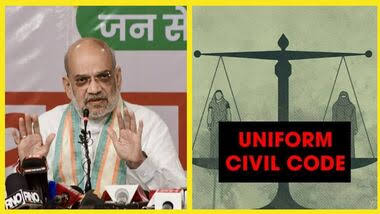
Union Home Minister Amit Shah announced that all 21 NDA-governed states will introduce a Uniform Civil Code before the 2029 general elections. While Uttarakhand remains the only state currently enforcing post-independence legislation, Gujarat, Assam, and Madhya Pradesh have cleared bills to establish uniform family, marriage, and property laws.
MUMBAI — Union Home Minister Amit Shah has announced that governments across all 21 states ruled by the Bharatiya Janata Party-led National Democratic Alliance will introduce a Uniform Civil Code before the 2029 general elections. Speaking at a press conference in Mumbai on Sunday, Shah outlined the coordinated legislative roadmap to establish standard personal laws governing marriage, divorce, succession, and adoption regardless of religious faith. The move signals an intensified regional push to realize a core ideological agenda through state-level statutes rather than a singular federal omnibus bill.
Phased Expansion Planned Across Alliance-Governed States
Addressing reporters, Shah expressed confidence that all NDA-administered state legislatures would enact localized civil code legislation before 2029. The phased rollout strategy leverages individual state legislative assemblies under the concurrent list, circumventing the legislative hurdles of passing a uniform national law through Parliament.
The announcement comes during the launch of the "Seva Sankalp Abhiyan," a nationwide outreach initiative organized by the ruling alliance. Shah emphasized that the legal reform builds on past central interventions, such as the criminalization of instant triple talaq, intended to ensure gender equity and equal legal protections for women across civil matters.
Current Implementation Status: Where the Uniform Civil Code Stands
While discussions around a nationwide code have persisted for decades under Article 44 of the Directive Principles of State Policy, actual implementation remains fragmented.
Uttarakhand became the first state in post-independence India to enact a Uniform Civil Code, passing its bill in February 2024 and formally enforcing the statute in January 2025. The Himalayan state currently operates a dedicated administrative portal regulating marriage registrations, divorce decrees, succession claims, and live-in relationships.
Beyond Uttarakhand:
Gujarat: Cleared its state Uniform Civil Code Bill in March 2026, which is undergoing notification procedures.
Assam: Passed legislation in May 2026, becoming the first northeastern state to adopt the measure, while explicitly exempting indigenous tribal groups from its purview.
Madhya Pradesh: Approved its draft bill in July 2026, incorporating provisions for mandatory civil registration of marriages and inheritance parity.
Drafting Panels: States including Maharashtra and Chhattisgarh have constituted judicial committees chaired by retired judges to prepare draft legislation.
Outside the post-independence framework, Goa continues to enforce its Portuguese Civil Code of 1867, a civil law legacy preserved following the territory's integration into the Indian Union in 1961.
Tribal Exemptions and Implementation Scrutiny
A consistent feature of the emerging state bills is the blanket exemption granted to Scheduled Tribes. Responding to concerns raised by indigenous groups in central and northeastern regions, official drafts in Assam and Madhya Pradesh protect traditional customary practices and community land-tenure systems from civil code consolidation.
Critics and opposition leaders have questioned the decentralized rollout, arguing that varying state provisions could create cross-border legal disparities in civil jurisprudence. Conversely, legal proponents argue that state-level enactment allows governments to address unique local demographic factors while testing administrative mechanisms before wider adoption.
Official Sources
Policy announcements and statements were delivered during an official media briefing by the Ministry of Home Affairs in Mumbai. Legislative records, statutory rules, and administrative gazettes detailing state implementations are published by the Government of Uttarakhand and monitored under constitutional records maintained by the Ministry of Law and Justice.
Quotes
"We have introduced the Uniform Civil Code in several states, and I am confident that in the 21 BJP-NDA-ruled states, we will introduce the UCC before 2029," Union Home Minister Amit Shah stated during the briefing.
According to officials familiar with the legislative process, the state-by-state strategy ensures that local cultural sensitivities are accommodated while creating institutional mechanisms for civil registrations.
Why It Matters
Implementing a Uniform Civil Code across 21 states will fundamentally alter civil litigation, family law, and property inheritance for hundreds of millions of citizens. Businesses and consumers will see standard rules for estates, wills, and contract-related spousal claims, while individual citizens will face mandatory registration requirements for unions and domestic partnerships.
Key Facts at a Glance
Target Deadline: Rollout planned across all 21 NDA-governed states prior to the 2029 parliamentary elections.
Active Enactment: Uttarakhand remains the sole post-independence state with an operational Uniform Civil Code (in force since January 2025).
Bills Cleared: Gujarat, Assam, and Madhya Pradesh have passed legislation and are finalizing statutory notification.
Tribal Protection: Emerging state codes explicitly exclude Scheduled Tribes to preserve indigenous customary traditions.
Frequently Asked Questions
What is the Uniform Civil Code?
The Uniform Civil Code is a legal framework that replaces disparate religious personal laws with a single set of civil statutes governing marriage, divorce, child custody, adoption, and property succession.
Which Indian state currently enforces a post-independence UCC?
Uttarakhand is the only state that has fully implemented its Uniform Civil Code, operational since January 2025. Goa operates under a historic Portuguese-era civil code dating to 1867.
Are tribal communities included under the new state codes?
State bills passed in Assam and Madhya Pradesh specifically exclude Scheduled Tribes, preserving their customary rights and community practices.
Source: Ministry of Home Affairs, Ministry of Law and Justice, and the Government of Uttarakhand.