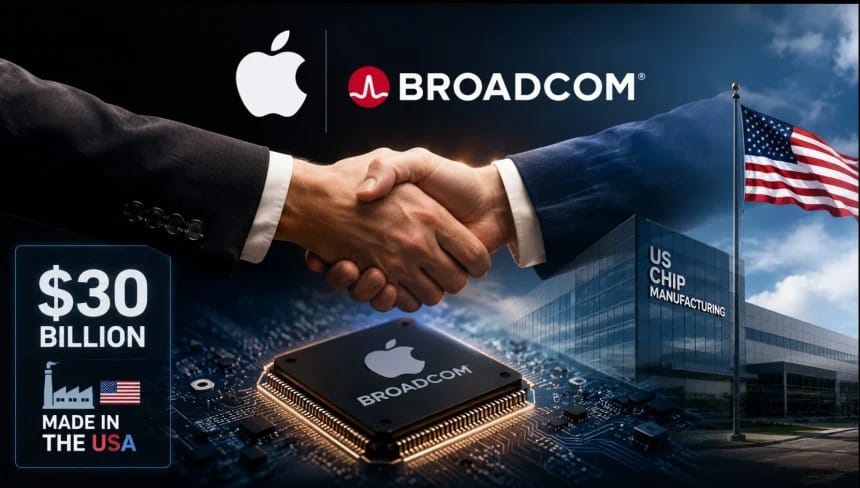
Apple has signed a historic multiyear contract exceeding $30 billion with Broadcom to supply more than 15 billion U.S.-made wireless chips through 2031. The deal funds a $1.5 billion expansion of Broadcom’s Colorado factory, securing custom components and insulating Apple from international supply chain disruptions.
CUPERTINO, California — Tech giant Apple Inc. has finalized a massive multiyear supply agreement with semiconductor designer Broadcom Inc. valued at more than $30 billion. The transaction establishes a long-term framework to manufacture over 15 billion specialized wireless chips entirely within the United States.
Announced on July 8, 2026, this deal marks the largest single corporate pledge under Apple’s domestic supply initiative. The development provides severe structural stability for Apple’s core product lines while moving substantial high-tech manufacturing capacity out of Asian tech corridors.
Fort Collins Production Lines Benefit From $1.5 Billion Expansion
Under the parameters filed with federal regulators, the contractual obligation extends through 2031. A core component of the arrangement includes a dedicated $1.5 billion capital expenditure investment by Broadcom to systematically modernize and expand its existing manufacturing hub in Fort Collins, Colorado.
The Colorado semiconductor facility will immediately scale production of advanced radio-frequency (RF) components and localized data processing architecture. Specifically, the plant will focus on Film Bulk Acoustic Resonator (FBAR) filters. These essential hardware components isolate cellular signals and prevent interference, ensuring clean cellular, Wi-Fi, and Bluetooth network performance inside the iPhone, iPad, and MacBook ecosystems.
Beyond standard RF hardware, Broadcom is actively co-developing custom Application-Specific Integrated Circuit (ASIC) solutions. According to supply chain analysts, these custom silicon components will help power Apple's upcoming dedicated artificial intelligence servers, scheduled for primary industrial deployment as early as next year.
Mitigating Supply Chain Vulnerabilities and Political Pressures
The $30 billion commitment is a central piece of Apple’s broader corporate mandate to inject $600 billion directly into the domestic economy over a four-year window. The push comes amid persistent tariff pressures from the federal administration, which threatened a blanket 25 percent levy on imported electronic goods unless critical assembly lines shifted onshore.
By focusing investments on high-value silicon components rather than the final assembly lines, Apple is building an insulated domestic ecosystem. The company is actively executing similar onshore purchasing strategies with Taiwan Semiconductor Manufacturing Company (TSMC) facilities in Arizona, Texas Instruments in Texas, and GlobalFoundries in New York.
Financially, the deal protects both firms ahead of structural management transitions. Outgoing Apple CEO Tim Cook, who will hand over operational control to hardware executive John Ternus on September 1, 2026, noted that the arrangement secures vital component access for years to come. Following the release of the transaction details, Broadcom stock climbed roughly 5 percent in trading sessions.
Official Sources Section
The underlying details regarding transaction limits, volume expectations, and facility upgrades originate directly from official press filings hosted on the Apple Newsroom Portal. Longitudinal commitments, manufacturing specifications, and corporate timelines coordinate with administrative disclosures logged in the U.S. Securities and Exchange Commission (SEC) Registry.
Statement From Corporate Leadership
Because the technical blueprints for future iPhone iterations remain highly confidential, executive commentary remained focused on broader economic and infrastructure impacts.
"Apple and Broadcom have a long history together, and this new phase of our partnership further accelerates our commitment to American manufacturing and innovation," stated Apple CEO Tim Cook in an official corporate release.
Why It Matters
For general consumers and telecom users, this deal ensures that next-generation network modems and filters will operate with optimized battery footprints and reduced signal degradation.
For the tech market, the deal signals that long-term component security is paramount. By anchoring Broadcom to its supply chain until 2031, Apple ensures its hardware pipeline remains uninterrupted during executive transitions, while protecting its bottom line from global geopolitical friction.
Key Facts at a Glance
Financial Scope: A multiyear supply pact valued at more than $30 billion running through the year 2031.
Volume Target: Guarantees the fabrication of over 15 billion highly specialized wireless connectivity chips on U.S. soil.
Industrial Upgrades: Broadcom will commit $1.5 billion to overhaul and expand its semiconductor facility in Fort Collins, Colorado.
Strategic Alignment: Represents the largest singular procurement order finalized under Apple's American Manufacturing Program.
Frequently Asked Questions (FAQ)
What specific devices will use these U.S.-made chips?
The advanced radio frequency hardware, including FBAR filters and Bluetooth components, will be implemented across Apple's entire device matrix. This includes upcoming iterations of the iPhone, iPad, Apple Watch, and Mac personal computers.
Will this agreement raise the retail price of Apple devices?
No direct consumer price increases are anticipated. The $30 billion spending target is drawn from Apple’s existing $600 billion capital deployment budget, designed to insulate the firm from expensive international shipping fees and foreign trade tariffs.
How does this contract impact Broadcom's business footprint?
The agreement cements Apple as Broadcom's anchor client, historically accounting for roughly 20 percent of the chipmaker's total revenue. The deal also finances a major upgrade to Broadcom's domestic production capabilities.
Sources: Apple Corporate Newsroom Platform, Broadcom Investor Relations Disclosure Index, U.S. Securities and Exchange Commission Documentation