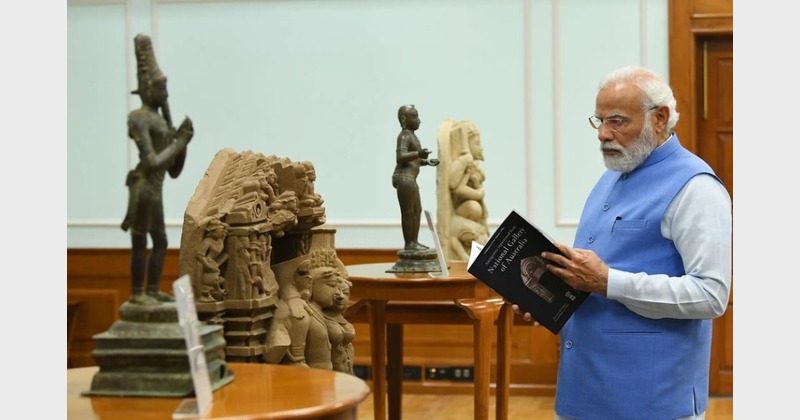
Australia has announced the voluntary return of three ancient Indian artefacts—a 12th-century Nandi, a Bhadrakali trident, and a Skanda statue—to India. Announced during the 2026 India-Australia Annual Summit, the move reflects a deepening strategic partnership and a mutual commitment to cultural reconciliation and the ethical preservation of heritage.
The voluntary repatriation of these historic treasures marks a significant milestone in cultural diplomacy between Canberra and New Delhi.
MELBOURNE — Australia has officially announced the voluntary return of three ancient Indian artefacts to their country of origin, a gesture that highlights the deepening cultural ties between the two nations. The announcement was made on July 9, 2026, during the Third India-Australia Annual Summit in Melbourne, where Prime Minister Narendra Modi and Australian Prime Minister Anthony Albanese reaffirmed their commitment to the India-Australia Comprehensive Strategic Partnership.
The returned antiquities, all originating from the sacred temple traditions of Tamil Nadu, are considered vital pieces of India's heritage. Their repatriation is part of a broader commitment to ethical collection management and the recognition of historical cultural bonds.
Reclaiming a Sacred Legacy
The triad of artefacts returning to India includes:
A Granite Nandi Sculpture: A majestic 11th–12th century granite figure of Nandi, the celestial vehicle of Lord Shiva. This sculpture represents a cornerstone of medieval Shiva temple architecture, symbolizing devotion and strength.
A Bronze Trident (Bhadrakali): An 11th-century metal trident featuring the image of Bhadrakali, a fierce and protective manifestation of the divine feminine. This piece is celebrated for its intricate metalwork and religious significance.
A Six-Headed Skanda Statue: A remarkable 12th-century basalt sculpture of the six-headed war deity Skanda, widely worshipped as Lord Murugan in southern India.
According to officials, these items were previously held in the collections of the National Gallery of Australia and the Art Gallery of New South Wales. The items will be transported back to India in due course to be housed in national collections, fulfilling a shared goal of preserving and respecting cultural heritage.
Diplomacy Through Cultural Exchange
The repatriation coincided with a landmark summit that covered a range of bilateral issues, including trade, clean energy, and maritime security. During the joint press interaction, Prime Minister Albanese framed the move as a testament to the mutual respect defining the current bilateral relationship. He explicitly welcomed the progress made in returning these items, noting that it promotes healing and reconciliation.
In a parallel gesture of goodwill, India has also moved to repatriate an Australian First Nations ancestor currently held in the Government Museum of Chennai. This reciprocal exchange of cultural property is being hailed as a profound "living bridge" between the two nations, underscoring the role of the Indian diaspora and cultural history in modern statecraft.
Official Sources
Why It Matters
This repatriation is significant as it demonstrates a shift toward ethical collecting and the restoration of cultural heritage that was lost or exported illegally in the past. For citizens and historians, the return of these Tamil Nadu treasures is an act of reclaiming national identity and rectifying historical wrongs, while for international relations, it serves as a powerful symbol of trust between Australia and India.
Key Facts at a Glance
Total Artefacts: Three ancient pieces of Tamil Nadu origin.
Age/Origin: 11th–12th century temple artefacts, including Nandi (stone), a Bhadrakali trident (metal), and Skanda (stone).
Key Agreement: Confirmed during the Third India-Australia Annual Summit on July 9, 2026.
Reciprocity: India is concurrently repatriating an Australian First Nations ancestor, highlighting a mutual commitment to cultural reconciliation.
FAQ
Why are these specific artefacts being returned?
Australia is voluntarily returning these items as part of its ongoing commitment to ethical collection management and to strengthen the multifaceted strategic partnership with India.
Where were the artefacts held previously?
The items were previously housed in the National Gallery of Australia and the Art Gallery of New South Wales.
What is the significance of the reciprocal repatriation?
The return of a First Nations ancestor by India, alongside the return of Indian antiquities by Australia, represents an act of "truth-telling" and mutual respect between the two nations.