Union Minister Nitin Gadkari has confirmed that the 1,350-km Delhi-Mumbai Expressway is 80% complete, with full operations expected within two years. The ₹1.10 lakh crore project will reduce travel time to 12 hours, boosting trade and logistics through improved connectivity across six states and a direct link to the JNPT port.
Union Minister Nitin Gadkari confirms 80% completion of the mega-corridor, promising a 12-hour travel time between the two major Indian metropolises by 2028.
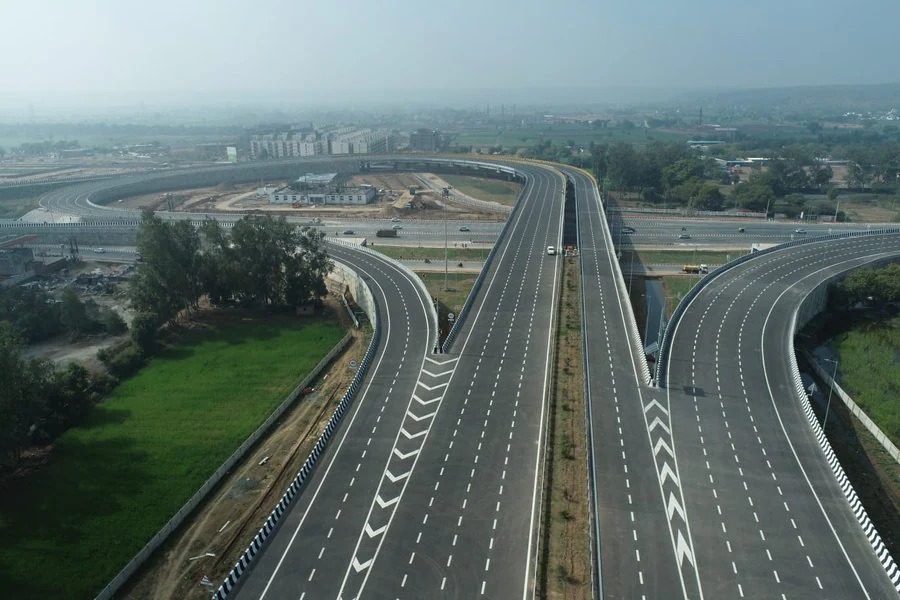
KOTA — Union Minister for Road Transport and Highways Nitin Gadkari announced on Wednesday that the ambitious Delhi-Mumbai Expressway is on track for full completion within the next two years. During a high-level inspection of the corridor in Rajasthan’s Kota district, the Minister confirmed that approximately 75% to 80% of the ₹1.10 lakh crore project is now finished, marking a significant milestone for India’s infrastructure development.
The project, which aims to transform the nation’s logistics and transport landscape, is designed to slash travel time between the national capital and India's financial hub to approximately 12 hours. The latest updates come following a joint inspection by Minister Gadkari, Lok Sabha Speaker Om Birla, and Rajasthan Chief Minister Bhajanlal Sharma, who reviewed construction progress at the strategic Mukundra Hills Tiger Reserve Tunnel and the Laban Interchange.
Accelerating Connectivity and Economic Growth
The Delhi-Mumbai Expressway is more than just a roadway; it is positioned as a primary engine for regional economic transformation. Minister Gadkari emphasized that the corridor is strategically planned to attract industrial clusters, logistics hubs, educational institutions, and agro-based industries to the regions along its 1,350-km route.
"Quality infrastructure creates investment and employment, which ultimately helps eliminate poverty," the Minister stated, drawing on the philosophy that robust road networks are foundational to a country’s economic prosperity.
The government’s strategy includes integrating the expressway with smaller regional links. During his visit to Kota, the Minister approved a new 10-km four-lane bypass on National Highway-52 and a 21-km greenfield spur to provide seamless connectivity between Kota and the expressway. These additions are expected to enhance trade efficiency and reduce transit times for local industries.
Addressing Construction Challenges
While the project is nearing completion, the Ministry of Road Transport and Highways (MoRTH) and the National Highways Authority of India (NHAI) have faced logistical and technical challenges. Recent reports highlighted pavement distress on certain sections, leading to the termination of contracts for non-performing entities.
"In view of the contractor's persistently poor performance, residual works were suspended, and remaining construction was entrusted to new builders to ensure effective restoration," an official statement clarified. The NHAI is currently conducting micro-milling and structural rectifications to ensure the roadway meets long-term safety and durability standards.
Impact on Logistics and Commuters
For businesses and travelers, the completion of the Delhi-Mumbai Expressway represents a fundamental shift. By providing a high-speed, access-controlled route that bypasses congested urban areas, the expressway will significantly lower operational costs for logistics providers and reduce fuel consumption for long-haul transport.
The integration of the Jawaharlal Nehru Port Trust (JNPT) via a 92-km dedicated spur will further streamline exports and imports, providing a direct gateway from the northern hinterlands to global shipping lines.
Key Facts at a Glance
Project Completion: The entire 1,350-km corridor is expected to be fully operational within two years.
Current Progress: Approximately 80% of the ₹1.10 lakh crore project is complete.
Travel Time: Once finished, the road trip between Delhi and Mumbai will be reduced to 12 hours.
Infrastructure Highlights: Includes India’s first eight-lane tunnel through the Mukundra Hills Tiger Reserve.
Economic Impact: Designed to serve as a catalyst for logistics parks, medical colleges, and industrial growth in underdeveloped tribal districts.
Frequently Asked Questions (FAQ)
1. When will the full Delhi-Mumbai Expressway be open to the public?
Union Minister Nitin Gadkari has stated that the entire expressway will be fully completed and operational within two years.
2. How much time will it take to travel from Delhi to Mumbai via this route?
The expressway is designed to reduce the travel time between Delhi and Mumbai (Nariman Point/JNPT) to approximately 12 hours.
3. What are the key features of the expressway?
The expressway is a 1,350-km greenfield project featuring high-speed connectivity, automated tolling, advanced traffic management, and specialized wildlife passages, including an eight-lane tunnel through the Mukundra Hills.
4. Will the expressway help with economic development?
Yes, the government expects the corridor to attract large-scale investment in logistics parks, industrial clusters, and educational facilities, acting as a driver for regional economic growth.
Source: Ministry of Road Transport and Highways, National Highways Authority of India (NHAI), Jawaharlal Nehru Port Authority