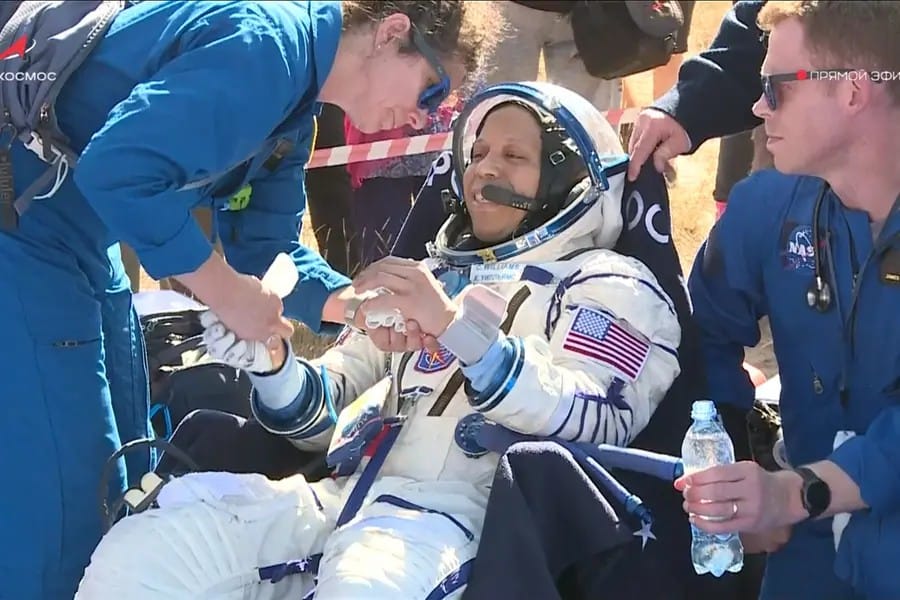
NASA astronaut Chris Williams and Roscosmos cosmonauts Sergey Kud-Sverchkov and Sergei Mikaev landed safely in Kazakhstan on July 26, 2026, after 241 days aboard the International Space Station. Their 102-million-mile mission included microgravity cancer research, in-space manufacturing tests, and critical station upgrades to prepare for future Artemis lunar exploration.
DZHEZKAZGAN, Kazakhstan — NASA astronaut Chris Williams and Russian cosmonauts Sergey Kud-Sverchkov and Sergei Mikaev landed safely on the Kazakh steppe on Sunday, July 26, 2026, ending a 241-day mission aboard the International Space Station (ISS). The Soyuz MS-28 spacecraft touched down under a parachute canopy at 6:27 a.m. EDT (3:27 p.m. local time), completing a journey of 3,856 Earth orbits spanning more than 102 million miles. The crew's return marks the completion of key scientific experiments in low Earth orbit aimed at supporting long-duration human spaceflight and biomedical breakthroughs.
Orbital Deorbit and Precision Parachute Touchdown
The crew's journey home began early Sunday morning when the Soyuz MS-28 spacecraft undocked from the space station's Rassvet module at 3:03 a.m. EDT. Following a deorbit burn to slow the vehicle's speed, the spacecraft shed its service and orbital modules before re-entering Earth's atmosphere.
The descent module withstood atmospheric heating reaching nearly 2,000 degrees Celsius before deploying its main parachute to cushion the final landing southeast of Dzhezkazgan. Recovery teams from NASA and Roscosmos reached the capsule within minutes, assisting the crew out of the module for preliminary medical evaluations on site.
The flight marked the first spaceflight for both Williams and Mikaev, while mission commander Kud-Sverchkov completed his second orbital tour. Following initial health assessments, the crew was transported by helicopter to Karaganda. From there, Williams will board a NASA transport plane bound for Johnson Space Center in Houston, Texas, while Kud-Sverchkov and Mikaev travel to Star City, Russia.
Scientific Achievements and Spacewalk Operations
During their eight-month stay aboard the orbiting laboratory, the trio conducted scores of scientific investigations across biomedical, physical, and materials sciences. Williams spearheaded research evaluating novel cancer treatments in microgravity and advanced in-space manufacturing methods for high-performance semiconductor components.
Williams also executed two spacewalks during the mission. His extravehicular activities included installing hardware to support space station power system upgrades and replacing a joint assembly on the Canadarm2 robotic system.
Command of the orbital laboratory officially transferred on Saturday when Kud-Sverchkov handed over responsibility for Expedition 75 to NASA astronaut Jessica Meir during a traditional change-of-command ceremony.
Official Sources Section
Information regarding the trajectory, landing parameters, and medical status of the crew was verified through official announcements released by the National Aeronautics and Space Administration (NASA) and press updates published by the Roscosmos State Corporation for Space Activities.
Quote Section
"I am feeling better and better with each moment," stated Soyuz MS-28 commander Sergey Kud-Sverchkov shortly after exiting the descent module on the Kazakh steppe. "I would like to thank everyone who supported this landing and our entire mission team on the ground."
Why It Matters
Long-duration space missions provide critical biological data regarding human physiology in microgravity, including bone density loss and vascular changes. The findings gathered during this 241-day flight directly inform risk-mitigation protocols for NASA’s upcoming Artemis lunar missions and future deep-space exploration to Mars. Furthermore, ongoing joint operations between the United States and Russia demonstrate continued technical cooperation in low Earth orbit despite broader geopolitical tensions.
Key Facts at a Glance
Duration: 241 days in space, launching on Nov. 27, 2025, and landing on July 26, 2026.
Crew Members: NASA astronaut Chris Williams and Roscosmos cosmonauts Sergey Kud-Sverchkov and Sergei Mikaev.
Distance: Completed 3,856 orbits around Earth, covering over 102 million miles.
Post-Landing Route: Williams returns to Johnson Space Center in Houston; cosmonauts return to Star City.
Frequently Asked Questions (FAQ)
How long was Chris Williams in space?
NASA astronaut Chris Williams spent 241 days aboard the International Space Station during his first orbital mission.
Where did the Soyuz MS-28 capsule land?
The spacecraft landed on the remote steppe of Kazakhstan, southeast of the city of Dzhezkazgan.
Who is now in command of the International Space Station?
NASA astronaut Jessica Meir assumed command of Expedition 75 prior to the departure of the Soyuz MS-28 crew.
What scientific work was completed during this mission?
The crew conducted microgravity cancer treatment studies, tested in-space manufacturing techniques for electronics, and performed spacewalks to upgrade station power systems.
Source: Official mission advisories from National Aeronautics and Space Administration (NASA) and statement releases from Roscosmos State Corporation for Space Activities.