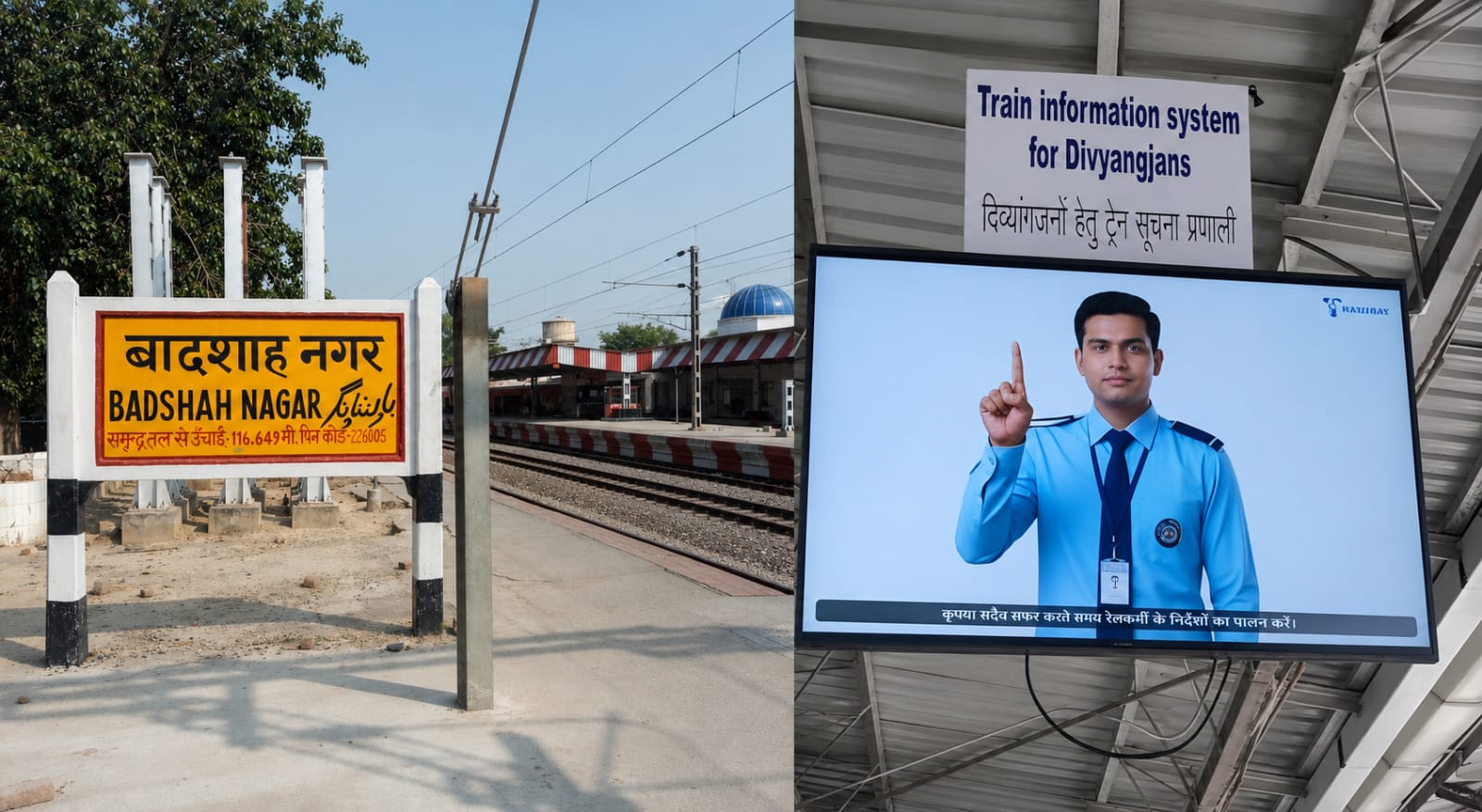
Indian Railways has introduced its first AI-powered sign language train information system at Badshahnagar station in Lucknow. Developed by the Signal and Telecommunication Department with Techtron Infotech, the system automatically translates live English and Hindi audio announcements into Indian Sign Language, broadcasting real-time avatar animations via LED screens to assist hearing-impaired passengers.
LUCKNOW, INDIA — In a major technological leap for public transit accessibility, Indian Railways has officially deployed its first-ever Artificial Intelligence (AI) powered sign language train information system. The landmark system has been made fully operational at the Badshahnagar railway station under the Lucknow Division of the North Eastern Railway zone.
Developed to bridge critical communication gaps, the technology automatically converts standard audio announcements into real-time visual sign language, enabling passengers with hearing disabilities to access vital travel updates independently.
Real-Time Audio-to-Sign Conversion Technology
The newly implemented system directly integrates into the station's existing public address audio infrastructure. Using specialized artificial intelligence models, the technology captures spoken live train updates—including arrival and departure timings, platform reassignments, and scheduling delays—in both Hindi and English.
The AI system immediately processes these audio inputs, converting them into Indian Sign Language (ISL). The finalized information is then broadcast across dedicated high-definition LED monitors on Platform 1 via a expressive digital avatar designed to convey clear linguistic gestures.
The system was engineered by the Lucknow Division’s Signal and Telecommunication Department, led by Senior Divisional Signal and Telecommunication Engineer Vaibhav Shrivastava. The technical development was completed in collaborative partnership with private technology firm Techtron Infotech Pvt. Ltd.
Successful Field Trials and Validation
Prior to its commercial launch, the system underwent a rigorous two-month field trial at Badshahnagar station to verify translation accuracy and structural reliability.
According to regional officials, the final verification phase was conducted under the direct supervision of representatives from a Noida-based advocacy organization working for the deaf and hard-of-hearing community, alongside four certified sign language interpreters. The expert panel validated that the digital avatar's hand gestures, facial expressions, and timing correctly mapped to the live audio broadcasts before giving the clearance for public rollout.
Estimated Impact
Railway data suggests that the new facility could eventually benefit more than 100,000 passengers with disabilities who utilize the Badshahnagar station network as regular commuters or regional travelers.
Official Sources Section
According to official declarations from the North Eastern Railway (NER) zone and regional administrative statements, this development aligns closely with the Ministry of Railways' comprehensive action plan for accessible public transit infrastructure. Detailed documentation regarding the project's parameters and pilot results was confirmed via administrative updates shared by the North Eastern Railway division.
Statements from Railway Leadership
"The technology automatically converts existing public announcements into sign language, allowing passengers with disabilities to access travel information independently without relying on third-party assistance," stated Gaurav Agarwal, Divisional Railway Manager (DRM) for the Lucknow Division.
Agarwal further confirmed that "a successful trial of the system was conducted in the presence of representatives of a Noida-based organisation working for people who are deaf and hard of hearing, and four certified sign language interpreters."
Why It Matters
For decades, non-verbal passengers on the Indian rail network have remained fundamentally dependent on physical inquiry counters or the assistance of fellow travelers to track sudden track changes or delay notifications.
By automating the translation of voice announcements into standardized Indian Sign Language, the system establishes a scalable framework for universal design. It eliminates accidental travel delays caused by missed audio cues, enhances passenger dignity, and offers a blueprint for modernizing the remainder of Indian Railways' vast station network.
Key Facts at a Glance
Location: Platform 1, Badshahnagar Railway Station, Lucknow Division, North Eastern Railway.
Core Technology: Real-time AI-driven translation of live Hindi and English audio announcements into Indian Sign Language (ISL).
Visual Interface: High-definition LED monitors displaying a digital avatar with expressive, real-time linguistic gestures.
Development Partners: Built in-house by the Signal and Telecommunication Department alongside Techtron Infotech Pvt. Ltd.
Testing Window: Deployed following a comprehensive two-month trial validated by certified sign language interpreters.
Frequently Asked Questions (FAQ)
How does the new system work for passengers at the station?
The system captures the live voice announcements made by station operators over the loudspeakers and uses AI to instantly translate those words into Indian Sign Language. A digital human avatar then acts out the translation on large LED screens located on the platform.
What languages are supported by the AI translation software?
The system captures live station announcements spoken in both Hindi and English and translates them directly into Indian Sign Language (ISL).
Will this technology be expanded to other railway stations in India?
While Badshahnagar is the first station to officially receive the system following its successful trial, railway officials indicated that it serves as a pilot model. Plans are being evaluated to scale the technology across other high-traffic hubs within the North Eastern Railway zone, including potential future installations at stations like Gorakhpur.
Source: North Eastern Railway Official Portal, Lucknow Divisional Railway Administration Press Briefing, Disability Insider Report Portal.