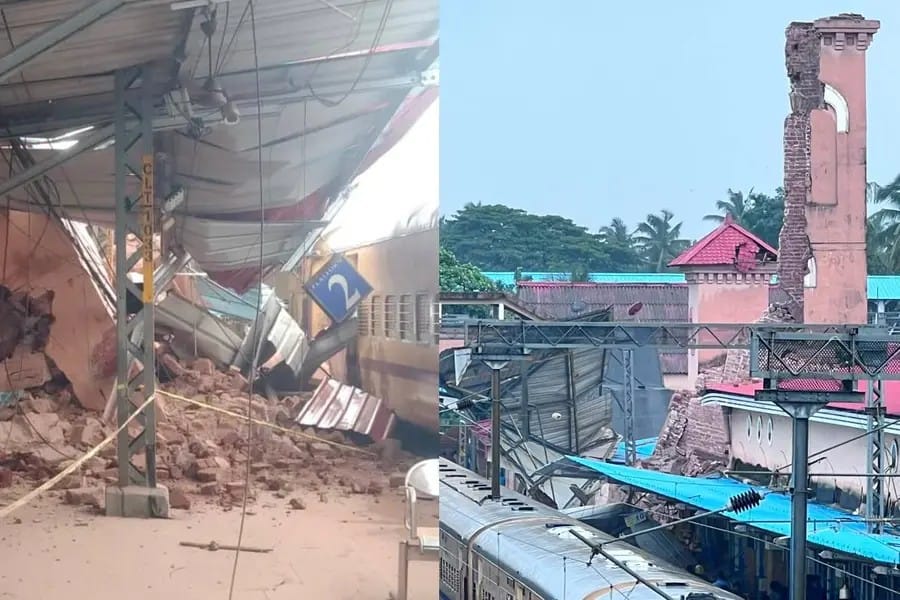
A century-old heritage clock tower partially collapsed onto Platform 2 at Kerala's Kozhikode Railway Station on July 9, 2026, amid heavy monsoon rains. While no injuries were reported, the falling debris severed overhead power lines, halting trains on three tracks and forcing extensive cancellations and route realignments across the region.
KOZHIKODE, INDIA — A major rail disaster was narrowly averted on Thursday morning, July 9, 2026, when a historic, 150-year-old clock tower building partially collapsed onto the platforms at the Kozhikode (Calicut) Railway Station in Kerala. The sudden structural failure, which occurred at approximately 11:10 AM, sent tonnes of heavy brickwork and concrete debris crashing down onto Platform 2 and Track 3, knocking out vital overhead electrical lines.
The incident triggered an immediate safety shutdown of the high-voltage power grid across Platforms 1, 2, and 3, completely halting rail operations through one of the Malabar region's busiest transit gateways. While multiple south-bound premium services suffered severe delays and forced route adjustments, Southern Railway authorities confirmed that no passenger or railway staff casualties were reported.
Heavy Rain Cascades into Structural Failure
Preliminary engineering assessments conducted by the Southern Railway zone indicate that days of continuous, torrential downpours in the Kozhikode district severely compromised the foundation of the aging brick structure. The region has been placed under an active orange alert by the India Meteorological Department (IMD) due to a lingering monsoon storm system.
The iconic 25-meter-tall clock tower, situated adjacent to the Station Master's office, split vertically. Massive chunks of the heritage roof tumbled onto Platform 2, where the Kozhikode–Kannur Passenger train was stationed waiting for its 2:05 PM departure.
Because the train cars were locked and passengers had not yet been permitted to board, the falling masonry struck the flanks of the empty rake without penetrating the passenger cabins. A small number of on-duty railway personnel spotted early structural shifts and ran to safety seconds before the primary impact.
Massive Disruption to Regional Train Schedules
To facilitate debris clearing operations and repair the severed overhead cables, station authorities temporarily banned public access to Platforms 1, 2, and 3. For several hours, the station was forced to route all passing traffic exclusively through Platform 4, creating an immediate bottleneck for high-speed long-distance corridors.
The emergency forced the Southern Railway's operations wing to implement a series of immediate cancellations, short-terminations, and scheduling realignments:
Jan Shatabdi Express (Kozhikode–Thiruvananthapuram): The 1:45 PM premium service was blocked from entering the central terminal. It originated its journey from the nearby Kallai Railway Station instead.
KSR Bengaluru–Kozhikode Express: The incoming interstate service was short-terminated at West Hill Railway Station. Officials confirmed its return leg to Bengaluru would also depart from West Hill.
Long-Distance Delays: Major cross-state lines, including the Netravati Express and the Mangaluru–Thiruvananthapuram Eranad Express, were stopped at signals outside city limits or held at rural stations for several hours.
To mitigate the impact on stranded travelers, the Kerala State Road Transport Corporation (KSRTC) mobilized an emergency fleet of shuttle buses to transfer passengers between Kozhikode, Kallai, and West Hill terminals.
Infrastructure Demolition Context and Safety Debates
The collapsed clock tower was already slated for controlled dismantling as part of the ongoing station modernization project under the central government's Amrit Bharat Station Scheme (ABSS). Piling work and platform modifications have been underway at the Kozhikode terminal for several months.
According to S.N. Narain, Chief Public Relations Officer (CPRO) for the Southern Railway, technical teams had already identified the structure's vulnerability and were in the process of erecting safety barricades around the tower when the rain-induced collapse occurred.
However, the unexpected failure has drawn sharp criticism from local political leadership regarding defensive safety protocols on active public construction sites. Members of the legislative assembly have expressed concern that the vibrations from nearby heavy machinery and ongoing structural piling work may have actively accelerated the degradation of the already weak heritage building.
Official Sources Section
The material details, structural timelines, and operational adjustments detailed within this dispatch are based on formal statements issued by the Southern Railway Zone commercial branch, technical site briefs from the Ministry of Railways, and localized weather registries maintained by the India Meteorological Department.
Demand for Accountability and State-Wide Audits
"While constructing new buildings, we should also ensure the old ones are safe," stated regional MLA P.A. Mohamed Riyas during an emergency press briefing outside the cordoned station perimeter.
"If cracks were noticed earlier, the authorities should have informed the public about its dangers and to be cautious. Secondly, barricades ought to have been set up in advance, and staff deployed to warn passengers away. This is something that should have never happened. We are demanding a comprehensive safety audit of all similar aging railway structures across Kerala."
Why It Matters
The structural failure highlights the growing logistical difficulties of upgrading century-old, high-traffic transit hubs while maintaining daily commuter operations. It highlights the absolute necessity of implementing aggressive protective shoring and structural isolation barriers around heritage brick buildings before starting adjacent heavy construction. For commuters, the incident demonstrates how a single localized structural failure can ripple outward, disrupting regional supply chains and delaying tens of thousands of travelers across multiple states.
Key Facts at a Glance
The Incident: A 150-year-old heritage clock tower partially collapsed onto Platform 2 at Kozhikode Railway Station at 11:10 AM.
Casualties: Zero injuries or fatalities were reported; nearby personnel fled before impact, and an adjacent passenger train was empty and locked.
The Cause: Prolonged heavy monsoon rains and foundation weakening, occurring amidst ongoing redevelopment work under the Amrit Bharat Station Scheme.
Transit Impact: Overhead power lines were severed, shutting down tracks 1, 2, and 3, and forcing major premium trains to terminate at Kallai and West Hill.
Political Response: Lawmakers have demanded an immediate, independent high-level inquiry and a comprehensive safety audit of all older railway properties in the state.
Frequently Asked Questions (FAQ)
Did the clock tower collapse cause any injuries?
No passenger or railway employee injuries were reported. Security staff had cordoned off parts of the area, and the nearby Kozhikode-Kannur train was completely empty of passengers when the structure fell.
Why did the heritage clock tower fall down?
Preliminary assessments indicate that continuous heavy rainfall over several days weakened the foundation of the 130-to-150-year-old structure. Additionally, local leaders are investigating whether vibrations from nearby heavy construction work played a role.
How are current train services at Kozhikode being handled?
Train traffic on tracks 1, 2, and 3 was temporarily halted due to debris and broken power lines. While repair teams work on the site, limited traffic is being rerouted through Platform 4, and certain major trains are starting or ending at nearby alternative stations like Kallai and West Hill.
Source: Southern Railway Chief Public Relations Office Bulletin, Kozhikode Railway Police Station Log, Press Trust of India Regional Bureau, Mathrubhumi English Online News.