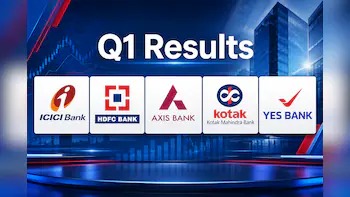
India's financial sector is bracing for a major test on Saturday, July 18, 2026, as 21 prominent firms headlined by banking giants HDFC Bank, ICICI Bank, Axis Bank, and Kotak Mahindra Bank declare their Q1 results. Markets are highly focused on net interest margins, loan momentum, and shifting deposit mixes.
MUMBAI — A massive slate of corporate earnings will take center stage in India's financial sector on Saturday, July 18, 2026, as 21 prominent domestic firms prepare to declare their financial results for the first quarter of the fiscal year 2026-27 (Q1 FY27). The heavy corporate lineup is heavily anchored by the country's largest banking giants, including HDFC Bank, ICICI Bank, Axis Bank, and Kotak Mahindra Bank.
Because Indian commercial banks routinely post their numbers over the weekend when the stock markets are closed, institutional investors, equity analysts, and retail shareholders are closely tracking these metrics. The upcoming multi-firm data disclosure serves as an essential health check for the broader economy, providing definitive signals regarding deposit growth, systemic credit costs, and Net Interest Margin (NIM) stability in a persistent high-rate macro environment.
Heavyweight Financial Giants Set the Market Tone
The concentration of major banking names on a single Saturday makes July 18 one of the most critical earnings disclosure dates of the current fiscal cycle. Heading into the weekend reveal, the banking sector has exhibited positive technical momentum. On Friday, the Bank Nifty index surged nearly 1% to reclaim the psychologically vital 58,000 mark, largely driven by preemptive institutional buying in large-cap private lenders.
The primary weight on the 21-firm slate rests on the standalone performance of HDFC Bank, the country's largest private sector lender. According to preliminary consensus estimates compiled by leading brokerage houses like Motilal Oswal Financial Services, the bank is projected to post a 5.9% year-on-year rise in net profit to approximately ₹19,230 crore.
Concurrently, its Net Interest Income (NII) is anticipated to climb 8.5% year-on-year to touch ₹34,100 crore, although analysts expect its net interest margins to remain largely flat or face a slight 2-basis-point dip due to seasonal agricultural pressures.
Expectations Over Deposit Rebalancing and Loan Growth
A primary focal point across the 21 reporting firms remains the structural divergence between deposit gathering and credit deployment. Private lenders have had to navigate an intense industry-wide scramble for retail funds, which has driven up the cost of operations.
For instance, at Axis Bank, analysts are anticipating a sequential compression in its NIM by more than 10 basis points, down from the 3.62% baseline reported in the final quarter of the previous fiscal year. This pressure stems directly from a structural shift in the deposit mix.
Consumers have increasingly migrated away from low-yield Current Account Savings Account (CASA) structures into higher-cost term deposits, which grew at a rapid 22.8% year-on-year rate at the bank. Despite this funding headwind, Axis Bank's gross advances remained robust, charting an 18.8% year-on-year expansion to reach ₹12,72,900 crore—consistently pacing ahead of the broader banking industry's average growth rate.
Public Sector Recovery and Broader Corporate Filings
Beyond the marquee private financial institutions, state-owned lender Punjab National Bank (PNB) is also scheduled to present its Q1 results on July 18. Markets are highly focused on whether the state-owned giant can maintain its recent operational turnaround, which previously saw profits jump 160%.
PNB has successfully transitioned from massive legacy loan provisioning to a recovery-led expansion strategy. Analysts are looking to verify if its Gross Non-Performing Asset (GNPA) ratio is successfully maintaining its downward trajectory toward a targeted sub-5% baseline.
The remainder of the 21-firm slate features diverse mid-cap and large-cap non-banking corporate entities, including engineering firms, energy suppliers, and specialized manufacturers. Equity desks indicate that the cumulative performance of these peripheral listings will help gauge industrial production parameters and input-cost impacts outside the banking sphere.
Official Sources Section
The corporate earnings calendars, financial consensus forecasts, historical performance baselines, and data indices featured in this market brief are compiled from official regulatory filings submitted to the National Stock Exchange of India (NSE) and the BSE Limited, corporate investor relations portals, and verified consensus estimates distributed by Indian financial brokerages.
Quote Section
Market strategists note that the high concentration of financial heavyweights on July 18 will directly shape domestic equity market trends for the following week.
According to officials familiar with exchange listing regulations, weekend board meetings allow management teams to disseminate dense financial packets cleanly without sparking erratic, panic-driven intra-day trading volatility. Financial research teams stated that:
"The upcoming Q1 results drop represents an incredibly concentrated litmus test for the banking index. Investors are moving past general asset quality discussions to focus strictly on liability costs. Whether these banks can sustain loan growth without suffering major margin compression will determine the medium-term path for financial stocks."
Why It Matters
For Indian retail investors, pension fund managers, and everyday consumers, the incoming wave of corporate earnings dictates immediate portfolio positioning. Because banks carry the heaviest collective weight inside the benchmark Nifty 50 index, their reported margin stability, loan performance, and provisions will heavily influence institutional capital inflows and determine the availability and cost of retail credit across the country.
Key Facts at a Glance
Concentrated Slate: A total of 21 domestic companies are legally scheduled to file their Q1 results on Saturday, July 18, 2026.
Banking Heavyweights: Market leaders HDFC Bank, ICICI Bank, Axis Bank, and Kotak Mahindra Bank anchor the weekend corporate disclosures.
Profit Projections: HDFC Bank's net profit is estimated to rise 5.9% year-on-year to hit approximately ₹19,230 crore.
Margin Friction: Rising costs from consumers shifting into high-yield term deposits are expected to compress net interest margins across private lenders.
Market Preparation: The Bank Nifty index surged nearly 1% ahead of the announcements, regaining the important 58,000 level.
FAQ Section
Why do Indian banks typically report their quarterly earnings on Saturdays?
Reporting on Saturdays gives institutional investors, retail traders, and market regulators a full 48-hour window to review complex financial packets, asset metrics, and management commentary without causing reactive intra-day trading volatility.
What are the key financial indicators to watch in HDFC Bank's Q1 results?
Investors will be closely tracking Net Interest Income (NII) growth, the stability of Net Interest Margins (NIMs) against seasonal pressures, deposit growth rates, and the progress of loan expansions across corporate and retail divisions.
How are high-cost term deposits impacting private sector banks this quarter?
As consumers shift funds from low-yield current and savings accounts (CASA) into higher-yield term deposits, banks are facing increased funding costs, which puts downward pressure on their net interest margins.
Source: National Stock Exchange of India (NSE) Corporate Earnings Calendar; BSE Limited Listing Compliance Registry; Institutional Research Previews from Motilal Oswal Financial Services.