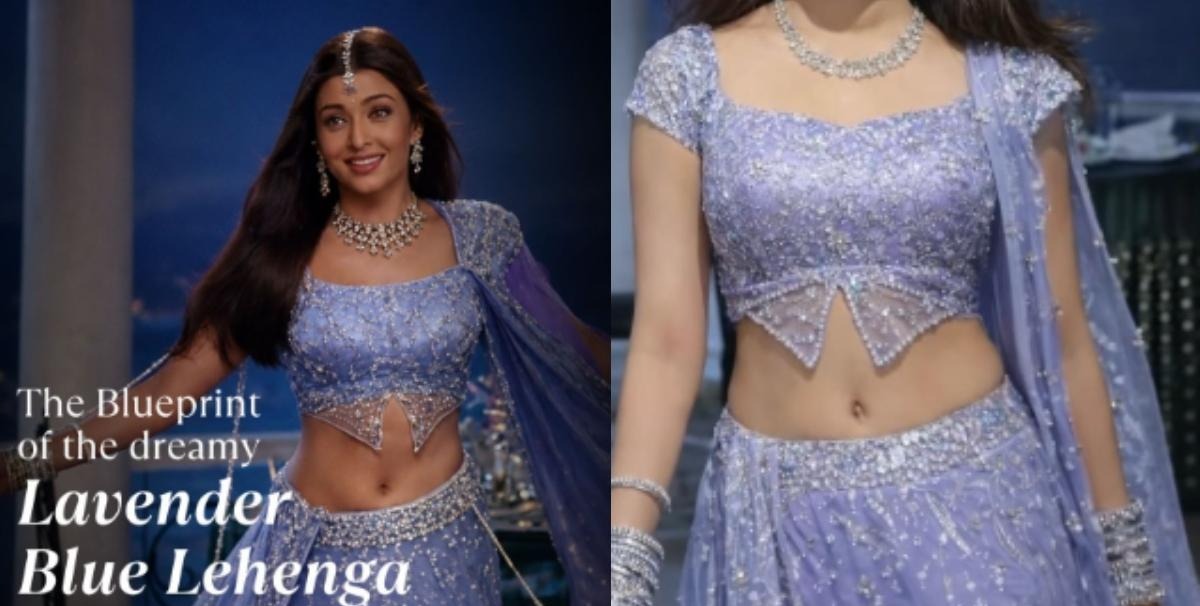
In 2003, Aishwarya Rai wore a custom lavender-blue organza lehenga by Neeta Lulla in Dil Ka Rishta and it quietly conquered every Indian bridal wardrobe for the next decade. Decades later, designer Neeta Lulla has revealed exactly how this dreamy couture creation became the ultimate bridal moodboard of the early 2000s.
Long before brides pinned inspiration on Instagram or scrolled through wedding hashtags, Indian women had one moodboard Bollywood. Aishwarya Rai's lavender-blue lehenga from Dil Ka Rishta (2003), designed by couturier Neeta Lulla, didn't just trend in its time; it launched what Lulla herself now calls "a thousand recreations." In a May 2026 Instagram reveal, Lulla pulled back the curtain on the making of this iconic ensemble and the fashion world took notice all over again.
The Couture Secret Behind The Colour
The lehenga's signature lavender-blue tone was not off a shelf. Neeta Lulla revealed that the hues were custom-dyed specifically for the ensemble, chosen because the soft pastel palette complemented Aishwarya's distinctive blue-green eyes in a way that felt almost cinematic. "This colour became very popular with my clothes on Aishwarya because she really loved the colour," Lulla shared, adding that the dyeing process was handled by artisans in her workshop to achieve the perfect gradient finish. At a time when lavender was barely on the Indian bridal colour radar, this choice was quietly revolutionary.
The Blouse That Changed Everything
The lehenga was crafted in organza, but what set it apart was the blouse construction. Neeta Lulla incorporated a kurti-style structure into the front of the choli, with a subtle central slit creating a silhouette that was, as the designer put it, "sensuous and still modest." This fusion of traditional Indian modesty with a contemporary, slightly fashion-forward blouse shape made it immensely wearable for real brides, which is precisely why boutiques across India began receiving recreation requests within months of the film's release.
Jewellery Designed For The Dream
No detail was left to chance. The entire jewellery set choker, earrings, maang tikka, and bangles was specially designed to complement the lehenga's palette and silhouette, incorporating Swarovski crystals and blue beads that echoed the custom-dyed tones. Lulla noted that "even the jewellery was crafted to make the entire look a timeless piece of couture history," reinforcing that the ensemble was conceived as a complete artistic vision rather than individual pieces.
From Screen To Shaadi Mandap
The lehenga's impact on Indian bridal fashion cannot be overstated. It arrived just as pastel bridal wear was beginning to challenge the dominance of traditional reds, and Aishwarya's ethereal screen presence accelerated that shift. Women across tier-1 and tier-2 cities began requesting "Dil Ka Rishta-style" lehengas from their local tailors, and the lavender-blue palette entered the vocabulary of Indian bridal fashion permanently. With Indian maximalism having a renewed moment today and Y2K nostalgia at its peak, the look may well be poised for yet another revival.
Bridal Fashion Takeaways
- The lehenga was crafted in organza with custom-dyed lavender-blue hues, achieved through handwork by artisans in Neeta Lulla's atelier
- The blouse featured an innovative kurti-structure with a central slit a fusion of modesty and modern sensuality
- Jewellery including choker, maang tikka, bangles, and earrings was purpose-designed with Swarovski crystals and blue beads
- The pale lavender palette was a deliberate departure from bridal reds, making it a trailblazer in pastel bridal fashion in India
- Designer Neeta Lulla confirmed the look was conceived as a head-to-toe couture vision, not a mix-and-match ensemble
- The lehenga sparked demand for recreations within months of the film's 2003 release and remained a boutique bestseller across the decade
- With Y2K fashion trends resurging in 2025–26, the look is being flagged as a prime candidate for a fresh new bridal revival
Sources: NDTV (May 9, 2026), Hindustan Times (May 7–8, 2026), Times of India, iDiva