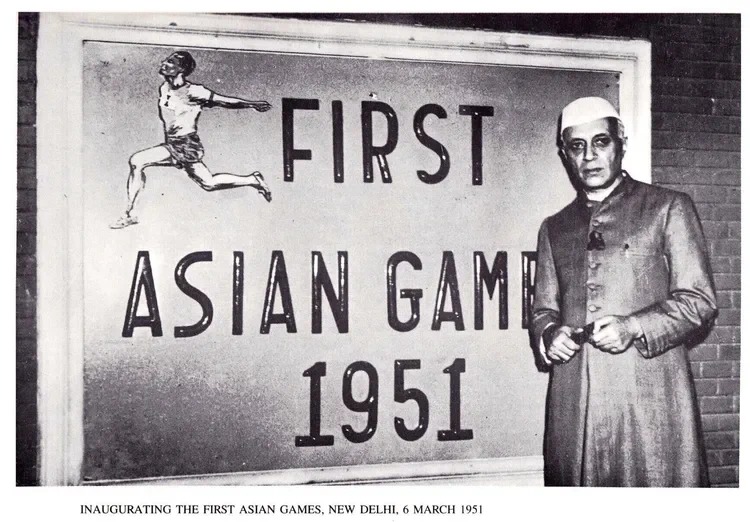
Tracing back to 1951, the Asian Games were shaped by India's strategic vision and sports diplomacy. Spearheaded by Professor G.D. Sondhi and Prime Minister Jawaharlal Nehru, New Delhi's hosting of the inaugural Asiad established a enduring continental legacy of athletic unity, regional cooperation, and professional sports governance.
How India
Gave Birth to the Asian Games
Long before
the Asian Games grew into the world's second-largest multi-sport event, it
started as a simple but powerful idea: what if sport, not politics, could bring
a war-scarred, newly independent Asia together?
That idea
took root in New Delhi - and it's a story worth knowing.
An Idea
Born at the Olympics
The year was
1948. The world was still recovering from the devastation of World War II, and
dozens of Asian nations were newly independent or on the verge of it. At the
London Olympic Games that year, an Indian sports administrator named Professor
Guru Dutt Sondhi - then a member of the International Olympic Committee,
floated a bold proposal alongside delegates from other Asian countries: create
a dedicated multi-sport event just for Asia.
The goal
wasn't only athletic. Sondhi and his fellow organizers believed sport could do
something diplomacy alone couldn't - help fractured, newly independent nations
find common ground. India's first Prime Minister, Jawaharlal Nehru, backed the
idea wholeheartedly, seeing it as a way to build regional peace and solidarity
through friendly competition rather than politics.
From
Shanghai to New Delhi
Interestingly,
the very first Asian Games weren't originally meant to be held in India at all.
Shanghai was the intended host. But political turmoil in China at the time
forced a change of plans, and New Delhi stepped in.
In March
1951, athletes from 11 nations arrived in the Indian capital for what would
become the first-ever Asian Games creating a historic moment that quietly
cemented India's place at the foundation of modern Asian sports.
Building
the Framework: The Asian Games Federation
Getting the
Games off the ground wasn't just about picking a host city; it required an
entirely new governing body. That happened in New Delhi too.
A few things
worth knowing about how it all came together:
- The blueprint was drawn up in
Delhi. In
February 1949, delegates from the founding nations gathered at Patiala
House in Delhi to draft the constitution of the Asian Games Federation
(AGF), the organization that would run the Games every four years, timed
to fall between Olympic cycles.
- The symbols were Indian too. Professor Sondhi didn't just
help conceive the Games, he also designed much of their identity,
including the now-famous motto, "Ever Onward," and the
sun-shaped emblem meant to represent the shared energy of the Asian
peoples.
- It grew far beyond its
beginnings. Over
the decades, the AGF evolved into what's now known as the Olympic Council
of Asia (OCA), which today counts 45 member nations and oversees a Games
that looks nothing like its modest 1951 original.
Why This
History Still Matters
It's easy to
think of the Asian Games as just another entry on the sporting calendar, but
its origin story carries real weight.
For one,
it's a reminder that sport was used as a tool to heal post-colonial divisions
and build trust between nations still finding their footing on the world stage.
That's not a small thing in the context of 1950s Asia.
It also
matters for anyone thinking about how host cities and sports economies function
today. The billion-dollar stadiums, broadcast deals, and infrastructure booms
that come with hosting the modern Asian Games all trace back to one unlikely
fact: a developing nation, India, proved in 1951 that it could successfully
organize and run a major international sporting event, long before "developing
nations hosting world-class sport" was a familiar idea.
The Quick
Facts
- First Games: New Delhi, India — March 4 to
March 11, 1951
- Key visionary: Professor Guru Dutt Sondhi,
backed by PM Jawaharlal Nehru
- Founding nations: 11 countries competed across
six sports
- Motto: "Ever Onward"
Source: WOWNEWS24X7Olympic Council of Asia (OCA) History Archives, Indian Olympic Association (IOA) Records, and historical documentation via Ministry of Youth Affairs and Sports, Government of India.