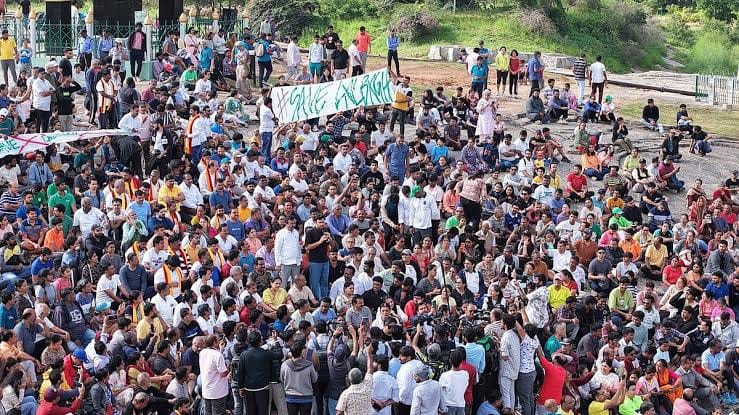
Over 5,000 Bengaluru citizens, RWAs, and environmental campaigners marched at Lalbagh Botanical Garden on August 30, 2026. The demonstration opposed a state bill permitting a 5% diversion of park land for public projects, alongside plans for an 18.5-km underground tunnel road passing near historic botanical grounds.
BENGALURU — More than 5,000 citizens, environmental activists, and members of Resident Welfare Associations (RWAs) staged a peaceful awareness march at Lalbagh Botanical Garden on August 30, 2026, protesting state government plans to divert park land for infrastructure projects. The public rally, organized under the banner "Walk in Lalbagh. Walk for Lalbagh," was triggered by the passage of the Karnataka Government Parks (Preservation) (Amendment) Bill, 2026, alongside concerns over the proposed 18.5-kilometer Hebbal-to-Silk Board subterranean tunnel road corridor.
Participants began assembling at 7:00 a.m. near the West Gate of the historic 240-acre botanical garden. Protesters marched through the grounds, chanted slogans, and gathered around the 3.4-billion-year-old Peninsular Gneiss rock formation. The peaceful demonstration highlighted growing opposition to legislative moves that allow state authorities to reallocate public park land for infrastructure development.
Legislative Amendment Sparks Citywide Civic Opposition
The primary catalyst for the rally is the Karnataka Government Parks (Preservation) (Amendment) Bill, 2026, passed by both houses of the state legislature. The legislation modifies the original 1975 Act governing protected public parks, permitting the state government to alienate up to 5% of a protected park or garden's total area for designated public utility and infrastructure projects.
Civil society groups and RWA representatives contend that the 5% provision poses a long-term ecological threat to iconic green belts like Lalbagh Botanical Garden and Cubbon Park. Under the 5% threshold, up to 12 acres of Lalbagh's protected ecosystem could potentially be diverted for non-park construction. Protesters carried placards reading "Not 5%, Not 1%, Not One Inch," demanding the absolute protection of urban green spaces.
Concerns were also raised regarding the proposed ₹12,000-crore underground tunnel road project designed to connect North and South Bengaluru. Environmental campaigners cite technical surveys indicating that subterranean drilling and alignment paths could impact 5 to 6 acres of Lalbagh's land, potentially damaging underground aquifers and root systems of heritage flora.
Official Sources Section
According to official releases from the Karnataka Legislative Assembly and statements from state executive officials, the Karnataka Government Parks (Preservation) (Amendment) Bill, 2026, introduces a high-level committee evaluation mechanism led by the Additional Chief Secretary to assess any public utility proposal before recommending land diversion. State authorities maintain that the bill contains strict statutory safeguards intended exclusively for necessary government utility projects, with total diversions capped at 5%.
Further details regarding municipal urban transport plans can be monitored via the Bruhat Bengaluru Mahanagara Palike (BBMP) and the official portal of the Government of Karnataka.
Quotes Section
"According to officials, the legislation provides a statutory framework to enable critical urban public utility infrastructure while establishing evaluation mechanisms to prevent unauthorized commercial exploitation of public land."
Organizers from the Lalbagh Walkers' Association and civil society groups stated that "urban parks are the vital green lungs of Bengaluru, and no percentage of protected botanical space should be compromised for concrete infrastructure."
Why It Matters
For Bengaluru Residents: Safeguarding designated park areas preserves critical lung space, urban cooling buffers, and groundwater recharge zones in an heavily urbanized environment.
For Urban Commuters: The debate highlights competing choices between vehicle-centric mega-infrastructure, such as tunnel corridors, and investments in public transit networks like expanded metro rail and bus fleets.
For Property Owners & RWAs: Municipal policy regarding public green spaces directly impacts neighborhood liveability ratings, ecological health, and long-term urban property values.
Key Facts at a Glance
Event: Mass citizen protest walk at Lalbagh Botanical Garden on August 30, 2026.
Controversial Policy: Amendment allowing up to 5% of protected public park land to be transferred for infrastructure utility use.
Project Impacted: Proposed 18.5-km Hebbal-to-Silk Board subterranean tunnel road.
Attendance: Over 5,000 citizens, environmental groups, RWAs, and civic representatives.
Legal Status: Opposition leaders and citizen groups have petitioned the Governor of Karnataka to withhold assent to the bill.
Frequently Asked Questions
What is the Karnataka Government Parks (Preservation) Amendment Bill, 2026?
It is a state legislative amendment that permits up to 5% of protected government park land to be diverted, sold, leased, or transferred for designated public utility projects following high-level committee review.
Why are Bengaluru citizens protesting at Lalbagh?
Citizens and RWAs oppose the potential loss of green space, arguing that allowing even 5% diversion threatens fragile botanical ecosystems, heritage trees, and ancient geological structures like the Peninsular Gneiss rock.
How does the proposed tunnel road affect Lalbagh?
Environmental groups express concern that subterranean alignment, ventilation shafts, and access portals for the 18.5-km tunnel road could require surface and sub-surface park area, risking groundwater disruption and vibration damage to vintage flora.
Featured Image
An expansive shot depicting thousands of citizens and morning walkers gathered near the Peninsular Gneiss rock at Lalbagh Botanical Garden, holding banners calling for the preservation of Bengaluru's green spaces.
Source: Official filings and releases from the Karnataka Legislative Assembly, public proceedings of the Government of Karnataka, and civic statements from the Bruhat Bengaluru Mahanagara Palike.