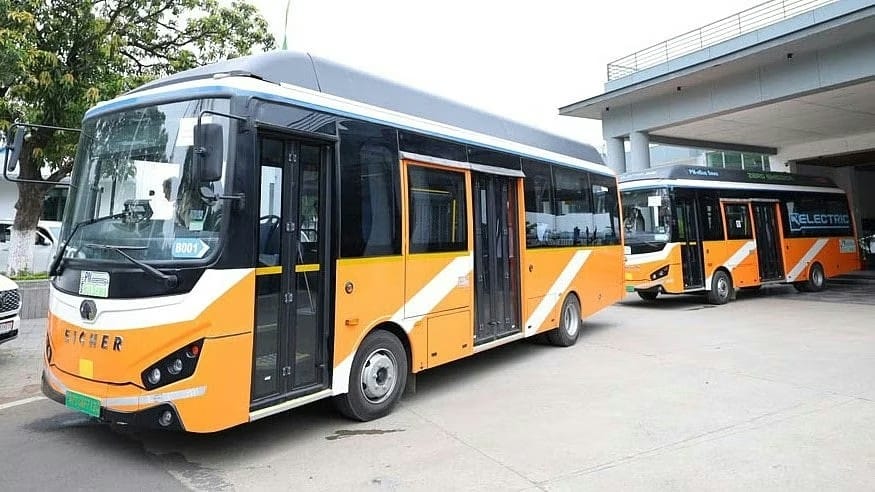
Bhopal officially initiated trial runs for its new PM E-Bus Sewa fleet on July 20, 2026, deploying 21 eco-friendly vehicles across three critical transit corridors. The five-day trial assesses route dynamics ahead of an August public launch, which will feature a 20 percent reduction in commuter fares.
BHOPAL — The Bhopal Municipal Corporation and local transport authorities officially commenced a five-day comprehensive trial run of the new PM E-Bus Sewa fleet on Monday, July 20, 2026. Aimed at lowering urban vehicular emissions and enhancing commuter comfort, the initial operational tests are being conducted across three heavily trafficked urban routes connecting key transit hubs. Regular passenger services are slated to follow on these corridors immediately upon the successful completion of technical evaluations by early August.
The standard field tests follow an official high-profile pre-launch inspection by Mayor Malti Rai at the newly outfitted Bairagarh Depot, alongside a special cabinet-level review journey undertaken by Madhya Pradesh Chief Minister Dr. Mohan Yadav. The arrival of the clean-energy buses marks a critical milestone in the state’s phased re-engineering of its regional and municipal transport infrastructure.
Technical Mapping Across Three Selected High-Density Corridors
According to transit project logs, 21 advanced electric vehicles have arrived in the city for the preliminary testing phase, with an additional 20 units expected to join the municipal fleet over the next 10 days. The ongoing trial runs are systematically split into two distinct operational daily shifts: a morning window running from 8:00 AM to 12:00 PM, and an afternoon tracking shift from 2:00 PM to 6:00 PM.
The transit department's evaluation teams are using the trial period to actively analyze real-world traffic bottlenecks, peak-hour passenger volume pressures, and battery performance across three specific commercial pathways originating from Bairagarh:
The Board Office Corridor: Traversing Old Bhopal via core administrative blocks.
The Bhopal Railway Station Route: Terminating directly at Platform Number 1 to handle interstate commuters.
The Kolar Extension: Stretching south to the densely populated residential belt of Bairagarh Chichli.
Infrastructure Reinforcement and Unified Fare Adjustments
To sustain the incoming fleet, urban development agencies have completed civil works on specialized electrical infrastructure. The Bairagarh Depot has been equipped with 11 dedicated high-capacity charging bays designed to ensure rapid turnaround times once the network scales up to standard public usage.
| Parameter | Current Fleet Metric | Projected Scaled Target |
| Active Fleet Units | 21 E-Buses | 100 E-Buses (Phase 1) |
| Operational Depot | Bairagarh Facility | 26 Newly Planned Routes |
| Added Tech Features | ITMS, GPS, Panic Buttons | Full Metro Link Integration |
In a major fiscal restructuring aimed at accelerating public adoption, authorities have implemented a synchronized fare reduction of approximately 20 percent across all municipal transit categories. The lower tariff structures follow a structural shift in management over to Madhya Pradesh Yatayat Pvt. Ltd., which successfully removed local road taxes previously applied to public vehicles crossing municipal boundaries.
Official Sources Section
Regulatory clearances, operational route parameters, and technical deployment metrics are officially maintained and distributed by the Bhopal Smart City Development Corporation Limited and the executive directorate of Madhya Pradesh Passenger Transport and Infrastructure Limited.
Quote Section
"According to officials managing the urban transit portfolio, the trial runs are vital to evaluating local traffic pressures and structural battery drain on high-density corridors before opening these air-conditioned, tech-enabled services to everyday commuters next month."
Why It Matters
The rollout of the PM E-Bus Sewa system in Bhopal offers practical benefits for regular city commuters, office workers, and peripheral students by reducing average travel expenses by up to one-fifth. Environmentally, the transition to high-tech electric vehicles curbs urban air pollution while equipping local transit systems with modern surveillance tools like CCTV networks, real-time GPS tracking, and automated emergency panic systems.
Key Facts at a Glance
Trial Activation: Five days of mandatory route tests commenced on July 20, 2026, ahead of public passenger clearings.
Route Target: Initial services are restricted to three primary routes connecting Bairagarh to Old Bhopal, Kolar, and the central railway station.
Fleet Volume: 21 premium electric buses are currently deployed, with a total of 100 units slated to fill the municipal network in upcoming phases.
Economic Benefit: Structural tax overhauls have enabled municipal operators to slash consumer ticket prices by roughly 20 percent.
FAQ Section
Which routes are covered under the current electric bus trial runs?
The trial runs originate from the main Bairagarh Depot and travel across three separate paths ending at the Board Office (via Old Bhopal), Bhopal Railway Station Platform 1, and Bairagarh Chichli in Kolar.
When can standard passengers start using the new e-bus service?
Public passenger services are scheduled to formally launch immediately following the conclusion of the technical trials, with a target rollout date set for early August 2026.
What safety features are installed inside these new PM E-Buses?
Each vehicle comes equipped with an Intelligent Transport Management System (ITMS), live GPS tracking, internal CCTV cameras, and dedicated emergency panic buttons.
Sources: Bhopal Municipal Corporation Portal, Press Information Bureau (PIB) India.