Environment Minister Abdul Awal Mintoo has called for increased blue carbon finance to shield coastal communities from climate-driven disasters. By treating mangroves and wetlands as strategic national infrastructure, regional leaders aim to establish unified carbon markets, enhance climate resilience, and secure sustainable livelihoods across the Asia-Pacific region.
DHAKA — Environment, Forest and Climate Change Minister Abdul Awal Mintoo has declared that blue carbon finance is highly essential to protect vulnerable coastal communities and bolster the regional "delta economy." Speaking at an international session titled "Accelerating Integrated Climate Action in Asia and the Pacific," Mintoo urged the global community to recognize coastal ecosystems as vital climate, community, and development assets.
The call for enhanced financial mechanisms comes as nations across the Bay of Bengal and the Indian Ocean region face mounting threats from rising sea levels, coastal erosion, and an increasing frequency of cyclones. Minister Mintoo emphasized that mangrove forests and coastal wetlands are not merely environmental resources, but constitute critical national climate infrastructure that provides a natural barrier against storm surges.
Protecting the Delta Economy
The economic stakes for the region are immense. According to World Bank statistics cited by the minister, cyclones cause an average annual loss of approximately US$ 1 billion in Bangladesh alone. Furthermore, climate migration projections indicate that nearly 13.3 million people in the country could be internally displaced by 2050 due to the impacts of climate change.
"It is imperative to strengthen regional cooperation to develop blue carbon mapping, unified carbon measurement methods, and regional carbon markets," Mintoo said. He noted that because the climate and ecosystems of the Bay of Bengal are ecologically interconnected, countries including India, Thailand, and Indonesia share common vulnerabilities and must coordinate their strategies to attract and utilize climate finance effectively.
The Role of Blue Carbon Finance
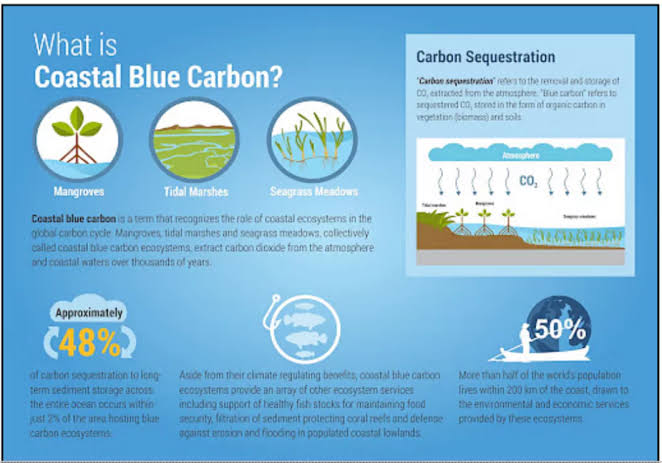
Blue carbon refers to the carbon captured and stored by coastal and marine ecosystems such as mangrove forests, tidal marshes, and seagrass meadows. While these ecosystems sequester carbon at significantly higher rates than terrestrial forests, they remain under-represented in national greenhouse gas accounting frameworks.
Investment in blue carbon projects is increasingly seen as a way to bridge the climate financing gap. By generating carbon credits—which companies and governments can purchase to neutralize emissions or meet climate targets—these projects can provide a sustainable revenue stream for restoration and conservation efforts.
However, experts caution that the surge in blue finance must be managed with "blue justice" in mind. The rapid expansion of marine protected areas and carbon credit projects risks marginalizing local communities if they are excluded from decision-making or denied access to traditional fishing and livelihood areas. Consequently, international bodies and ministers are increasingly calling for community-centric, equitable benefit-sharing models that prioritize local ownership and livelihood security.
Official Sources
The international session was organized by the United Nations Economic and Social Commission for Asia and the Pacific (ESCAP) in collaboration with international stakeholders. The discussion featured high-level delegations, including environment ministers from Pakistan and the Maldives, as well as ESCAP Executive Secretary Armida Salsiah Alisjahbana.
Why It Matters
For India and its neighbors, the integration of blue carbon into national climate policies offers a dual advantage: it serves as a powerful nature-based solution to mitigate global warming while simultaneously enhancing coastal resilience. By treating coastal wetlands as strategic national infrastructure, countries can secure more robust climate funding, protect millions from displacement, and create alternative, sustainable livelihoods for those living on the front lines of the climate crisis.
Key Facts at a Glance
Economic Impact: Cyclones cause an average annual loss of about US$ 1 billion in Bangladesh, highlighting the urgency of coastal protection.
Climate Migration: Nearly 13.3 million people in Bangladesh are at risk of internal displacement by 2050 due to climate impacts.
Regional Collaboration: Ministers are pushing for unified carbon measurement methods and regional carbon markets to better leverage blue carbon potential.
Natural Defense: Mangroves store 3–5 times more carbon per hectare than tropical forests and serve as essential barriers against storm surges.
FAQ
What is blue carbon finance?
Blue carbon finance involves channeling capital—often through carbon credits—into the protection and restoration of coastal ecosystems like mangroves and seagrasses, which are highly efficient at storing carbon.
Why is regional cooperation necessary?
Because coastal ecosystems like the Bay of Bengal are interconnected, standardized data and shared carbon markets allow for more effective climate mitigation and disaster risk reduction across borders.
How does this protect coastal communities?
Beyond carbon sequestration, these ecosystems provide flood resilience, filter water, support fisheries, and offer natural protection against extreme weather events like cyclones.
Source: Bangladesh Sangbad Sangstha (BSS), United Nations ESCAP, Dakshin Foundation