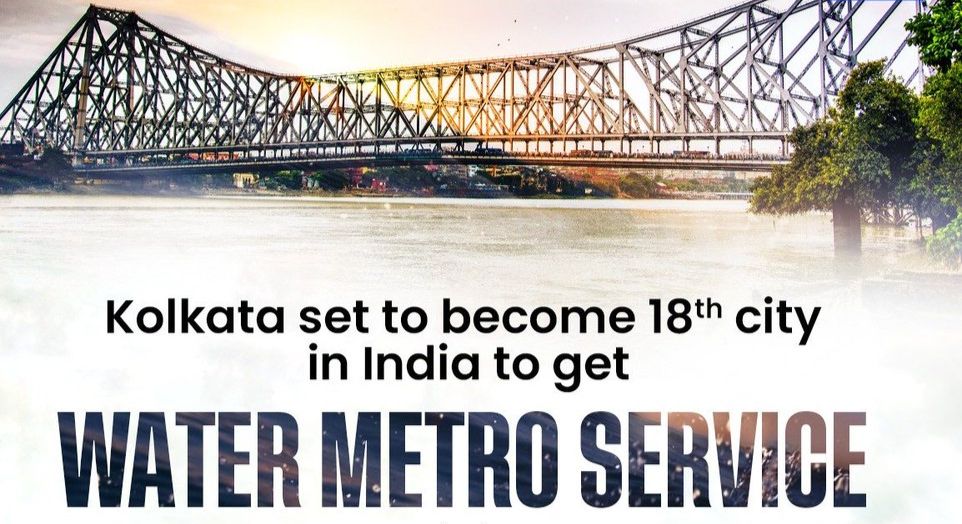
West Bengal Chief Minister Suvendu Adhikari announced that Kolkata will officially join India's national water metro network as its 18th member. Backed by a ₹22,700 crore Sagarmala 2 maritime blueprint, the clean transport project includes building 44 new jetties and deploying a modern fleet of battery-powered hybrid vessels along the Hooghly.
KOLKATA — In a major development for urban public transit, Kolkata is officially set to integrate into India's expanding nationwide water metro network. West Bengal Chief Minister Suvendu Adhikari announced on Thursday, June 4, 2026, that the historic riverine metropolis has secured regulatory clearance to become the 18th city in India to deploy this state-of-the-art water-based mass rapid transit system.
The announcement followed a high-level bilateral infrastructure review meeting between state leadership and the Union Minister for Ports, Shipping, and Waterways, Sarbananda Sonowal. The unified transit upgrade is anchored by an ambitious structural layout that includes the construction of 44 new jetties spanning the banks of the Hooghly River.
This infrastructure overhaul marks West Bengal’s formal entry into the central government's newly enacted Sagarmala 2 infrastructure program, unlocking a massive ₹22,700 crore maritime and coastal development pipeline over the next five years.
Technical Specifications: Battery Fleets to Replace Legacy Ferries
According to internal project criteria reviewed under the newly drafted National Water Metro Policy 2026, the Kolkata Water Metro network will radically modernize public ferry transport across the region. The system is designed to gradually phase out aging, carbon-heavy diesel launches in favor of fully air-conditioned, low-emission, battery-powered electric and hybrid vessels.
The state development desk indicated that the new vessels will feature standard capacities ranging from 50 to 100 passengers per boat. The interior cabins are being designed with modern seating and ergonomic layouts that match existing subterranean metro rail coaches.
Crucially, the vessels will operate on highly efficient electric propulsion systems, drawing power from specialized fast-charging land banks. They will also carry integrated backup diesel generators exclusively reserved for mid-river emergencies or power grid drops.
Expanding Infrastructure: 44 New Jetties Receive Crucial Approvals
To support the deployment of the hybrid fleet, the state is moving ahead with extensive civil infrastructure works along the riverbanks. Chief Minister Adhikari confirmed that the Syama Prasad Mookerjee Port Trust (SMPT) has already cleared the vast majority of required technical approvals, issuing 41 No-Objection Certificates (NOCs) for the proposed riverfront terminals, with the final three clearances currently undergoing fast-tracked review.
Alongside constructing 44 new jetties, the state transport division is launching a comprehensive renovation and beautification program targeting seven historic ghats along the Hooghly corridor:
Baghbazar Ghat
Sovabazar Ghat
Babughat
Ahiritola Ghat
Mullick Ghat
Ramkrishna Ghat
Bandha Ghat
State officials stated that the initial phase of riverfront and terminal restoration is on track to wrap up before the autumn Durga Puja festival, offering immediate congestion relief to commuters.
Macroeconomic Impact on Urban Congestion and Logistics
The transition to a coordinated water metro project alters daily logistics for millions of daily commuters moving between Kolkata and the neighboring industrial hub of Howrah. By moving a significant portion of cross-river passenger traffic off major bridges, the municipal administration expects a measurable reduction in road traffic jams during morning and evening rush hours.
Furthermore, because these aquatic networks utilize natural, existing water channels, they require significantly lower capital layout and land acquisition footprints compared to traditional elevated rail lines or highways.
Funding for the multi-billion-rupee enterprise will be shared systematically between central and state allocations, with the Ministry of Ports, Shipping, and Waterways opening up distinct operations to public-private partnerships (PPP) for long-term commercial terminal maintenance.
Official Sources Section
The infrastructure timelines, budget figures, vessel specifications, and regulatory approvals highlighted in this news report are drawn from official press briefings hosted at the West Bengal State Secretariat, statutory administrative notifications published by the Ministry of Ports, Shipping, and Waterways, and operational feasibility logs managed by the Syama Prasad Mookerjee Port Trust.
Why It Matters
Bringing the Water Metro network to Kolkata offers massive practical benefits for local daily commuters, regional businesses, and environmental planners. Traveling via efficient, battery-powered electric ferries allows passengers to completely bypass congested roadways and bridge traffic jams, significantly reducing daily travel times between Howrah and Kolkata. On a macro level, transitioning to green propulsion systems directly supports lower municipal carbon outputs, providing a clean, scalable alternative to traditional fossil-fuel transit methods.
Key Facts at a Glance
18th Water Metro Hub: Kolkata officially joins India's nationwide water metro network, following previous Phase 1 rollouts in cities like Kochi and Guwahati.
Massive Jetty Rollout: The state has finalized a deployment footprint for 44 new jetties, securing 41 immediate NOCs from the regional port trust.
Green Fleet Transition: The system replaces older, polluting diesel ferries with high-tech, battery-powered hybrid vessels featuring full climate control.
Capital Infusion: The project forms a central part of a broader five-year, ₹22,700 crore Sagarmala 2 maritime proposal.
Ghat Restorations: Structural beautification and engineering repairs are underway across seven historic Hooghly riverfront ghats.
FAQ Section
1. When will the Kolkata Water Metro begin regular passenger operations?
Initial riverfront terminal modifications and historic ghat restorations are scheduled to conclude ahead of the autumn Durga Puja festival, with the first phase of hybrid vessel trials expected shortly after detailed project reports are finalized.
2. How do these new water metro vessels differ from existing river ferries?
The legacy wooden and steel ferries running along the Hooghly rely on traditional, high-emission diesel engines. The upcoming water metro fleet will feature air-conditioned, fully accessible, battery-powered vessels modeled after modern transit coaches.
3. Will the water metro system operate during heavy monsoon rains or low tides?
Yes. The hybrid vessels utilize advanced navigational aids and automated propulsion controls engineered to safely handle tidal shifts and heavy rains, ensuring consistent year-round schedules.
4. Who is funding the construction of the 44 new jetties and terminals?
Funding will follow a shared structure between the Central Government and the West Bengal State Government under the Sagarmala 2 program, with opportunities for public-private partnerships across terminal amenities and fast-charging docks.
Source: Official infrastructure briefings from the West Bengal State Secretariat; regulatory data repositories at the Syama Prasad Mookerjee Port Trust; and National Water Metro Policy frameworks distributed via the Press Information Bureau (PIB), Delhi.