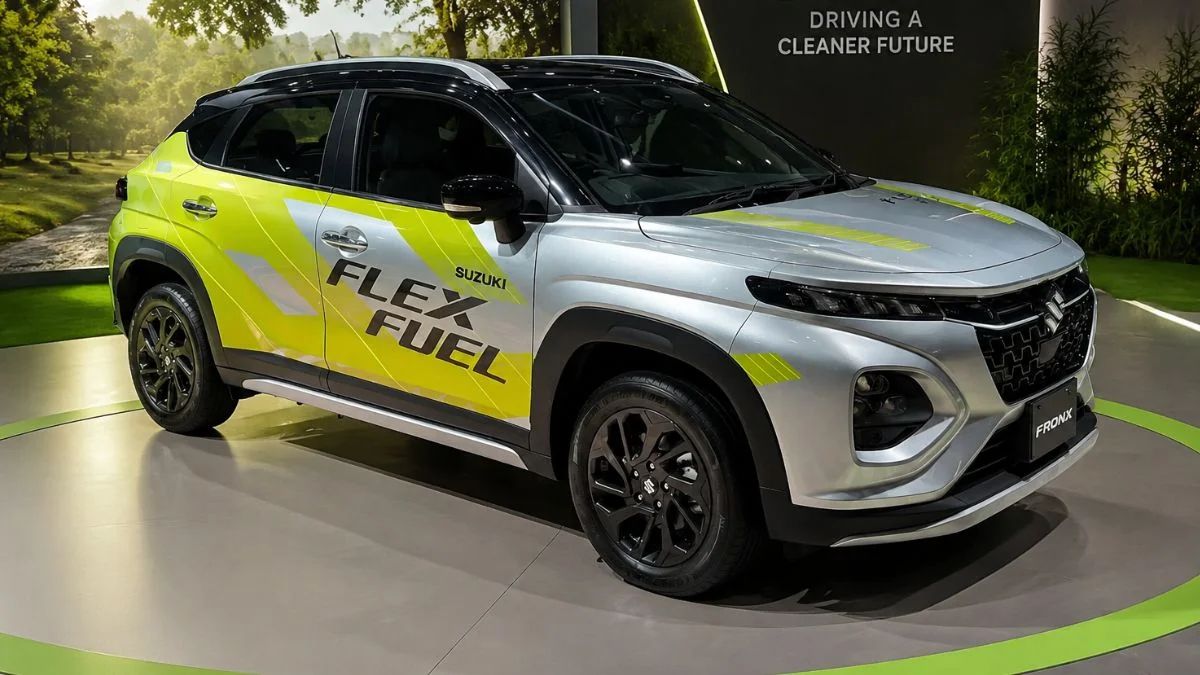
Maruti Suzuki has launched India's first flexible-fuel passenger car, a specialized variant of the WagonR. Built to operate on any fuel blend up to 100% ethanol, the re-engineered hatchback supports India's strategic push to lower crude oil imports, reduce carbon emissions, and strengthen rural agricultural economies.
NEW DELHI — Driving a fundamental shift in the country's alternative energy landscape, Maruti Suzuki India Limited has officially launched the nation's first mass-market flexible-fuel passenger vehicle. Unveiled in the national capital, the specialized Maruti Suzuki Flex-Fuel WagonR represents a critical technological milestone, engineered to operate seamlessly on any ethanol-petrol blend ranging from standard E20 up to 100% ethanol (E100).
The high-profile commercial launch was attended by Union Minister for Road Transport and Highways Nitin Gadkari and Minister for Petroleum and Natural Gas Hardeep Singh Puri. The debut of this production-ready hatchback effectively resolves a long-standing "chicken-and-egg" dilemma in India's automotive sector, establishing the hardware baseline necessary to spark large-scale domestic biofuel infrastructure investment.
Technical Innovation: Re-Engineering for Corrosive Fuels
According to official engineering dossiers released by Maruti Suzuki India Limited, the Maruti Suzuki Flex-Fuel WagonR features extensive structural revisions over its standard petrol counterpart. Because alcohol is highly corrosive and naturally absorbs ambient moisture, engineers had to redesign the entire fuel delivery pathway to protect internal components from premature degradation.
The vehicle is powered by a specially modified 1.2-litre, four-cylinder K12N naturally aspirated engine. To safely manage high ethanol concentrations, the power plant integrates:
Corrosion-resistant fuel pumps, specialized fuel injectors, and reinforced rubber fuel lines.
An advanced Electronic Control Unit (ECU) paired with smart fuel-mix sensors that continuously assess the exact ratio of ethanol in the tank.
Automated, real-time adjustments to ignition timing and fuel injection parameters to maintain optimal engine performance across varying blends.
While the hatchback has been formally homologated to run on E85 standards (85% ethanol, 15% petrol) to match current Bureau of Indian Standards (BIS) fuel provisions, the underlying powertrain is fully capable of running on pure, 100% ethanol once retail stations update their pumps.
Economic Alignment: From "Annadatas" to "Urjadatas"
The deployment of 100% ethanol vehicles aligns closely with the central government's macroeconomic goals of reducing expensive fossil fuel imports and curbing carbon emissions. India currently relies on foreign markets to fulfill roughly 87% of its domestic crude oil demand, draining valuable foreign exchange reserves.
Speaking at the launch event, Petroleum Minister Hardeep Singh Puri highlighted that increasing ethanol blending from a baseline of 1.5% in 2014 to the current E20 standard has successfully substituted 302 lakh metric tonnes of imported crude oil. This shift has saved India an estimated Rs 1.84 lakh crore in foreign exchange.
Minister Nitin Gadkari emphasized that shifting consumption toward agricultural biofuels directly supports local farming communities. By sourcing ethanol from domestic feedstocks like sugarcane, maize, and surplus rice, the automotive sector transfers energy spending away from foreign oil syndicates and funnels it back into rural economies, effectively transforming farmers from food producers (annadatas) into energy producers (urjadatas).
Retail Rollout Roadmap for High-Blend Fuel
To ensure the commercial viability of the Maruti Suzuki Flex-Fuel WagonR, the Ministry of Petroleum and Natural Gas announced a phased retail network deployment strategy to make high-blend fuel accessible to early adopters.
The government's infrastructure roadmap outlines clear regional milestones:
| Phase | Target Outlets | Regional Distribution Focus | Timeline |
| Phase 1 | 50 – 100 Pumps | Delhi-NCR and Mumbai–Pune–Nagpur Transport Corridors | Immediate |
| Phase 2 | 500 Pumps | Major Tier-1 Capital Cities and Agricultural Belts | December 2026 |
| Phase 3 | 5,000 Pumps | Nationwide Urban and Semi-Urban Networks | December 2027 |
Furthermore, NITI Aayog has formally classified high-blend ethanol vehicles as Zero-Emission Vehicles (ZEVs) because they generate near-zero particulate matter (PM) emissions. The government is also considering supportive policies to lower upfront ownership costs, including state road tax concessions and subsidized retail fuel pricing models.
Official Sources Section
The manufacturing specifications, historical import data, regulatory classifications, and fuel station rollouts detailed in this report are sourced directly from corporate launch briefings from Maruti Suzuki India Limited, official joint ministerial communiqués from the Ministry of Road Transport and Highways, and clean air transport guidelines published by NITI Aayog.
Quote Section
"At Maruti Suzuki, we are committed to offering cars with multiple technologies and fuels. Once it reaches mainstream adoption, flex-fuel vehicles have the potential to cut oil imports, carbon emissions, and local air pollution while enhancing domestic value addition and farmer incomes."
— Hisashi Takeuchi, Managing Director & CEO, Maruti Suzuki India
Why It Matters
The rollout of the Maruti Suzuki Flex-Fuel WagonR offers practical benefits for everyday commuters, automotive suppliers, and agricultural producers alike. Vehicle owners gain a versatile transportation option that can adjust to different fuel blends based on what is available and cost-effective at the pump. For the broader automotive market, it establishes a secondary pathway toward low-carbon transportation alongside electric vehicles, making excellent use of India's existing internal combustion manufacturing setup while supporting local biofuel supply chains.
Key Facts at a Glance
First Passenger Car: Maruti Suzuki launches India's first mass-market flex-fuel car with the production-ready WagonR.
Complete Flexibility: The re-engineered K12N engine can run smoothly on any fuel combination from E20 up to 100% ethanol (E100).
Infrastructure Targets: The government plans to expand specialized high-blend fuel dispensing stations to 5,000 locations by late 2027.
Zero-Emission Status: NITI Aayog formally classifies high-blend ethanol vehicles as zero-emission alternatives due to a massive drop in particulate matter.
Economic Impact: Shifting toward biofuels has already helped India conserve Rs 1.84 lakh crore in foreign exchange by substituting imported crude oil.
FAQ Section
1. Can I fill up a standard petrol WagonR with 100% ethanol?
No. Standard internal combustion engines are not built to handle high concentrations of alcohol. Running pure ethanol in a conventional car will corrode fuel pumps, degrade rubber lines, and trigger severe engine misfires due to incorrect ignition timing.
2. How does the price of the Flex-Fuel WagonR compare to the standard version?
Because it requires upgraded, corrosion-resistant components and smart electronic sensors, the flex-fuel version is expected to carry a price premium of approximately Rs 40,000 to Rs 50,000 over standard petrol and CNG models.
3. Does running a car on E85 or E100 fuel lower its fuel efficiency?
Yes. Ethanol has roughly 33% lower energy density than pure petrol, which translates to a 15% to 25% reduction in overall mileage. To balance this out, the government intends to price high-blend ethanol significantly lower than standard petrol to ensure drivers save money per kilometer.
4. When will E85 or E100 fuel be widely available at regular gas stations?
The retail expansion starts with a pilot network of 50 to 100 stations across Delhi-NCR and the Mumbai–Pune–Nagpur corridors, with a target to scale up to 5,000 active pumps across major cities by the end of 2027.
Source: Maruti Suzuki Investor Disclosures, Ministry of Petroleum and Natural Gas Portal, and official policy briefs from the Society of Indian Automobile Manufacturers (SIAM).