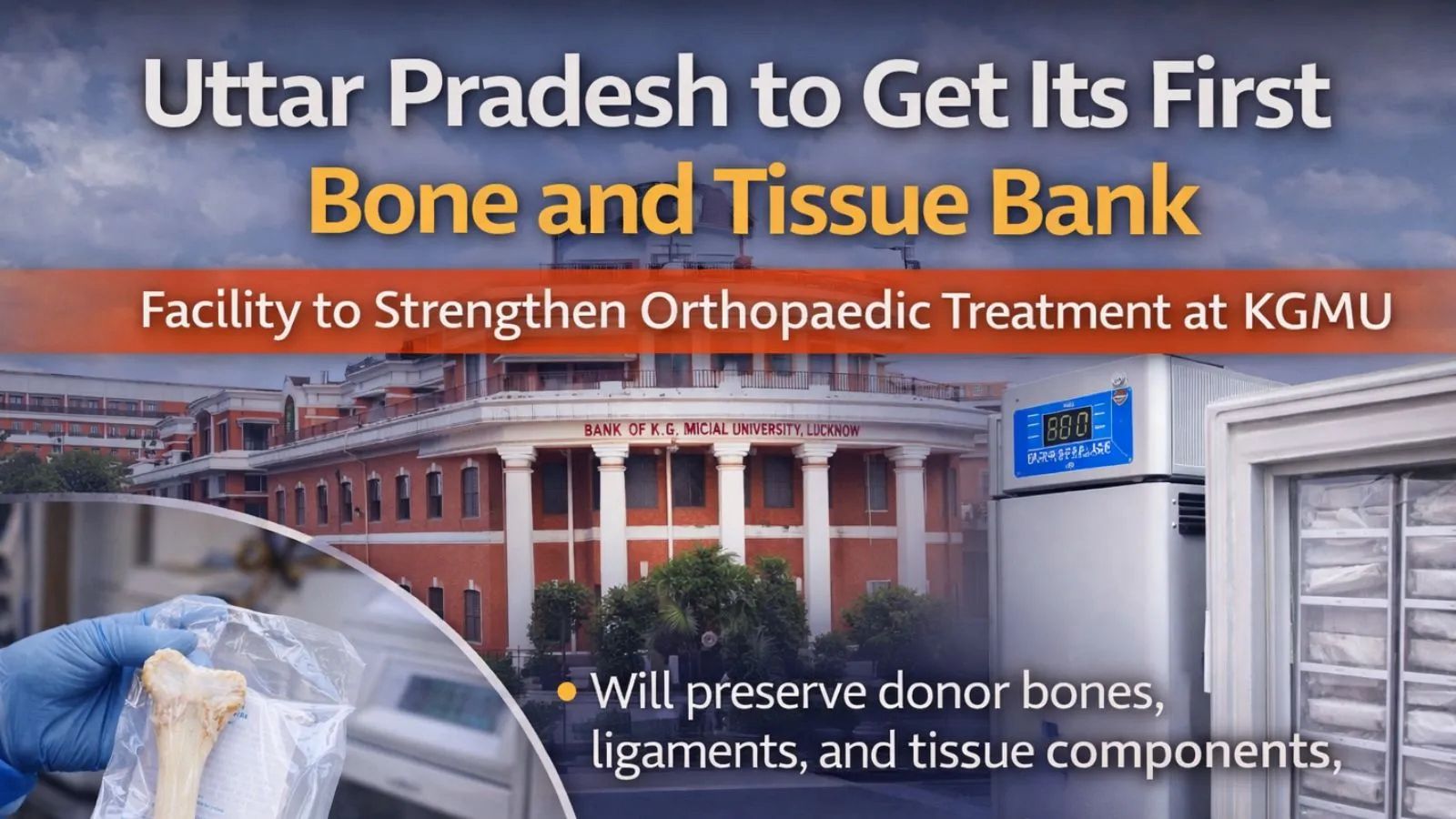
King George's Medical University has inaugurated Uttar Pradesh's first comprehensive bone and tissue bank in Lucknow. Developed by the orthopaedics department, the facility will handle retrieval, processing, and preservation of musculoskeletal grafts to support complex trauma, tumor reconstructions, and sports injury surgeries across the state.
King George's Medical University establishes an advanced facility in Lucknow to streamline musculoskeletal tissue preservation and empower complex reconstructive surgeries.
In a major milestone for regional healthcare infrastructure, King George's Medical University (KGMU) inaugurated Uttar Pradesh's first comprehensive bone and tissue bank in Lucknow on Monday, August 3, 2026. Developed under the aegis of the department of orthopaedics, the newly established facility is engineered to manage the complete lifecycle of musculoskeletal biological grafts—including retrieval, processing, preservation, storage, and distribution. Operating out of the state capital, the center aims to eliminate logistical hurdles in procuring quality-assured allografts, directly supporting critical medical interventions ranging from trauma reconstruction to oncological limb salvage procedures.
Technical Infrastructure and Scope of Grafts
Equipped with specialized laboratory hardware, the facility features certified clean rooms, sterile processing workstations, high-capacity lyophilizers for freeze-drying tissues, and ultra-low temperature storage units. Every stored biological sample undergoes stringent microbiological screening to ensure absolute patient safety.
Key operational metrics and structural attributes of the facility include:
Comprehensive Range of Grafts: The bank handles bone allografts, tendons, ligaments, and other essential musculoskeletal tissues.
Advanced Storage Standards: Infrastructure incorporates deep freezers operating at -40°C alongside ultra-low temperature freezers reaching -80°C for long-term preservation.
Traceability Protocol: Every processed graft is assigned a unique Bone Bank ID, ensuring end-to-end tracking from the initial donor screening phase to the final surgical recipient.
Multi-Specialty Integration: Beyond orthopaedics, the bank provides critical support to plastic surgery, neurosurgery, oral and maxillofacial surgery, oncology, and burn reconstruction units.
Impact on Patients, Surgeons, and Regional Healthcare
For patients suffering from severe bone tumors, revision joint replacements, complex spinal disorders, or traumatic skeletal injuries, local access to certified biological grafts drastically reduces surgical delays. Historically, hospitals across Uttar Pradesh relied on external tissue procurement agencies, often resulting in extended waiting lists. By establishing an in-house, self-reliant repository, KGMU enhances clinical outcomes, reduces treatment costs, and fosters advanced medical research and post-graduate training in tissue banking.
Why It Matters
The establishment of a state-backed bone and tissue bank bridges a critical gap in tertiary medical care. By ensuring a steady, quality-assured supply of biological grafts locally, medical institutions can perform complex life-saving and limb-saving procedures with greater speed and reliability, directly benefiting thousands of patients across northern India.
Key Facts at a Glance
Institution: King George's Medical University (KGMU), Lucknow.
Facility: Uttar Pradesh’s first comprehensive bone and tissue bank.
Core Functions: Retrieval, processing, preservation, and distribution of musculoskeletal allografts.
Target Specialties: Orthopaedics, oncology, plastic surgery, neurosurgery, and sports medicine.
Safety Measure: Unique Bone Bank ID assigned to every graft for complete traceability.
FAQ Section
What is the primary purpose of the newly opened bone and tissue bank at KGMU?
The facility is designed to manage the collection, processing, and preservation of musculoskeletal allografts to support complex orthopaedic, oncological, and reconstructive surgeries.
Which medical departments will benefit from this facility?
While anchored by the orthopaedics department, the bank will supply biological grafts to plastic surgery, neurosurgery, oral and maxillofacial surgery, oncology, and burn reconstruction units.
How does the bank ensure the safety and quality of stored tissue grafts?
Every graft undergoes rigorous donor screening, infection testing, and scientific processing under national guidelines, complete with a unique ID for end-to-end traceability.
Where can patients and medical professionals find more details on KGMU facilities?
Official institutional updates, departmental directories, and clinical service notices are published on the KGMU Official Portal.
Source: Hindustan Times, King George's Medical University Portal