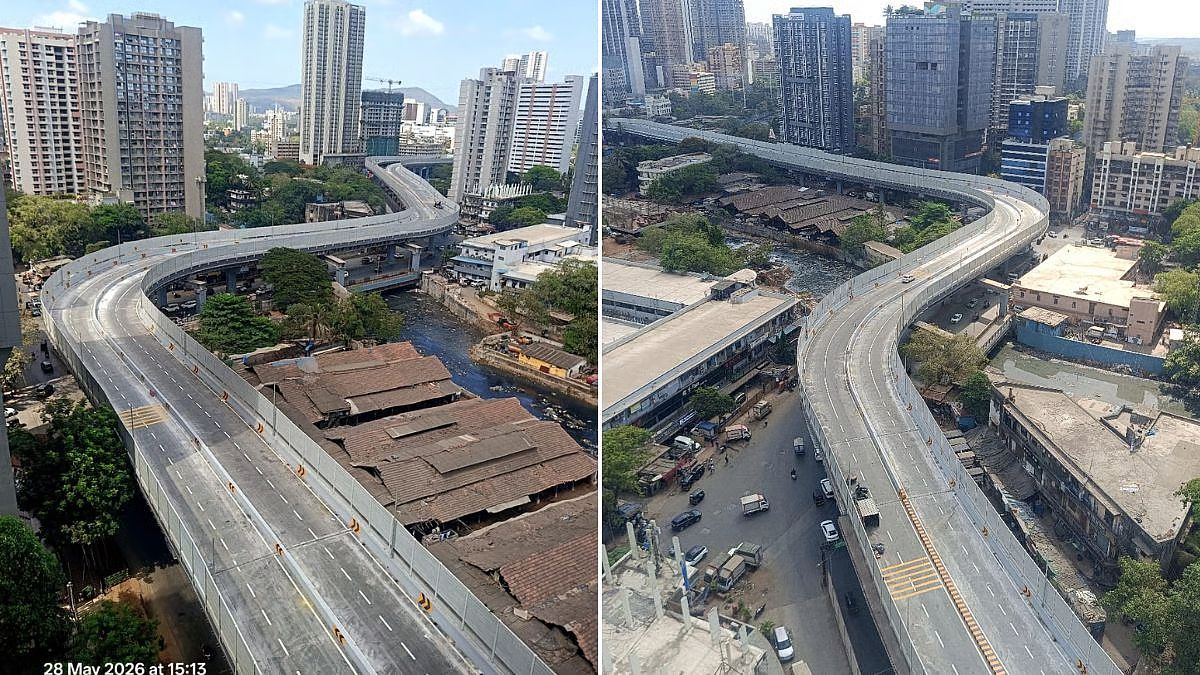
Mumbai Mayor Ritu Tawde has officially opened the long-awaited 750-metre extension of the Mrinal Tai Gore Flyover in Goregaon. Built by the BMC for ₹248 crore, the new four-lane link bypasses major bottlenecks on SV Road, slashing suburban transit times from 45 minutes to just 10 minutes.
MUMBAI — In a major step toward resolving the chronic traffic gridlock that impacts Mumbai's western suburbs, Mumbai Mayor Ritu Tawde officially inaugurated the much-awaited 750-metre extended Mrinal Tai Gore Flyover in Goregaon on Saturday morning, June 6, 2026. Built under the executive supervision of the Brihanmumbai Municipal Corporation (BMC), the newly finished four-lane flyover extension connects Ram Mandir Marg to Relief Road, bypassing some of the most heavily congested bottleneck zones in the area.
The infrastructure development went live for public vehicular traffic by Saturday evening. It provides an immediate structural solution for thousands of daily commuters, cutting peak-hour gridlock travel times down from 45 minutes to a swift 10-minute transit across the corridor.
Technical Architecture and Strategic Connectivity
The newly operational structure is a multi-lane expansion project engineered to bridge the severe cross-suburb connectivity gap in North Mumbai. While the main central span of the original Mrinal Tai Gore Railway Flyover was opened back in 2016, drivers regularly encountered immediate signal bottlenecks upon exiting toward local access roads.
To systematically address this problem, the civic administration implemented a multi-phase integration blueprint:
As part of the structural integration, engineering teams completely demolished and reconstructed the pre-existing bridge over the Walbhat River. The alignment now seamlessly spans across both the Walbhat and Oshiwara rivers, utilizing a 15.50-metre-wide deck that enables smooth, uninterrupted four-lane vehicular split flows.
Overcoming Prolonged Construction and Cost Overruns
The project faced severe logistical constraints and escalating costs between its initial design phase and final structural completion. Administrative sanction was granted in 2018, and construction officially commenced on March 22, 2019, under a joint venture managed by MEPL-Gyan. While municipal records originally targeted a 24-month completion window, a series of structural and global disruptions heavily extended the development timeline.
According to data presented in municipal review updates, the infrastructure expansion required ongoing budgetary adjustments due to unexpected engineering hurdles:
| Project Planning Stage | Estimated Project Budget | Status/Timeline Impacts |
| Initial Administrative Estimates (2018) | ₹209 Crore | Baseline Engineering Framework |
| Revised Municipal Proposal (2023) | ₹240 Crore | Covid-19 Extensions & Labor Halts |
| Final Project Capital Wrap-up (2026) | ₹248 Crore | Demolition Realignment & Completion |
Civic representatives clarified that securing mandatory police traffic permissions in the densely populated area proved highly complex. Furthermore, the final alignment length and landing designs had to be modified midway via General Arrangement Drawings (GAD) to accommodate safety adjustments requested by local resident forums.
Civic Accountability, Penalties, and Political Response
The extended delays leading up to the June 2026 completion drew sharp scrutiny from both civic oversight committees and political groups. Due to missed operational deadlines, the BMC enforced strict daily financial penalties against the contractor. The penalty framework started at ₹25,000 per day on May 1 and escalated sharply to ₹1,000,000 per day from May 12 until final project handover.
The quality of the execution has also drawn early political debate. While members of the ruling administration celebrated the launch as a milestone for suburban advancement, opposition figures raised early warnings regarding the pavement finishing.
Shiv Sena (UBT) MLA Aaditya Thackeray voiced concerns regarding the top-layer quality on social media. Concurrently, Mumbai Congress President Varsha Gaikwad questioned the immediate presence of pavement patchwork on a newly opened asset, warning that the stretch could experience rapid deterioration during the upcoming monsoon rains.
Official Sources Section
The infrastructure metrics, construction timelines, budgetary cost data, and municipal penalties outlined in this report are compiled from official project logs, corporate disclosures from the MEPL-Gyan joint venture, and formal development briefs published by the Brihanmumbai Municipal Corporation.
Quote Section
"The extension to the flyover is expected to ease traffic congestion in Goregaon, including on Swami Vivekanand Marg and surrounding areas. The 750-metre-long flyover extension will improve travel time from the earlier 45 minutes to 10 minutes. Care should be taken henceforth that no project work is delayed, and projects must be completed within fixed costs."
— Ritu Tawde, Mumbai Mayor
Why It Matters
The completion of the extended Mrinal Tai Gore Flyover marks a vital upgrade for Mumbai's transport infrastructure. For years, commuters trying to move east-to-west across Goregaon were trapped in bottlenecked junctions along Swami Vivekanand (SV) Road and Link Road, directly lowering daily productivity and driving up fuel waste.
By bypassing three of the worst traffic signals in the western suburbs, this corridor establishes a direct, high-capacity connection between the Western Express Highway (WEH) and local residential neighborhoods. Local urban planners note that this reduced congestion is already improving transit accessibility, which is expected to drive fresh commercial and residential real estate interest in Goregaon.
Key Facts at a Glance
Official Launch: Mumbai Mayor Ritu Tawde inaugurated the 750-metre long four-lane extension of the Mrinal Tai Gore Flyover on June 6, 2026.
Commute Optimization: Peak transit times across the crowded suburban corridor have dropped dramatically from 45 minutes down to 10 minutes.
Financial Scope: Originally budgeted at ₹209 crore in 2018, unexpected technical hurdles and pandemic delays pushed the final project cost to ₹248 crore.
Contract Revisions: The project was executed by the MEPL-Gyan joint venture and included the complete demolition and rebuild of the Walbhat River bridge.
Enforced Penalties: Following repeated construction delays, the BMC levied daily performance penalties on the contractor, which peaked at ₹1,000,000 per day in May.
FAQ Section
1. Where exactly is the new Mrinal Tai Gore Flyover extension located?
The newly opened 750-metre extension is located in Goregaon West, creating a direct four-lane road connection between Ram Mandir Marg and Relief Road.
2. How much travel time will the new flyover extension save?
According to official municipal traffic assessments, the extension allows drivers to completely skip three major traffic signals on SV Road, dropping travel times from 45 minutes down to 10 minutes.
3. Why did the flyover extension take so long to complete?
Construction began in March 2019 but faced extended delays due to pandemic-related labor shortages, dense local traffic conditions, and mid-project design changes to rebuild the Walbhat River crossing.
4. What safety and community features are built into the bridge?
The BMC integrated four distinct lanes, updated pedestrian pathways, high-visibility directional signage, and modern noise-reduction barriers along the outer walls to shield neighboring residential buildings from traffic roar.
Source: Brihanmumbai Municipal Corporation Project Portal; Mumbai Municipal Commissioner’s Office; Maharashtra Ministry of Urban Development Infrastructure Archive.