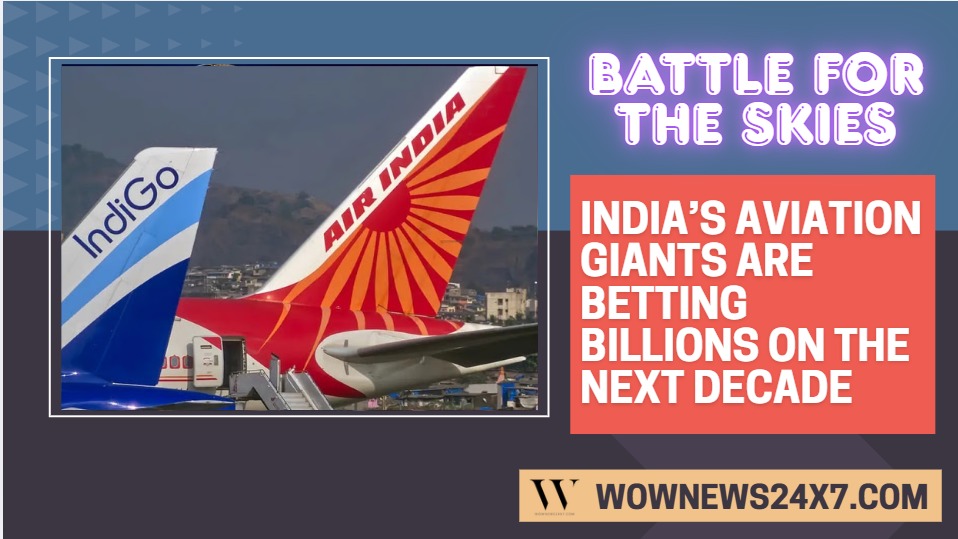
IndiGo and Air India are aggressively charting their ten-year growth strategies to capture surging domestic and international travel demand. While IndiGo accelerates its 600-aircraft fleet expansion, Air India continues its complex multi-year transformation, both balancing massive capital investments against fuel volatility and emerging competitive pressures across Indian skies.
India's leading aviation giants chart their ten-year expansion strategies to capture exponential domestic and international travel demand amid shifting market dynamics.
NEW DELHI — As India solidifies its position as one of the world's fastest-growing aviation markets, dominant carriers IndiGo and the Air India Group are aggressively mapping out their ten-year strategic roadmaps. Together controlling roughly 90 percent of domestic skies, both airline heavyweights are investing heavily in fleet expansion, digital architecture, and global network connectivity. However, this long-term planning unfolds against an evolving competitive landscape characterized by contrasting corporate trajectories and the looming presence of emerging sector challengers.
The strategic blueprint comes at a critical juncture for the subcontinent's transportation sector. With national passenger traffic projected to scale significantly over the coming decades and commercial fleets expanding to meet rising middle-class aspirations, corporate leadership teams are positioning themselves to dominate both domestic trunk routes and lucrative international long-haul corridors.
Fleet Scaling and Global Network Expansion
According to official corporate updates and regulatory filings from InterGlobe Aviation (IndiGo), the market leader is pressing forward with one of the largest aircraft procurement pipelines in global aviation history. IndiGo's strategic plan targets a massive fleet expansion toward a 600-aircraft milestone by 2030, aiming to push international deployment up to 40 percent of its total seat capacity using new long-haul assets like the Airbus A321XLR and A350.
Simultaneously, the Tata Group-backed Air India is navigating a complex, multi-year transformation program. Despite absorbing substantial financial headwinds and executing a massive record-order book of 470 aircraft, Air India's long-term strategy focuses on fleet renewal, comprehensive service transformation, and upgrading legacy operational infrastructure to cement its status as a premier full-service global carrier.
Market Dynamics, Challenges, and Emerging Competition
The strategic maneuvering highlights a growing structural divergence in the domestic market. While IndiGo continues to command over 60 percent of domestic market share, Air India has faced persistent operational hurdles, supply chain bottlenecks, and geopolitical disruptions that have temporarily constrained its capacity growth. Tata Sons leadership has candidly noted that turning around Air India is a complex 5-to-10-year journey.
Meanwhile, agile mid-tier operators such as Akasa Air are steadily expanding their footprints, prompting industry analysts to monitor whether the current duopoly could gradually transition into a more contested three-way market structure. Fleet efficiency, fuel price volatility, and foreign exchange fluctuations remain critical variables influencing both carriers' operational margins.
Impact on Travelers, Businesses, and Investors
For millions of air travelers, the fierce competition between IndiGo and Air India translates into broader route selections, enhanced digital booking experiences, and upgraded cabin offerings—including IndiGo's nascent push into business-class configurations. However, passengers also face localized fare pressures during peak travel seasons when capacity adjustments occur.
For institutional investors and aviation stakeholders, the decade-long capital expenditure cycles require careful evaluation of balance sheet resilience. While long-term traffic fundamentals remain robust, near-term profitability remains sensitive to aviation turbine fuel (ATF) pricing and currency movements.
Official Sources Section
Information regarding airline fleet projections, strategic roadmaps, and traffic data is derived from official corporate communications, regulatory filings, and market briefings published by InterGlobe Aviation (IndiGo), the Tata Group, and the Directorate General of Civil Aviation (DGCA).
"According to officials and corporate statements, the next decade will demand disciplined capital allocation, robust technological integration, and agile operational execution to capture the full potential of India's surging travel demand."
Why It Matters
As India's commercial aviation sector scales toward supporting over a billion passengers in the coming decades, the strategic choices made by IndiGo and Air India will define global connectivity, national economic integration, and regional travel costs. Understanding these long-term maneuvers offers vital insight into how major industrial players adapt to structural market shifts.
Key Facts at a Glance
Market Leaders: IndiGo and Air India Group collectively control approximately 90 percent of India's domestic aviation market.
Fleet Milestones: IndiGo is targeting a 600-aircraft strong fleet by 2030, significantly increasing its international route capacity.
Transformation Timeline: Tata Sons leadership notes that Air India's comprehensive turnaround is structured as a 5-to-10-year enterprise.
Long-Term Projections: Indian commercial passenger traffic and airport infrastructure are projected to expand exponentially through 2040.
Frequently Asked Questions
What are the primary growth targets for IndiGo over the next decade?
IndiGo aims to scale its fleet toward 600 aircraft by 2030 and expand international seat capacity allocation up to 40 percent using new widebody and long-range narrowbody aircraft.
How is Air India approaching its long-term strategy?
Air India is executing a multi-year transformation plan focused on fleet renewal, service upgrades, technical training, and network restructuring backed by a massive aircraft order book.
What challenges are impacting the Indian aviation sector currently?
Airlines continue to navigate external headwinds, including volatile aviation turbine fuel prices, foreign exchange fluctuations, regional airspace pressures, and supply chain component delays.
Where can official aviation statistics and regulatory updates be accessed?
Official traffic data, safety regulations, and market share reports are published regularly by the Directorate General of Civil Aviation (DGCA).
Source: InterGlobe Aviation (IndiGo), Tata Group, Directorate General of Civil Aviation (DGCA)