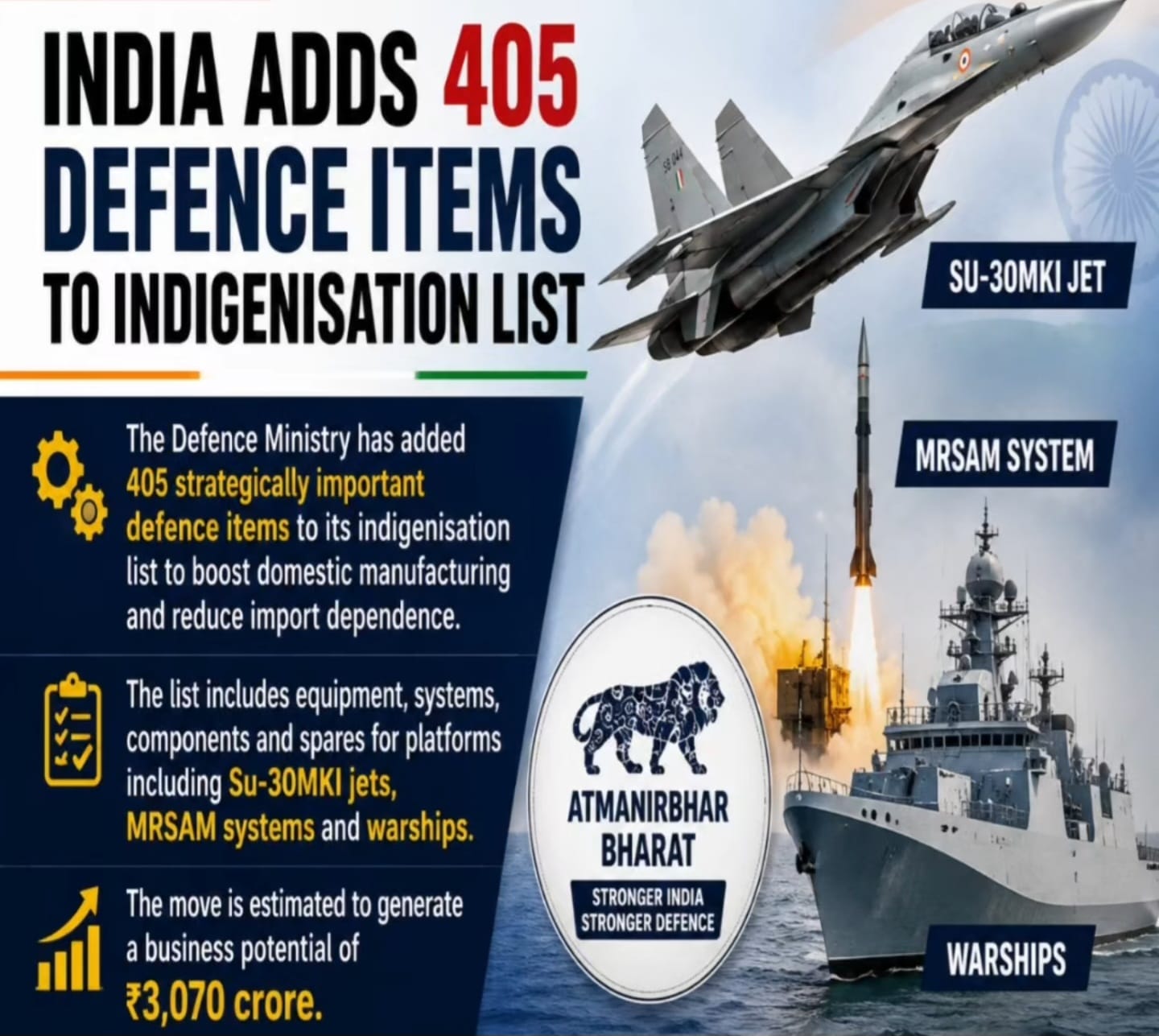
The Ministry of Defence has notified its sixth Positive Indigenisation List covering 405 items with a business potential of ₹3,070 crore. The move mandates local sourcing for helicopter, tank, jet, and missile components to bolster domestic manufacturing under the Aatmanirbhar Bharat initiative.
NEW DELHI — The Ministry of Defence notified its sixth Positive Indigenisation List comprising 405 strategically important defence items, creating an estimated business potential of ₹3,070 crore for domestic manufacturers under the Aatmanirbhar Bharat initiative.
The announcement expands opportunities for private firms, micro, small, and medium enterprises (MSMEs), and research entities to manufacture sub-systems, assemblies, and raw materials locally rather than procuring them abroad.
Details of the Sixth Positive Indigenisation List
Issued by the Department of Defence Production (DDP), the sixth Positive Indigenisation List (PIL) targets critical elements across the defence supply chain. Out of the 405 notified items, 389 belong to Defence Public Sector Undertakings (DPSUs), while 16 are designated for the Indian Coast Guard (ICG).
The notification spans multiple operational domains and includes components for high-profile platforms:
Aviation Platforms: Components and Line Replaceable Units (LRUs) for the Su-30MKI, Light Combat Aircraft (LCA) Tejas, Advanced Light Helicopter (ALH), Light Utility Helicopter (LUH), Chetak, Cheetah, and AL-31FP engine assemblies.
Armoured Fighting Vehicles: Critical spares and assemblies for main battle tanks including the T-72, T-90, and BMP-II infantry combat vehicles.
Missiles and Ammunition: Sub-assemblies for Konkurs-M, Invar, and Medium Range Surface-to-Air Missile (MRSAM) systems, along with High Explosive Anti-Tank (HEAT) ammunition.
Defence Electronics: Fire control systems, radars, sonars, and satellite communication equipment.
Each listed item features a distinct indicative indigenisation timeline, after which open imports will be phased out and procurement routed exclusively to domestic suppliers.
| Feature Category | Sixth Positive Indigenisation List Details |
| Total Notified Items | 405 items |
| Breakdown by Entity | 389 items (DPSUs), 16 items (Indian Coast Guard) |
| Estimated Business Value | ₹3,070 Crore |
| Item Classifications | LRUs, sub-systems, spares, raw materials, components |
| Issuing Authority | Department of Defence Production, Ministry of Defence |
Official Sources Section
According to official releases from the Department of Defence Production and notifications published on the official Ministry of Defence portal, the decision is designed to boost domestic research, development, and production capacity.
Official data highlights that previous indigenisation efforts have already yielded significant outcomes:
Over 33,000 defence items have been offered to domestic industry through the SRIJAN Defence Portal
More than 15,700 items have been successfully indigenised over the past five years.
Import substitution value generated from indigenised items stands at approximately ₹9,000 crore.
DPSUs have issued procurement orders worth roughly ₹10,000 crore to domestic vendors up to March.
Strategic Impact and Quotes
Regarding the implementation of the sixth list, Union Defence Minister Rajnath Singh highlighted that the measure deepens domestic supply chains while lowering import dependencies.
According to officials from the Ministry of Defence:
"The sixth Positive Indigenisation List marks another step in the government's efforts to promote self-reliance in defence manufacturing under the Aatmanirbhar Bharat initiative. It is expected to further expand opportunities for the Indian industry, strengthen the domestic defence manufacturing ecosystem, promote investment and innovation, and contribute to reducing dependence on imports."
Why It Matters
By imposing phased import bans on specific spares and components, the government creates guaranteed order books for domestic manufacturing firms, encouraging investments in advanced metallurgy, precision engineering, and electronics manufacturing.
For Indian private enterprise and start-ups, the ₹3,070 crore addressable opportunity lowers entry risks in the defence equipment domain while establishing long-term supply relationships with primary defence public undertakings.
Key Facts at a Glance
Scope: 405 items added to the domestic-only procurement list.
Economic Value: Generates a market opportunity worth ₹3,070 crore for Indian companies.
Target Platforms: Covers spares for Su-30MKI, LCA Tejas, T-90 tanks, and naval systems.
Repository: Detailed item specifications and deadlines are hosted on the SRIJAN Defence Portal
Frequently Asked Questions
What is a Positive Indigenisation List in India's defence sector?
A Positive Indigenisation List contains defence items, spares, and sub-systems that Indian armed forces and DPSUs cannot import after set deadlines, requiring them to purchase exclusively from domestic manufacturers.
Which platforms are covered under the sixth Positive Indigenisation List?
It covers components for helicopters (ALH, LUH, Chetak), combat jets (Su-30MKI, LCA Tejas), tanks (T-72, T-90), missile systems (MRSAM, Konkurs-M), and various naval electronics.
Where can domestic suppliers find the specific list of 405 items?
The itemised technical details and indigenisation timelines are accessible via the official SRIJAN Defence Portal operated by the Department of Defence Production.
Source: Press releases and official notifications issued by the Ministry of Defence and published via the Press Information Bureau and SRIJAN Defence Portal.