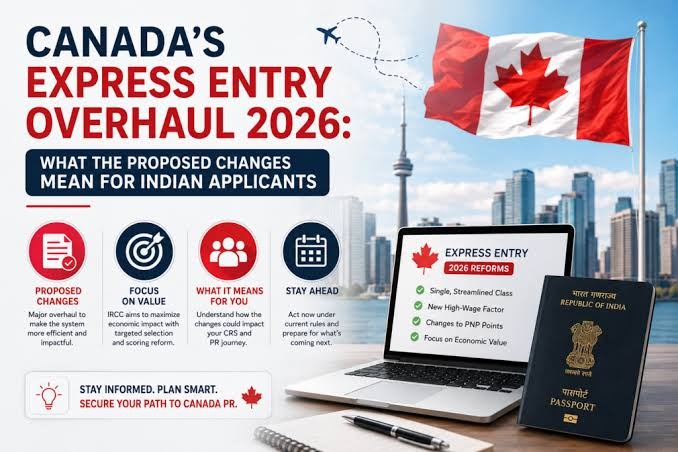
Canada is advancing plans to overhaul its Express Entry migration platform by consolidating legacy streams into a single class. The proposed reforms aim to optimize economic selection and adapt CRS scoring criteria to current labor demands, impacting prospective international applicants navigating the immigration pool in 2026.
Immigration, Refugees and Citizenship Canada proposes a major structural overhaul of the Express Entry immigration system to streamline federal economic classes.
Immigration, Refugees and Citizenship Canada (IRCC) announced significant regulatory proposals under its Forward Regulatory Plan to restructure the country's flagship migration architecture. Aimed at optimizing economic value amid reduced permanent resident targets of 380,000 for 2026, the federal overhaul seeks to replace the three legacy application streams—the Federal Skilled Worker Class, the Canadian Experience Class, and the Federal Skilled Trades Class—with a single, unified immigration class. The modernization effort follows administrative reviews highlighting the need for tighter alignment between Comprehensive Ranking System (CRS) scores and high-wage labor market demands.
Streamlining Federal Streams and CRS Adjustments
The core structural shift involves retiring the separate management silos that have historically governed federal economic applications. Under the proposed framework, all candidates will feed into a simplified, consolidated selection pool governed by updated scoring metrics. IRCC has signaled that adjustments are under consideration for high-wage occupation factors and the longstanding 600-point bonus awarded for provincial nominations, which authorities suggest may be reevaluated to prevent redundancy with targeted category-based selection draws.
According to administrative updates and regulatory documents published by Immigration, Refugees and Citizenship Canada (IRCC), formal consultations regarding category priorities and point weightings are progressing through late 2026. Legal implementation will require formal publication in the Canada Gazette before transitioning active applicant profiles into the new operational software.
Impact on Indian Professionals, Skilled Workers, and Applicants
For prospective applicants across India, the impending platform shift introduces both strategic challenges and potential adjustments. Candidates relying heavily on traditional provincial nomination pathways must monitor shifting criteria, while applicants with established Canadian work experience or high-wage employment offers may benefit from upcoming scoring priorities.
Immigration advisors and trade analysts emphasize that individuals already holding active Invitations to Apply (ITAs) under current rules remain protected, as IRCC has committed to honoring existing invitations. Experts advise applicants currently meeting eligibility criteria to enter the existing pool to secure consideration under active draws while regulatory transitions undergo public consultation.
"According to officials, modernizing the federal selection platform is essential for ensuring that economic immigration categories respond dynamically to shifting domestic labor shortages and productivity benchmarks."
Key Facts at a Glance
Structural Overhaul: IRCC plans to merge three legacy federal programs into a single, unified immigration class.
Scoring Adjustments: Proposed changes evaluate new high-wage employment factors and potential modifications to provincial nomination point allocations.
Immigration Targets: Permanent resident admission goals are adjusted to 380,000 for 2026 to manage temporary and permanent resident volumes.
Regulatory Process: Structural updates require official publication in the Canada Gazette prior to full system implementation.
Frequently Asked Questions
What is changing in Canada's Express Entry system? IRCC has proposed replacing the Federal Skilled Worker, Canadian Experience, and Federal Skilled Trades classes with a single streamlined framework.
Will existing Invitations to Apply (ITAs) be honored? Yes, IRCC has confirmed that candidates who have already received ITAs under the current system will not be penalized or affected retroactively.
Are provincial nomination points being eliminated? While under review due to overlaps with category-based selection draws, any modifications require formal regulatory notice.
Where can official immigration updates and policy documents be tracked? Complete regulatory notices are hosted on the official Immigration, Refugees and Citizenship Canada (IRCC) portal.
Source: Immigration, Refugees and Citizenship Canada (IRCC), Government of Canada Open Portal