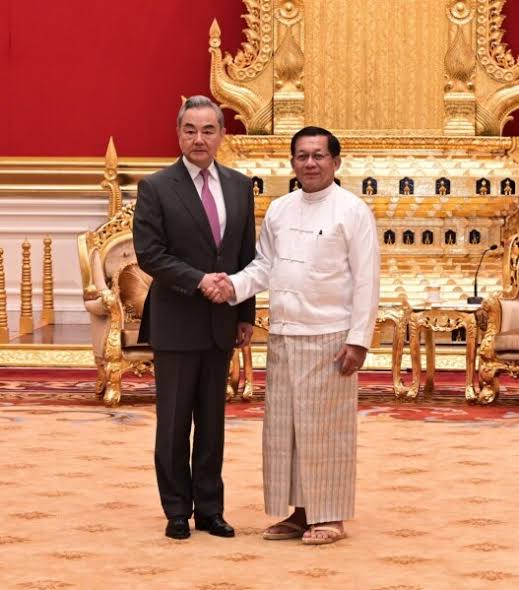
Chinese Foreign Minister Wang Yi held talks with Myanmar's Tin Maung Swe in Beijing to accelerate economic corridor projects and curb cross-border crime. The meeting comes immediately after Myanmar President U Min Aung Hlaing concluded a rare strategic visit to India, highlighting the country's delicate geopolitical balancing act.
BEIJING — Chinese Foreign Minister Wang Yi hosted his newly appointed Myanmar counterpart, Tin Maung Swe, for high-level bilateral talks in Beijing on Friday. The meeting marks a concerted effort by China to secure its strategic interests along its southern border and deepen economic pacts with Myanmar's freshly restructured government.
The high-stakes diplomatic encounter comes less than 48 hours after Myanmar President U Min Aung Hlaing concluded a rare five-day state visit to India. This consecutive engagement with Asia’s two largest powers underscores the administrative shift in Naypyidaw as the nation navigates intense domestic pressures and border instability.
Beijing Seeks Stability and Economic Commitments
According to official briefings released by the Chinese Foreign Ministry, Foreign Minister Wang Yi conveyed Beijing's readiness to establish deep-tier strategic cooperation with Myanmar's new government. The political restructuring in Myanmar saw former military junta leader U Min Aung Hlaing assume the presidency under a newly organized parliamentary framework following national elections held across December and January.
During the session, Wang explicitly emphasized that China adheres strictly to a policy of non-interference in internal affairs and supports Myanmar's pursuit of domestic peace and reconciliation. However, the Chinese delegation heavily prioritized security concerns, directly calling for unified bilateral law enforcement operations to dismantle sophisticated cross-border criminal networks, including illegal online gambling operations and rampant telecom fraud networks operating along the shared Yunnan border.
Geopolitical Balance Following President's India Trip
The timing of the Beijing summit highlights Myanmar's delicate balancing act between its primary regional neighbors. From May 30 to June 3, 2026, President Min Aung Hlaing undertook an official visit to India at the invitation of Indian Prime Minister Narendra Modi.
According to official readouts from India's Ministry of External Affairs and the Press Information Bureau, the Indo-Myanmar discussions in New Delhi centered on a broad framework of cross-border security along India's northeastern states, joint defense cooperation, and expanding bilateral financial trade through a dedicated Rupee-Kyat trade settlement mechanism.
Faced with India's expanding maritime and infrastructure footprint in the Bay of Bengal, China responded swiftly by leveraging Friday’s talks to accelerate the development of the Myanmar-China Economic Corridor (CMEC)—a core component of Beijing's Belt and Road Initiative that provides China with direct alternative access to the Indian Ocean.
Impact on Regional Stability and Commerce
The ongoing diplomatic maneuvers carry profound implications for regional traders, border communities, and international investors. For logistics companies and businesses operating across the China-Myanmar border, stricter joint security enforcement could lower the high operational risks created by armed ethnic conflicts that have repeatedly halted commercial traffic.
Furthermore, Myanmar's willingness to welcome increased Chinese-funded manufacturing operations, juxtaposed against its new economic arrangements with Indian business networks, means transnational corporate entities must adapt to rapidly evolving compliance, currency settlement, and safety protocols across the Southeast Asian corridor.
Official Sources Section
The details, commitments, and institutional quotes cited in this report originate from official diplomatic statements issued by the State Council of the People's Republic of China, formal notifications from the Ministry of Foreign Affairs of Myanmar, and the joint bilateral statements broadcast by the Government of India's Press Information Bureau.
Quote Section
"According to officials from the Chinese Foreign Ministry, Beijing remains fully committed to supporting Myanmar's sovereign development path while expecting rigorous collaboration to ensure the total peace, security, and tranquility of shared border regions."
Why It Matters
Myanmar's geostrategic location makes its internal stability a vital interest for both Beijing and New Delhi. As ethnic conflicts persist near its borders, any disruptions threaten vital energy pipelines, trade routes, and regional infrastructure projects. The back-to-back talks prove that both China and India are competing to secure their borders and economic investments, making Myanmar a key focal point for South Asian geopolitics.
Key Facts at a Glance
Diplomatic Sequence: The China-Myanmar ministerial talks occurred directly after Myanmar President Min Aung Hlaing finished a five-day state visit to India.
Economic Corridor Focus: Myanmar Foreign Minister Tin Maung Swe reaffirmed plans to accelerate the construction of the China-Myanmar Economic Corridor.
Security Crackdown: Both nations agreed to launch enhanced joint operations targeting cross-border telecom fraud and online gambling syndicates.
Financial Diversification: The meetings follow Myanmar's recent trade expansion with India using the localized Rupee-Kyat settlement mechanism.
FAQ Section
Why did the Myanmar Foreign Minister travel to Beijing right after the President visited India?
The sequential meetings demonstrate Myanmar’s foreign policy approach of balancing relations with its powerful neighbors, ensuring continued economic and military backing from China while expanding trade ties with India.
What is the China-Myanmar Economic Corridor (CMEC)?
The CMEC is a massive network of oil pipelines, deep-water ports, and rail lines connecting southern China directly to the Indian Ocean through Myanmar, allowing Beijing to bypass the congested Strait of Malacca.
How are China and India handling border security differently with Myanmar?
While India focuses on working with Myanmar to secure its militancy-hit northeastern borders, China's immediate focus centers on securing trade infrastructure and stopping cross-border telecom fraud syndicates operating near Yunnan.
Source: Ministry of Foreign Affairs of the People's Republic of China, Ministry of External Affairs of India, Press Information Bureau of India