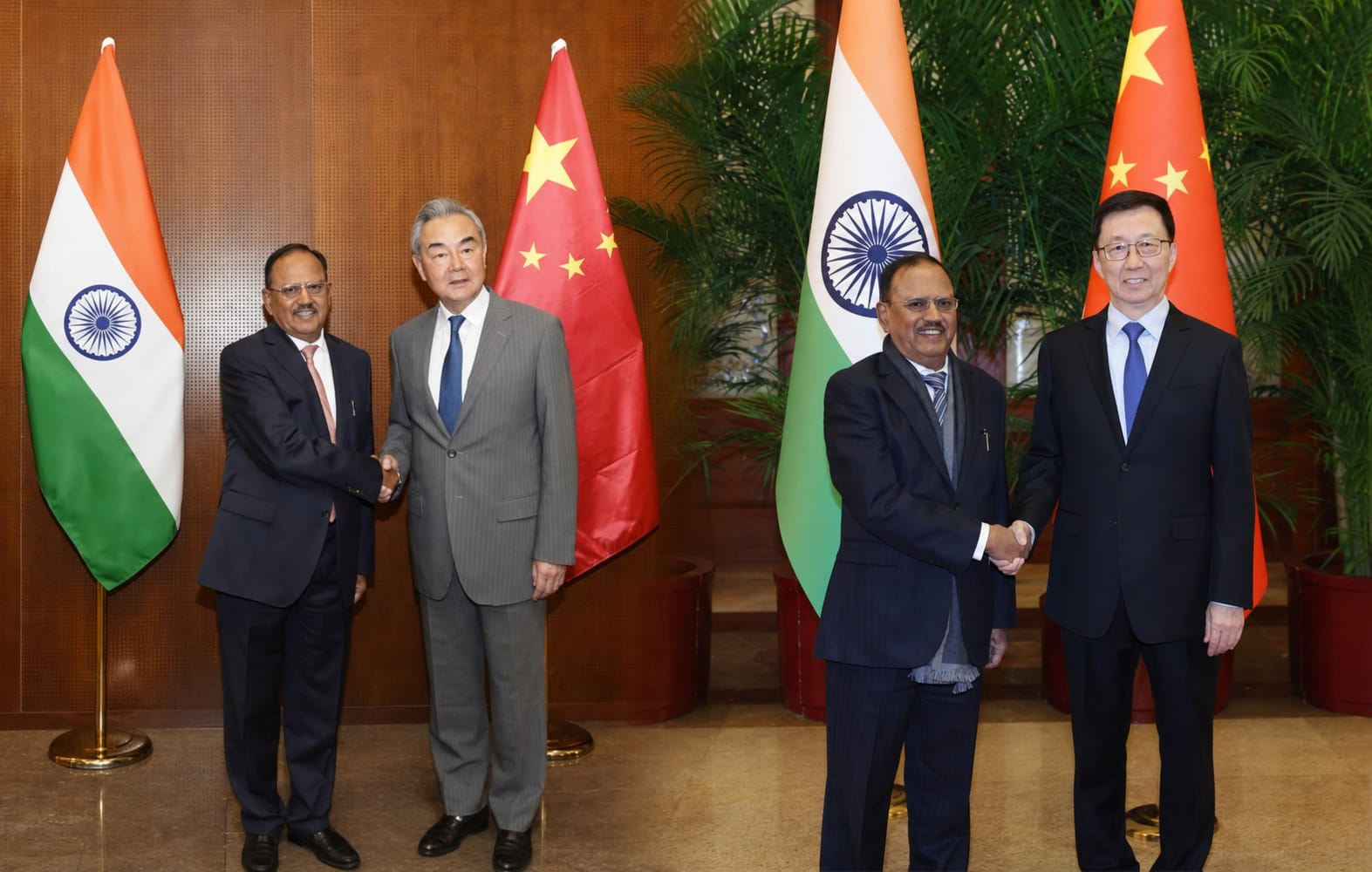
India's National Security Advisor Ajit Doval met Chinese Vice President Han Zheng in Beijing to advance the 25th round of boundary negotiations. These critical diplomatic talks aim to stabilize bilateral ties and de-escalate Himalayan frontier tensions ahead of the September 2026 BRICS summit hosted in New Delhi.
BEIJING — Indian National Security Advisor Ajit Doval met with Chinese Vice President Han Zheng and Foreign Minister Wang Yi in Beijing on Tuesday. The high-level bilateral discussions, structured as the 25th round of Special Representatives talks on the India-China boundary question, are designed to navigate recurring border tensions and de-escalate military standoffs along the frontier. This diplomatic engagement is exceptionally important today as it paves the way for the upcoming BRICS summit hosted in New Delhi from September 12-13, where Chinese President Xi Jinping is expected to be in attendance.
Navigating the Himalayan Boundary Dispute
The core agenda of Doval’s two-day visit revolves around the deeply complex India-China boundary dispute, which spans a 3,488-kilometer frontier. Ties between the two Asian giants have remained historically strained, severely deteriorating following the fatal Galwan Valley military clash in 2020 and the ensuing prolonged troop stand-off in eastern Ladakh.
Doval, acting as India’s designated Special Representative, engaged in exhaustive dialogue with his Chinese counterpart Wang Yi before formally calling on Vice President Han Zheng. Recent months have seen renewed diplomatic friction, notably following Indian media reports in late July 2026 alleging that military patrols from both nations came face-to-face in the northeastern state of Arunachal Pradesh. While the Indian government firmly rejected reports of active incursions, New Delhi consistently maintains that Arunachal Pradesh is an integral and inalienable part of its sovereign territory, rejecting Beijing’s persistent territorial claims over the region it refers to as southern Tibet.
Despite this lingering strategic distrust, both administrations have sought a cautious stabilization over the past year. The Special Representatives mechanism, originally established in 2003, serves as the primary diplomatic backchannel to manage these friction points and prevent localized border incidents from escalating into broader geopolitical conflicts. Officials on both sides regard the mechanism as a vital, structured tool for keeping diplomatic channels open even during periods of intense military posturing.
Setting the Stage for BRICS 2026
Beyond immediate border pacification, the Beijing meetings serve as a crucial precursor to global multilateral engagements. New Delhi is actively preparing to host the 2026 BRICS summit in mid-September. The bloc, originally formed in 2009 by Brazil, Russia, India, and China, has since expanded globally and operates as a major forum for emerging economies seeking greater influence in a shifting international order traditionally dominated by Western institutions.
Although Beijing has yet to issue official confirmation regarding President Xi Jinping's precise travel itinerary, diplomatic channels strongly anticipate his participation in the New Delhi summit. Should the visit materialize, it presents a critical diplomatic window for a potential bilateral sideline meeting between Indian Prime Minister Narendra Modi and President Xi. The two national leaders previously convened on the sidelines of the Shanghai Cooperation Organisation (SCO) summit in Tianjin in August 2025.
Official Sources Section
Information regarding the diplomatic itinerary, meeting parameters, and bilateral statements was verified through the following official administrative channels:
State communications and flash reports broadcasted by the Xinhua News Agency
Diplomatic briefings and travel schedules confirmed by the Ministry of External Affairs (India)
Press conference transcripts and boundary updates provided by the Ministry of Foreign Affairs of the People's Republic of China
Quote Section
"At this meeting, the two sides will, in accordance with the spirit of the consensus reached by the leaders of the two countries, continue to engage in in-depth communication on the boundary question and jointly safeguard peace and tranquility in the border areas," Chinese Foreign Ministry spokesperson Lin Jian stated during a media briefing.
According to officials at the External Affairs Ministry in New Delhi, maintaining peace and tranquility along the Line of Actual Control (LAC) remains of "utmost importance," as the security environment on the frontier will directly shape the overall course of the broader bilateral relationship.
Why It Matters
For global markets and regional stakeholders, the diplomatic stabilization of Sino-Indian relations drastically reduces the immediate risk of armed conflict between two nuclear-armed neighbors that collectively represent over a third of the global population. For citizens, travelers, and businesses, normalized bilateral ties can lead to enhanced border trade and a steady resumption of direct commercial flights, which have been heavily restricted since 2020. Furthermore, a cooperative stance between India and China at the forthcoming BRICS summit would significantly amplify the geopolitical leverage of the Global South in ongoing international trade, climate, and security negotiations.
Key Facts at a Glance
Diplomatic Engagement: India's NSA Ajit Doval held meetings with Chinese Vice President Han Zheng and Foreign Minister Wang Yi in Beijing.
Core Agenda: The 25th round of Special Representatives talks focused on managing the 3,488-kilometer boundary dispute and preventing military escalation.
Historical Context: Bilateral ties are undergoing cautious stabilization following the fatal 2020 Galwan Valley military clash.
Upcoming Milestone: The border talks aim to ensure smooth diplomatic proceedings ahead of the BRICS summit in New Delhi on September 12-13, 2026.
Regional Disputes: Border friction persists over Beijing's claims on Arunachal Pradesh, which the Indian government strictly rejects.
FAQ Section
What is the Special Representatives mechanism?
Established in 2003, the Special Representatives mechanism is a dedicated, structured diplomatic channel between India and China aimed at negotiating their longstanding Himalayan boundary disputes and preventing localized military escalations.
Why is Ajit Doval visiting Beijing now?
NSA Ajit Doval is in Beijing for a two-day visit to participate in the 25th round of border talks, aiming to stabilize bilateral relations ahead of the crucial BRICS summit taking place in New Delhi in September 2026.
Will Chinese President Xi Jinping visit India this year?
While Beijing has not yet officially confirmed his exact travel schedule, President Xi Jinping is widely expected to travel to New Delhi to attend the BRICS summit on September 12-13, 2026, potentially holding sideline bilateral talks with Prime Minister Narendra Modi.
Source: Ministry of External Affairs (India), Xinhua News Agency, Ministry of Foreign Affairs of the People's Republic of China.