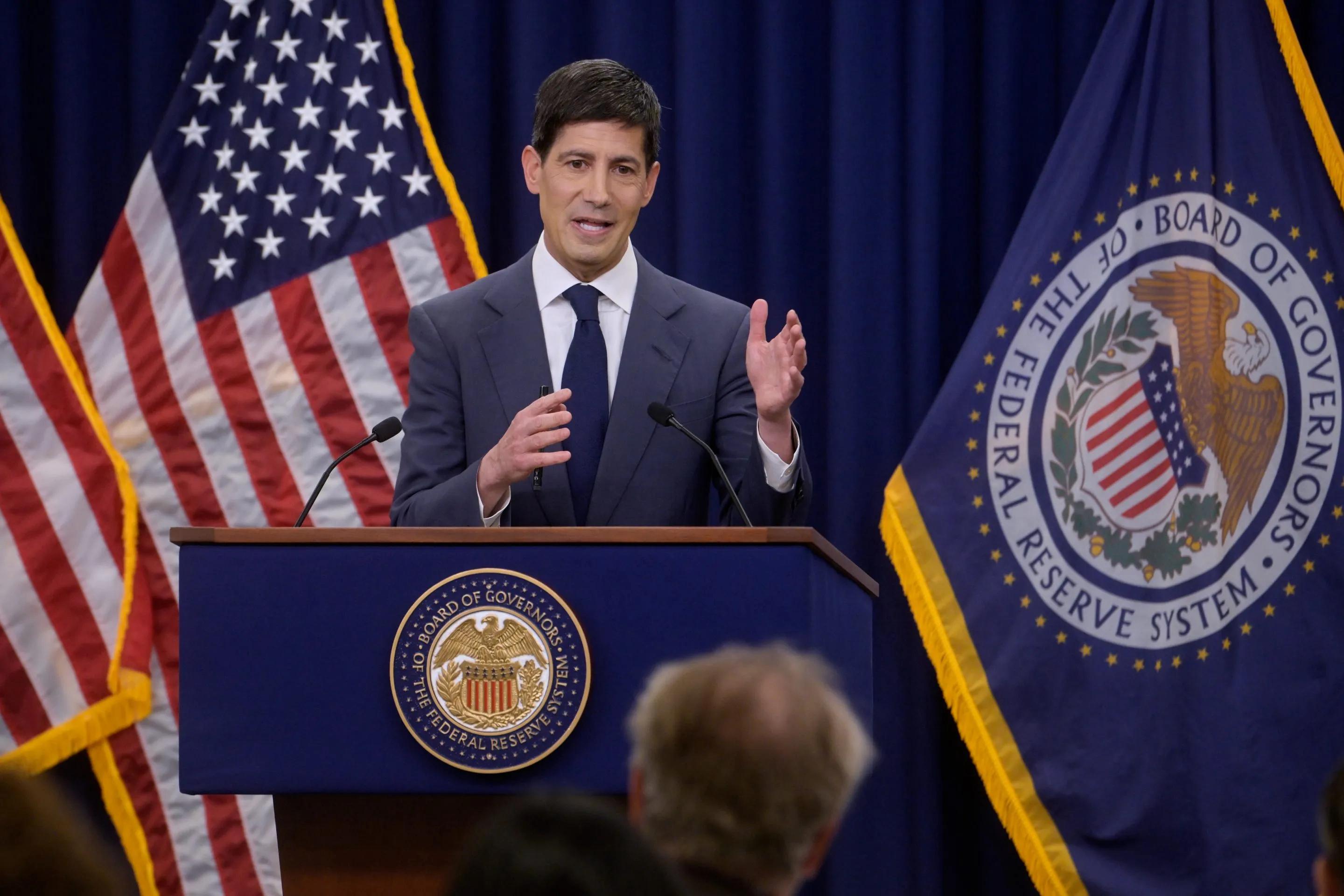
Federal Reserve Chair Kevin Warsh used his Jackson Hole debut on August 28, 2026, to criticize forward guidance, arguing it has outlived its utility. Warsh emphasized a data-dependent, quieter monetary policy approach while highlighting artificial intelligence as a major new variable influencing productivity, capital deployment, and future central banking frameworks.
Backed by official policy statements delivered at the Jackson Hole symposium, Federal Reserve Chair Kevin Warsh has signaled a major shift toward a quieter central bank by phasing out predictive interest rate roadmaps.
Central bank communication frameworks are undergoing a fundamental structural reassessment in the United States. Speaking at the Kansas City Fed's annual economic symposium in Jackson Hole, Wyoming, on August 28, 2026, Federal Reserve Chair Kevin Warsh delivered his keynote address targeting the routine use of forward guidance. Warsh argued that explicit policy roadmaps regarding future interest rate paths, which originated during the 2007–2008 global financial crisis, have outlived their usefulness during normal economic conditions.
The address establishes a deliberate pivot away from pre-committed policy trajectories. By leaning toward a data-dependent operational stance, the Federal Reserve aims to prevent financial markets from becoming overly dependent on central bank signaling. Furthermore, Warsh addressed emerging macroeconomic shifts, identifying artificial intelligence (AI) and capital tokenization as transformative new variables altering long-term productivity and labor dynamics.
Re-Evaluating Forward Guidance and Market Interdependence
To restore unvarnished market signals, the Federal Reserve is actively curtailing speculative policy prompts. According to official disclosures published via the Federal Reserve Official Site and reported by The Associated Press, core aspects of the new communicative approach include:
Retiring Crisis-Era Tools: Warsh stated that forward guidance creates unnecessary ambiguity under the guise of clarity, locking policymakers into rigid paths when conditions evolve.
The "Hall of Mirrors" Risk: The central bank cautioned against a feedback loop where markets rely entirely on Fed guidance while the Fed concurrently relies on distorted market prices, increasing the risk of policy errors.
Discipline Over Decisions: The leadership emphasized adherence to a strict data-driven discipline rather than pre-committing to definitive rate cuts or hikes ahead of incoming consumer price metrics.
Restoring Accountability: A quieter central bank allows the institution to focus tightly on its core statutory remit—achieving stable prices anchored to a 2% inflation target and maximum employment.
Artificial Intelligence as a New Monetary Variable
Beyond communications reform, the central bank is formally examining how rapid technological expansion interacts with macroeconomic stability. According to official transcripts and financial reporting by Bloomberg News, key considerations regarding artificial intelligence comprise:
Productivity and Capital Outlays: Massive capital expenditures are pouring into AI infrastructure, acting as a primary driver behind resilient corporate spending and changing capital-intensity models.
Token Sales and Labor Dynamics: With annualized token sales across leading labs surging past $100 billion, the Fed is investigating whether token usage serves as a complement or competitor to human labor.
Productivity Task Force: The Federal Reserve has established a specialized task force on productivity and jobs to study how technological structural changes impact long-term economic output and price equilibrium.
Why It Matters
The practical implications of altering central bank communications and evaluating artificial intelligence touch upon borrowing costs, mortgage pricing, and broader financial market volatility. For investors, businesses, and consumers, the shift away from predictable rate paths means financial markets must independently evaluate economic data, potentially increasing near-term asset price sensitivity while reducing the likelihood of policy misjudgments caused by rigid central bank commitments.
Key Facts at a Glance
Event Date: August 28, 2026, at the Jackson Hole Economic Policy Symposium.
Core Policy Shift: Phasing out explicit forward guidance under normal economic conditions.
Inflation Stance: Reaffirmed commitment to the 2% inflation target with a data-dependent discipline.
New Variable Monitored: Integration of an AI task force to examine productivity, token metrics, and labor impacts.
FAQ Section
What is forward guidance, and why is Kevin Warsh changing it?
Forward guidance is the central bank's practice of signaling future interest rate paths. Warsh argues that the tool has outlived its usefulness since the 2008 financial crisis, as it restricts flexibility and encourages markets to rely on Fed predictions rather than fundamental economic data.
How does artificial intelligence affect Federal Reserve monetary policy?
AI represents a major new variable affecting capital allocation, infrastructure spending, and potential productivity gains. The Fed has formed a dedicated task force to evaluate how these structural changes impact economic output and labor markets.
What are the implications of a "quieter Fed" for investors and markets?
A quieter central bank means fewer explicit hints about upcoming interest rate decisions. Market participants are expected to track fundamental economic indicators independently rather than anticipating immediate policy interventions.
Where can the full text of Kevin Warsh’s Jackson Hole speech be accessed?
The complete transcript and official policy principles are published directly on the Federal Reserve Official Speeches Portal.
Source: Federal Reserve Portal, Federal Reserve Speeches Desk, Associated Press