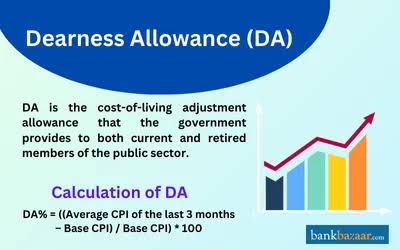
Dearness Allowance (DA) is an inflation-linked compensation provided to central government employees and pensioners. Calculated twice yearly using the 12-month average of the All-India Consumer Price Index for Industrial Workers (AICPI-IW), the standardized formula neutralizes rising living costs by directly increasing monthly basic pay percentages.
NEW DELHI — The Ministry of Finance and the Labour Bureau determine bi-annual Dearness Allowance (DA) adjustments for central government employees and pensioners using a mathematical formula linked directly to retail inflation metrics.
The revision mechanism cushions public sector households against rising living costs by converting macroeconomic inflation indicators into monthly cash allowances. The standard formula relies on the 12-month average of the All-India Consumer Price Index for Industrial Workers (AICPI-IW) compiled by the Labour Bureau. Understanding this framework highlights how macro-level inflation figures directly determine monthly take-home pay and pension disbursements.
The Mathematical Formulas behind DA Calculation
Dearness Allowance is revised twice a year, taking effect on January 1 and July 1. The exact percentages depend on specific sectors and applicable Central Pay Commission (CPC) frameworks.
Formula for Central Government Employees
Under the 7th Central Pay Commission guidelines, the calculation uses a 12-month trailing average of the AICPI-IW:
$$\text{DA Percentage} = \left[ \frac{\text{Average AICPI-IW for the past 12 months} - 261.4}{261.4} \right] \times 100$$
Note: For calculations using the older 2001=100 series base index, the subtractor and divisor baseline value was set at 115.76.
Formula for Public Sector Undertaking (PSU) Employees
Central Public Sector Enterprises (CPSEs) utilize Industrial Dearness Allowance (IDA), which is reviewed quarterly based on a three-month trailing average:
$$\text{IDA Percentage} = \left[ \frac{\text{Average AICPI-IW for the past 3 months} - 126.33}{126.33} \right] \times 100$$
Key Factors Influencing the Calculation
Several economic metrics and administrative rules dictate the final allowance figure:
Consumer Price Index for Industrial Workers (AICPI-IW): Published monthly by the Labour Bureau, Ministry of Labour and Employment, tracking basket prices of food, housing, fuel, and clothing.
Base Year Re-indexing: The government periodically updates base years (e.g., 2001=100 and 2016=100) and applies a linking factor to align historical data with current price structures.
Basic Pay Baseline: DA is calculated exclusively as a percentage of basic salary or basic pension, excluding other allowances like House Rent Allowance (HRA) or Transport Allowance.
Rounding Standard: The final percentage value is rounded down to the nearest whole integer before official notification.
Official Sources Section
According to official releases from the Ministry of Finance (Department of Expenditure) and notifications from the Labour Bureau, Dearness Allowance calculations are executed in strict accordance with recommendations submitted by the Central Pay Commission. Government regulatory filings confirm that monthly index data compiled by the Labour Bureau forms the sole objective basis for bi-annual rate revisions.
Operational and Economic Impact
Impact on Employees and Pensioners
A DA hike translates directly into increased gross salary and monthly pension pay. For instance, a 2% or 3% increase on a basic pay of ₹50,000 provides an additional ₹1,000 to ₹1,500 in monthly pre-tax income, mitigating eroded purchasing power caused by consumer inflation.
Impact on Government Exchequers
Each 1% increase in DA imposes an annual exchequer cost of approximately ₹3,000 crore to ₹3,500 crore, affecting both the Union Budget and State budgets as State governments typically replicate Central DA announcements.
Key Facts at a Glance
Frequency: Revised twice annually (effective January 1 and July 1) for central staff; quarterly for PSU employees.
Beneficiaries: Covers roughly 50 lakh central government employees and over 65 lakh pensioners.
Data Anchor: Governed by the 12-month trailing average of the All-India Consumer Price Index (AICPI-IW).
Taxability: Entirely taxable as income under the head "Salaries" according to Indian tax regulations.
Frequently Asked Questions
How does inflation directly affect the DA percentage?
When retail prices for essential goods increase, the monthly AICPI-IW figures rise. A higher 12-month average increases the numerator in the official formula, yielding a higher overall percentage allowance.
Is Dearness Allowance applicable to private sector employees?
No. DA is an entitlement specific to public sector, central government, state government employees, and government pensioners. Private sector salaries are adjusted through merit raises or performance bonuses rather than standardized DA formulas.
Are DA and Dearness Relief (DR) calculated differently?
The underlying percentage and formula are identical. The term "Dearness Allowance" applies to active government employees, whereas "Dearness Relief" applies to retired government pensioners.
Source: Ministry of Finance (Department of Expenditure), Labour Bureau (Ministry of Labour and Employment), Central Pay Commission Guidelines, Reserve Bank of India Economic Bulletins.