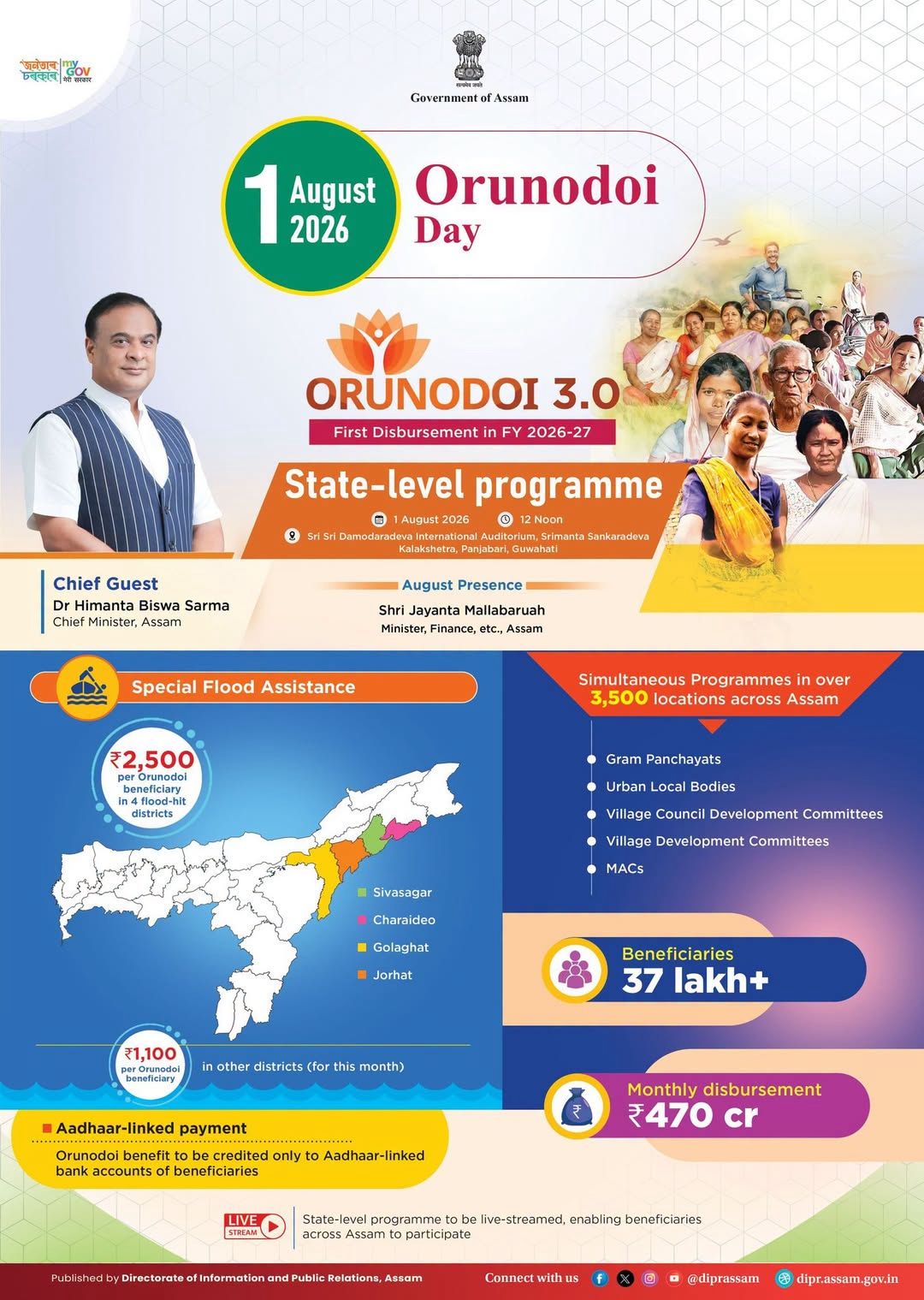
The Government of Assam is implementing Orunodoi 3.0, providing monthly financial assistance of Rs 1,250 to eligible women from economically vulnerable households. Disbursed via Direct Benefit Transfer (DBT) to Aadhaar-linked bank accounts, the state-backed welfare initiative aims to strengthen nutritional support and alleviate poverty across districts.
State government advances poverty alleviation and financial inclusion through structured Direct Benefit Transfers under the Orunodoi 3.0 framework.
The Government of Assam continues its expansive welfare rollout under Orunodoi 3.0, delivering crucial financial assistance of Rs 1,250 per month directly to women-headed, low-income households across the state. Administered by the state's administrative machinery, the revamped scheme utilizes automated Direct Benefit Transfer (DBT) channels linked directly to Aadhaar-verified bank accounts to ensure complete transparency. Designed to combat baseline poverty and secure nutritional support, the program serves as a primary pillar of the state's socioeconomic development strategy.
Expanding Reach and Transparent Disbursals
The operational mechanics of Orunodoi 3.0 focus on streamlining beneficiary identification and eliminating bureaucratic bottlenecks through digital integration. By syncing database lists with National Food Security Act (NFSA) registries, the state ensures that aid reaches marginalized segments efficiently.
Key operational elements of the welfare framework include:
Direct Benefit Transfer (DBT): Funds are transferred electronically into Aadhaar-seeded bank accounts designated for the woman head of the family, minimizing intermediaries.
Structured Resource Allocation: The financial assistance is structured to help cover household essentials, including provisions for nutrition, medical expenses, and daily staples.
Eligibility Parameters: Households with a composite annual income below Rs 2 lakh, lacking regular government employment or tax-paying members, remain primary beneficiaries.
Targeted Inclusion: Priority criteria account for vulnerable demographics, including widows, unmarried women above 45, persons with disabilities, and destitute citizens.
Impact on Citizens, Local Economies, and Households
For citizens and low-income families across Assam, the monthly cash flow provides immediate relief against inflationary pressures on food and healthcare. Economic analysts note that placing financial control directly in the hands of women enhances intra-household decision-making, improves child nutrition, and stimulates local retail economies as beneficiaries purchase essential goods within their communities.
Why It Matters
Direct cash transfer initiatives create a financial safety net that stabilizes vulnerable households against economic shocks. By targeting assistance toward women, the state framework fosters long-term improvements in household health, education, and financial literacy.
Key Facts at a Glance
Scheme Name: Orunodoi 3.0 (Assam).
Monthly Financial Aid: Rs 1,250 per eligible household.
Disbursement Mode: Direct Benefit Transfer (DBT) to Aadhaar-linked bank accounts.
Income Ceiling: Annual family income must be below Rs 2 lakh.
FAQ Section
What is the financial assistance amount provided under Orunodoi 3.0?
Eligible households receive Rs 1,250 per month under the Orunodoi 3.0 scheme.
How are the funds disbursed to beneficiaries?
Funds are transferred directly into the Aadhaar-linked bank accounts of designated women beneficiaries via Direct Benefit Transfer (DBT).
Who is eligible to apply for the Orunodoi 3.0 scheme?
Permanent residents of Assam belonging to economically weaker households with an annual income below Rs 2 lakh and no government-employed members are eligible.
Where can beneficiaries check their status or list inclusion?
Beneficiaries can verify their status and district-wise lists through the official portal at Government of Assam Orunodoi Portal.
Source: MyScheme Government Portal, Government of Assam Orunodoi Portal