Exiled Bangladeshi author Taslima Nasrin returned to Kolkata on Friday after a 19-year absence, receiving a civic reception at Rabindra Sadan on Saturday. Visibly emotional, Nasrin stated that the city, which once forced her out, has now given her hope and a renewed reason to dream.
Exiled author delivers an emotional address at a civic reception, stating that her long-awaited return proves injustice cannot last forever.
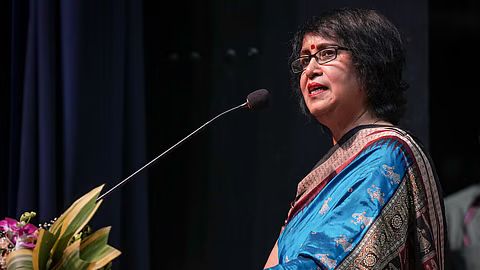
Nearly two decades after being forced out amid intense political and religious protests, author Taslima Nasrin returned to Kolkata on Friday, marking a dramatic and emotional homecoming to the city she considers her cultural sanctuary. Speaking on Saturday evening at a civic reception hosted at Rabindra Sadan by organizations including Secular Mission and the Human Rights and Bangladesh Freedom Fighters Foundation (HRBFF), the 63-year-old writer was accorded a warm public welcome. Her return to West Bengal, facilitated by updated security arrangements under the state's administration, opens a new chapter in the ongoing discourse surrounding freedom of expression and writers in exile.
An Emotional Homecoming and Reflection on Exile
Addressing a packed auditorium of supporters, literary figures, and citizens, Nasrin reflected on the heavy personal toll of her 19-year absence from Kolkata. Having lived away from the city since her departure in November 2007 under the erstwhile Left Front government led by Buddhadeb Bhattacharjee, she expressed deep gratitude for the renewed opportunity to walk the streets where she penned several of her notable works.
Key highlights from her public address and return include:
Reclaiming Hope: Describing the emotional weight of her journey, Nasrin remarked, “Kolkata, the city which made me cry, now shows me to dream again. I am returning to my life that has already been lost.”
Stand Against Fundamentalism: Reaffirming her lifelong advocacy, Nasrin stated that her writings have consistently targeted religious extremism and championed women's rights rather than serving any partisan political agenda.
Security and Institutional Support: Nasrin acknowledged the cooperation of the West Bengal government and local organizers for providing the comprehensive security infrastructure necessary to make her public appearance possible.
Security Arrangements: Kolkata Police deployed heightened security details across Rabindra Sadan and surrounding transit hubs to ensure a peaceful event.
Impact on Free Speech, Politics, and Civil Society
Taslima Nasrin's return carries deep resonance for civil society groups, human rights advocates, and political observers across India and South Asia. For literary circles, her presence reinforces Kolkata's historic identity as a haven for artists and free thinkers. Politically, the visit has drawn commentary from state leaders, including West Bengal Chief Minister Suvendu Adhkari, who emphasized the administration's commitment to protecting constitutional rights, freedom of speech, and democratic values. Observers note that the event highlights evolving political dynamics regarding security provisions for controversial public intellectuals.
Why It Matters
The reintegration of exiled writers into mainstream cultural life sets a vital precedent for the protection of international free expression. Ensuring that authors can speak safely without facing forced displacement protects the foundational tenets of pluralistic democracies and guarantees that diverse intellectual voices remain audible.
Key Facts at a Glance
Duration of Exile: 19 years away from Kolkata, following her departure in November 2007.
Venue of Appearance: Rabindra Sadan, Kolkata, during a civic reception on August 1, 2026.
Core Advocacy: Women's rights, secularism, and sustained opposition to religious fundamentalism.
Organizers: Secular Mission, Human Rights and Bangladesh Freedom Fighters Foundation (HRBFF), and Poschimbongyer Jonnyo.
FAQ Section
Why did Taslima Nasrin return to Kolkata after 19 years?
Taslima Nasrin returned to Kolkata to attend a major literary and anti-fundamentalism event at Rabindra Sadan and participate in a civic reception.
Why was Taslima Nasrin forced to leave Kolkata in 2007?
Nasrin was asked to leave Kolkata in November 2007 by the then-state government following violent protests and law-and-order challenges sparked by opposition to her controversial writings.
What did Taslima Nasrin say about her homecoming?
During her address, an emotional Nasrin stated that the city had given her hope once more, remarking that Kolkata "shows me to dream again".
Where can readers track further updates regarding her visit and literary events?
Official updates, news coverage, and statements are regularly published by regional and national outlets such as The New Indian Express and The Economic Times.
Source: The New Indian Express, The Print, The Economic Times, Kolkata Police