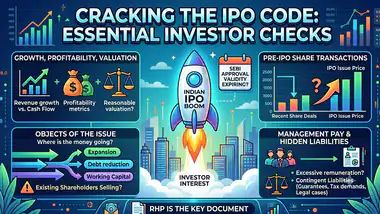
Initial public offering activity in India has gathered pace, with firms raising ₹22,400 crore by August 26, 2026. However, 37% of newly listed stocks have slipped below their issue prices. Financial experts advise investors to scrutinize Red Herring Prospectuses for six vital red flags regarding growth, valuation, and hidden liabilities.
Backed by financial market data, market analysts emphasize that thorough scrutiny of Red Herring Prospectuses is essential as post-listing performance cools.
While primary market activity across Indian stock exchanges continues to record steady capital raising—surpassing ₹22,400 crore by August 26, 2026—secondary performance indicators warrant caution. According to market analyses and financial reports published by LiveMint Personal Finance Desk, the proportion of initial public offerings closing below their issue prices on listing day has climbed to 37%.
Because IPO-bound companies lack an established secondary market trading history, prospective investors must depend heavily on disclosures filed prior to listing. Navigating the complex data within a Red Herring Prospectus (RHP) is critical to identifying warning signs, assessing corporate financial health, and evaluating whether demanded valuations are justifiable.
Evaluating Financial Health and Fund Utilization
Examining specific segments of corporate filings helps separate fundamentally sound enterprises from speculative offerings. According to expert guidance and regulatory compliance reviews, investors should track several core parameters:
Growth and Profitability Trajectory: Financial statements must be evaluated over multiple preceding fiscal years to check for consistent operational income rather than one-time gains.
Intended Use of Proceeds: Investors must determine whether capital raised will fund productive corporate expansion, debt reduction, or working capital requirements.
Pre-IPO Share Transactions: Tracking equity allocations completed months prior to public issuance helps verify if recent valuations align with actual fundamental business growth.
Management Compensation and Contingent Liabilities: Beyond headline debt, buyers must review guarantees issued for third parties, disputed tax demands, and ongoing legal proceedings detailed in the risk factors section.
Why It Matters
The practical implications of performing rigorous due diligence on IPO filings directly impact retail capital preservation. With nearly two-fifths of recent listings trading under their initial issue prices, failing to read the fine print in an RHP exposes investors to severe downside risk. By analyzing hidden liabilities, promoter holding patterns, and cash flow statements, market participants can avoid overvalued issues and make informed asset allocations.
Key Facts at a Glance
Capital Raised: Indian companies raised approximately ₹22,400 crore through August 26, 2026.
Listing Performance: 37% of IPOs closed below their issue price during the period.
Primary Source Document: The Red Herring Prospectus (RHP) serves as the core information portal for unlisted entities.
Core Checkpoints: Tracking fund utilization, contingent liabilities, pre-IPO valuations, and management remuneration.
FAQ Section
Why is the Red Herring Prospectus (RHP) important for IPO investors?
Because pre-IPO companies lack active exchange trading histories, the RHP provides the only comprehensive view of their financial health, legal liabilities, and business risks.
What percentage of recent IPOs have fallen below their issue price?
Data shows that 37% of IPOs closed below their issue price on listing day, highlighting growing post-listing volatility.
How can investors check how IPO proceeds will be used?
The 'Objects of the Issue' section in the RHP outlines precisely whether funds will target business expansion, debt repayment, or general corporate purposes.
Where can retail investors review official draft prospectuses and regulatory updates?
Official draft offer documents and regulatory circulars are published directly on the Securities and Exchange Board of India (SEBI) Portal and stock exchange archives.
Source: LiveMint, Securities and Exchange Board of India (SEBI), Trendlyne