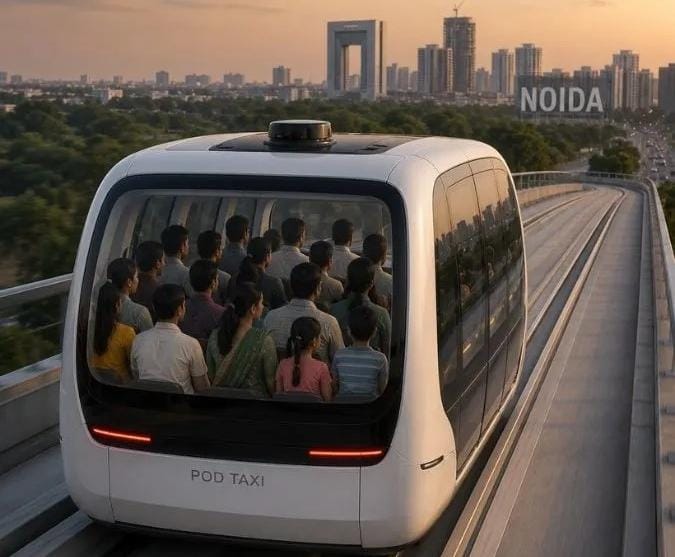
The Haryana State Industrial and Infrastructure Development Corporation (HSIIDC) is planning an integrated transit system featuring automated pod taxies and an extended metro link to cut travel times between Delhi and Manesar to under 40 minutes. The multi-modal network aims to bypass expressway gridlock and transform regional industrial connectivity.
GURUGRAM — Commuters traveling between the national capital and Haryana's rapidly growing industrial belt will soon see their transit time slashed significantly. The Haryana State Industrial and Infrastructure Development Corporation (HSIIDC) has outlined a multi-modal transit master plan designed to transport commuters from Dhaula Kuan in Delhi to Manesar in under 40 minutes.
The transit framework relies on a dual-track strategy: a high-speed automated Personal Rapid Transit (PRT) system, commonly known as a pod taxi, running alongside an extended Mass Rapid Transit System (MRTS) metro corridor. This major infrastructure update arrives as a direct policy response to the chronic vehicular congestion throttling the Delhi-Gurugram Expressway (National Highway 48), establishing an unencumbered public transport alternative for hundreds of thousands of daily corporate executives and manufacturing professionals.
Autonomous Pod Taxis to Anchor Last-Mile Industrial Transit
The centerpiece of the newly structured transit strategy is an elevated, high-frequency pod taxi network. Engineered to act as a point-to-point mass transit solution, these driverless, electricity-powered pods will run on a dedicated guideway system independent of surface traffic constraints.
By removing standard vehicle merge delays and intersection bottlenecks, the planned lines will operate at continuous high velocities, linking Delhi's strategic transport hubs directly with the core segments of the Industrial Model Township (IMT) in Manesar.
Beyond improving travel speeds, the pod taxi ecosystem functions as an eco-friendly last-mile delivery vector for the industrial sector. The localized networks are slated to link directly with specialized multi-modal transit centers, enabling commuters to step off high-speed regional lines and immediately board a pod to reach their specific factory or corporate campus.
Extended Metro Corridor to Integrate Regional Rapid Lines
To back the automated pod taxi system with high-volume passenger capabilities, HSIIDC's vision integrates seamlessly with major rail extension proposals spearheaded alongside the Haryana Mass Rapid Transit Corporation (HMRTC). The planned layout bridges the gap between Delhi and Haryana by extending the metro rail framework from Gurugram’s urban center straight through to the emerging transit junction at Pachgaon near Manesar.
| Planned Infrastructure Component | Core Operational Mandate |
| Pachgaon Mega Multi-Modal Hub | Blends Orbit Rail, MRTS Metro, and RRTS systems |
| Elevated PRT Pod Network | Fast, high-frequency industrial last-mile logistics |
| 130-Kilometer Orbit Rail | Connects Manesar to Sonepat and Palwal corridors |
This alignment is strategically located to anchor the proposed 130-kilometer-long Haryana Orbit Rail Corridor, which runs parallel to the Kundli-Manesar-Palwal (KMP) Expressway. By connecting traditional metro rail, regional rapid rail (RRTS), and automated pod taxies at designated stations, the state is building an integrated transit network where passengers can switch lines seamlessly.
Official Sources Section
The infrastructure blueprints, multi-modal alignments, and time-reduction assessments are based on project planning documentation issued by the Haryana State Industrial and Infrastructure Development Corporation (HSIIDC). Additional routing synchronization and multi-modal transit center data are corroborated by development briefs from the Haryana Mass Rapid Transit Corporation (HMRTC) and the urban transit planning division of the Gurugram Metropolitan Development Authority (GMDA).
Quote Section
"According to officials familiar with the master plan, the goal is to fully decouple industrial commuter transit from the unpredictable gridlock of the highway network, creating a highly reliable, high-tech transit corridor that boosts economic productivity across the sub-region."
Why It Matters
For daily commuters, manufacturing logistics firms, and real estate investors, the infrastructure overhaul marks a turning point for the National Capital Region's (NCR) southwest growth corridor. Cutting travel times down to 40 minutes makes cross-border commuting practical again, opening up Manesar's industrial zones to a broader pool of skilled workers from Delhi. For companies located in IMT Manesar, the logistics upgrade reduces supply chain delays, cuts fuel overhead costs, and enhances overall operational efficiency.
Key Facts at a Glance
Time Reduction: The combined pod taxi and rapid metro framework aims to slash commuter travel times between Delhi and Manesar to under 40 minutes.
Autonomous Pods: The proposed Personal Rapid Transit (PRT) pod taxi network will operate on its own dedicated, elevated lanes to avoid surface highway congestion.
Integrated Hubs: A major multi-modal transit hub planned for Pachgaon will bring together the Metro, RRTS, and the Haryana Orbit Rail under one roof.
Ecosystem Relief: The project is designed to pull significant passenger car volumes off the heavily congested NH-48 Expressway corridor.
FAQ Section
What is the main goal of the HSIIDC pod taxi project?
The project aims to provide a fast, traffic-free public transport link between Delhi and the industrial town of Manesar, reducing travel times down to under 40 minutes.
Will the new pod taxi lines replace the proposed Gurugram-Manesar Metro?
No. The automated pod taxi network is designed to work alongside the high-capacity metro line, acting as a fast last-mile shuttle between major metro stations and individual industrial sectors.
Where can commuters switch between these different transit modes?
The state is developing integrated multi-modal transit hubs, with a primary center planned at Pachgaon in Manesar, linking the regional rapid rail, metro, and pod systems together.
Source: Haryana State Industrial and Infrastructure Development Corporation Portal, Haryana Mass Rapid Transit Corporation Project Registry, Gurugram Metropolitan Development Authority Media Desk