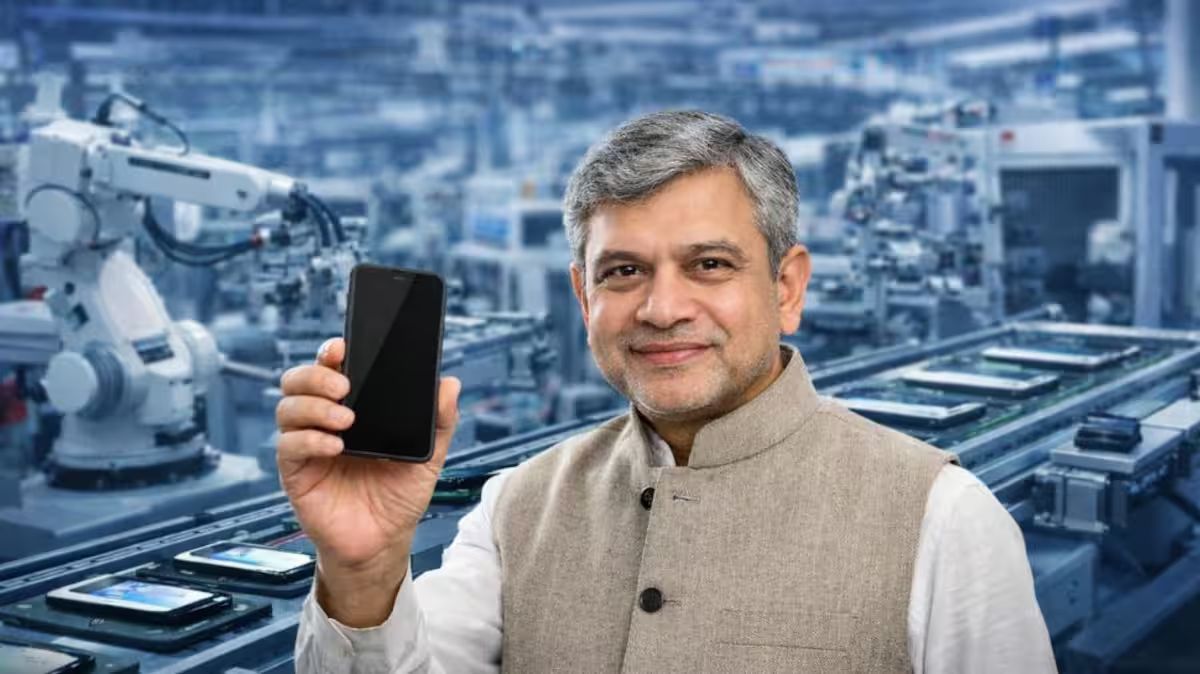
Union Minister Ashwini Vaishnaw announced that under the ₹62,500-crore Mobile Phone Manufacturing Scheme, India expects to launch indigenously designed smartphones within 10 to 14 months. Stressing strict screening, the government mandates genuine local intellectual property rights, shutting out copycat models to foster true technological sovereignty and domestic brand growth.
Backed by official ministry notifications in New Delhi, the government has launched the ₹62,500-crore Mobile Phone Manufacturing Scheme, demanding original intellectual property while locking out copycat brands.
Unveiling the Mobile Phone Manufacturing Scheme in New Delhi
India’s electronics manufacturing landscape is transitioning from assembly operations toward proprietary technological innovation. According to official announcements made by Union Minister for Electronics and Information Technology Ashwini Vaishnaw in New Delhi on August 21, 2026, the central government has formally notified the ₹62,500-crore Mobile Phone Manufacturing Scheme (MPMS).
The newly instituted five-year policy framework—running from fiscal year 2026-27 through 2030-31—aims to establish comprehensive supply chain depth and elevate domestic value addition. Crucially, the policy introduces a dedicated target segment specifically designed to nurture Indian-owned mobile phone brands, intellectual property (IP), and in-house research and development capabilities.
Strict Screening Standards and the Rejection of Copycats
Addressing media briefings following the scheme's rollout, Minister Vaishnaw emphasized that the government will enforce rigorous vetting protocols for participating domestic brands. To qualify for financial incentives under the indigenous brand segment, applicant companies must prove definitive ownership of their design intellectual property and trademarks within India.
The ministry stated that the framework leaves no room for unoriginal designs or imported white-label rebadging. Companies must demonstrate that their products match the best global standards in their respective market categories. Administrative reviews indicate that three potential Indian smartphone players are currently positioned to introduce homegrown devices to the market within a 10-to-14-month timeframe.
Why It Matters
The practical implications of the Mobile Phone Manufacturing Scheme extend directly to national economic self-reliance, high-value employment, and corporate investment. By incentivizing local R&D and strict intellectual property ownership, the policy aims to transition India from a global assembly hub into a creator of foundational mobile technology, generating an estimated 60,000 direct jobs and driving cumulative production targets.
Key Facts at a Glance
Budgetary Outlay: ₹62,500 crore allocated under the Mobile Phone Manufacturing Scheme (MPMS).
Timeline: Indigenously designed smartphones expected within 10 to 14 months.
Core Requirement: Mandatory proof of Indian-owned design intellectual property and trademarks.
Target Impact: Generating approximately 60,000 direct jobs and driving cumulative production.
FAQ Section
What is the primary objective of the Mobile Phone Manufacturing Scheme (MPMS)?
The scheme aims to enhance global competitiveness, deepen domestic component sourcing, and foster Indian-owned mobile phone brands equipped with indigenous design and intellectual property.
What criteria must companies meet to qualify under the Indian brand segment?
Applicants must be incorporated in India, maintain majority Indian ownership (over 51%), hold IP and trademarks domestically, and prove in-house R&D and original design capabilities.
Why did Minister Ashwini Vaishnaw emphasize blocking "copycats"?
To prevent unoriginal rebadging, the government requires strict verification ensuring that participating brands own their proprietary design patents rather than replicating existing foreign hardware.
Where can manufacturers review official guidelines and application procedures?
Detailed implementation guidelines, circulars, and application portals are managed directly through the Ministry of Electronics and Information Technology (MeitY).
Source: Press Information Bureau (PIB), The Economic Times, Hindustan Times