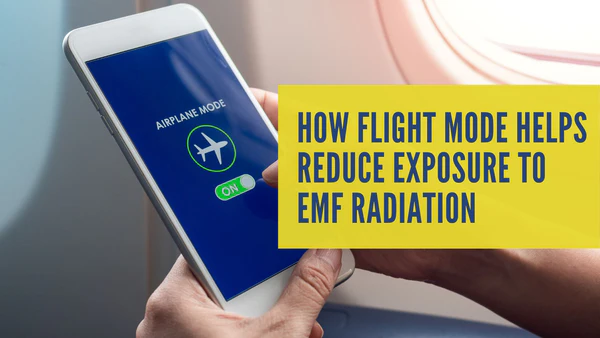
Activating airplane mode disables a smartphone's primary cellular transmitter, instantly halting its most powerful source of radiofrequency (RF) radiation. However, it does not stop all emissions; users must manually disable Wi-Fi and Bluetooth to end all wireless transmissions, and background electrical circuitry will still emit negligible, non-wireless electromagnetic fields.
WASHINGTON - Consumer safety debates surrounding mobile device emissions have intensified as users increasingly look for simple ways to manage their personal environment. A frequent question presented to public health agencies and telecommunications authorities is whether enabling "airplane mode" completely halts smartphone radiation.
The short answer is that airplane mode significantly cuts the vast majority of wireless radiofrequency (RF) radiation, but it does not reduce total electromagnetic emissions to zero. Understanding the distinction requires examining how modern mobile devices function under regulatory guidelines.
How Airplane Mode Impacts Smartphone Radiation
When a user activates airplane mode, the device executes a specific internal command: it terminates the power sent to its primary cellular transmitter. This instantly stops the phone from broadcasting the high-power radiofrequency energy used to connect with distant cell towers.
According to guidelines published by the California Department of Public Health (CDPH), a cell phone emits its highest levels of RF energy when it is actively searching for a cellular signal, such as in a moving vehicle or in areas with poor reception. By stopping this search, airplane mode halts the most substantial source of user exposure to RF emissions.
The Problem with Default Settings
However, a common misconception exists regarding what occurs after the initial toggle. On modern operating systems, activating airplane mode may leave alternative wireless antennas active, or allow users to manually re-enable them.
Wi-Fi Antennas: Often remain active or can be switched back on to access in-flight internet.
Bluetooth Modules: Frequently remain operational to maintain connections with wireless earbuds and smartwatches.
Background Circuitry: The device's internal processor, battery, and screen generate low-frequency electrical currents (extremely low frequency, or ELF-EMF) as long as the phone is powered on.
To completely halt intentional RF transmission, users must verify within their device settings that both Wi-Fi and Bluetooth are fully turned off alongside airplane mode.
The Nature of Mobile Emissions: Ionizing vs. Non-Ionizing
To accurately assess safety, regulatory bodies distinguish between different types of radiation. The Federal Communications Commission (FCC) and the World Health Organization (WHO) categorize smartphone RF emissions as non-ionizing radiation.
Unlike ionizing radiation (such as X-rays or ultraviolet light), non-ionizing radiofrequency energy lacks sufficient energy to strip electrons from atoms or directly damage cellular DNA.
"The radiofrequency energy emitted by mobile phones is a form of electromagnetic radiation that falls into the non-ionizing part of the spectrum," notes the Federal Communications Commission. "Operating a phone in airplane mode stops the transmission of these wireless signals entirely."
While public health organizations like the International Agency for Research on Cancer (IARC) maintain a classification of RF electromagnetic fields as "possibly carcinogenic to humans" due to long-term data uncertainties, consensus guidelines focus on exposure reduction rather than absolute avoidance.
Impact on Consumers and Technology Users
For safety-conscious consumers, travelers, and parents, utilizing airplane mode provides a practical, zero-cost method to minimize daily background exposure. This is particularly relevant during sleep hours or when devices are handed to children, whose thinner skulls make them more sensitive to localized RF absorption.
Furthermore, minimizing active transmissions offers immediate practical benefits:
Preserved Battery Performance: Halting continuous tower pings preserves device longevity.
Elimination of Roaming Costs: Travelers can prevent accidental connection fees when crossing borders.
Reduced Thermal Output: Devices run cooler when their power amplifiers are inactive.
Official Sources Section
Regulatory data and public advice regarding mobile phone emissions are managed by several key agencies:
Federal Communications Commission (FCC): Sets legal Specific Absorption Rate (SAR) limits for wireless devices sold in the United States.
California Department of Public Health (CDPH): Issues proactive community health guidance on reducing exposure to radiofrequency energy.
Federal Aviation Administration (FAA): Coordinates with airlines regarding portable electronic device usage rules in commercial airspace.
Quote Section
"According to officials at public health agencies, utilizing airplane mode is a highly effective way to eliminate a smartphone’s primary radiofrequency emissions, provided that secondary wireless connections like Wi-Fi and Bluetooth are also turned off."
Why It Matters
Understanding the mechanics of wireless settings empowers consumers to make informed choices about technology habits. Rather than buying unverified commercial "radiation shields"—which the Federal Trade Commission warns can actually force a phone to broadcast at higher power to maintain a signal—users can use built-in system settings to control their exposure levels instantly and reliably.
Key Facts at a Glance
Primary Cutoff: Airplane mode turns off the high-power cellular transmitter, stopping the phone's strongest source of RF radiation.
The Hidden Extras: Wi-Fi and Bluetooth may remain active while in airplane mode; they must be manually turned off for full RF cessation.
Thermal Emission: Even with all wireless features turned off, a powered-on phone still generates negligible thermal and extremely low-frequency (ELF) electrical fields from its internal circuits.
Signal Strength Dependency: When not in airplane mode, a phone emits significantly more radiation in low-signal areas as it maximizes power to find a cell tower.
FAQ Section
Q: Does airplane mode stop all radiation from a smartphone?
A: No. It stops intentional radiofrequency (RF) wireless transmissions, but the phone’s battery and active internal circuits will still emit tiny amounts of non-wireless electromagnetic fields (ELF-EMF) as long as the device is turned on.
Q: Can I still use Wi-Fi while airplane mode is turned on?
A: Yes, modern devices allow you to turn Wi-Fi back on while keeping cellular functions disabled. However, doing so means the phone will resume emitting RF radiation via the Wi-Fi antenna.
Q: Is cell phone radiation dangerous when airplane mode is off?
A: Regulatory agencies like the FCC state that phones operating within legal Specific Absorption Rate (SAR) limits are safe. However, agencies like the CDPH suggest minimizing close-body contact as a precautionary measure due to ongoing long-term scientific studies.
Q: Does putting my phone on airplane mode at night save battery?
A: Yes. Because the device stops constantly searching for and communicating with cellular towers, battery drain is heavily reduced.
Source: Federal Communications Commission Official Consumer Portal, California Department of Public Health Environmental Health Division.