The Ministry of Labour and Employment has launched EPFO 3.0, migrating member records to a single national database via the CITES project. The update introduces instant UPI transfers, cardless ATM withdrawals, a higher INR 5 lakh auto-settlement limit, and preserves a mandatory 25% retirement buffer.
NEW DELHI — The Ministry of Labour and Employment has initiated a comprehensive modernization of India’s retirement savings framework through the rollout of EPFO 3.0. Anchored by the successful migration of all member records to a single national network under the Centralised IT Enabled Services (CITES) project, the upgrade removes long-standing regional data silos. For millions of salaried workers nationwide, the transition introduces direct Unified Payments Interface (UPI) access, instant cardless ATM cash withdrawals, and an elevated auto-settlement ceiling. This structural shift transitions the statutory fund from a slow, paper-heavy ledger into a responsive digital finance asset.
The CITES Project and Database Centralization
The core foundation of the EPFO 3.0 architecture is the Centralised IT Enabled Services (CITES) project. Historically, the Employees' Provident Fund Organisation operated a fragmented network where each regional field office maintained standalone member databases. This lack of integration caused frequent data mismatches, forced manual employer verifications, and delayed transfer turnarounds when workers switched jobs across state borders.
According to official declarations from the Ministry of Labour and Employment, the CITES project successfully moves the entire national subscriber base onto a single unified cloud database. This central integration enables the processing of claims and administrative corrections from any authorized nodal center across the country, removing the requirement for subscribers to coordinate exclusively with their native registration offices.
New Withdrawal Rules, UPI Access, and ATM Integration
The most notable consumer-facing modification under the updated policy involves a direct integration with the National Payments Corporation of India (NPCI) network to power real-time fund transfers.
The operational parameters governing the new transactional features outline strict structural criteria:
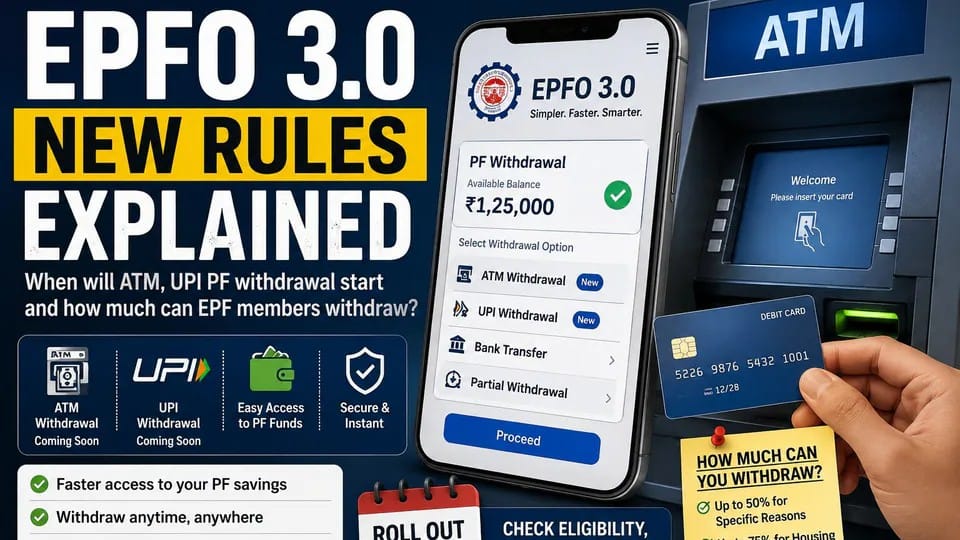
Instant UPI Processing: Members can link their verified UPI handles via the updated member portal or the UMANG application. Validated claims under INR 5 lakh are routed instantly to Aadhaar-seeded bank accounts, completely bypassing the traditional three-to-seven-day banking clearance cycles.
Cardless ATM Cash Withdrawals: Account holders can generate secure QR codes within their authenticated applications to withdraw permitted cash balances directly from UPI-enabled automated teller machines.
The 75% Corpus Rule: Active employees can draw up to a maximum threshold of 75% of their aggregate accumulated balance for partial emergency needs. The remaining 25% serves as a mandatory, non-bypassable retirement buffer that must remain active throughout the individual's employment life cycle.
Consolidated Claim Streams: The framework condenses 13 historical partial advance headings into three macro-categories: Essential Needs (covering medical events, weddings, and education), Housing (covering home acquisition or construction), and Special Circumstances (covering retrenchment or full retirement).
Furthermore, partial claims for wedding expenses are capped at five instances per career lifecycle, while educational advances are allowed up to ten times, subject to a baseline requirement of seven years of active service contributions.
Enhanced Auto-Settlement Limits and Tax Protections
To lower administrative friction, the organization has raised the automatic machine-processed settlement threshold from its previous cap of INR 1 lakh up to a new limit of INR 5 lakh. Provided a subscriber's Know Your Customer (KYC) documentation—including verified Aadhaar records, Permanent Account Number (PAN) details, and bank account linkages—displays full electronic validation, processing occurs via automated rules-based logic without manual clerical check-offs.
Importantly, the structural tax treatment codes remain unchanged under the EPFO 3.0 guidelines. Funds withdrawn after completing a continuous five-year employment service block remain entirely tax-exempt. Early liquidations exceeding INR 50,000 attract a 10% Tax Deducted at Source (TDS) rate if a valid PAN is linked, rising to 30% if tax identities are absent or unverified. Immediate medical emergencies and unexpected business closures continue to be exempt from early-withdrawal tax assessments.
Official Sources Section
The technical changes, structural limits, and infrastructure metrics presented in this report reflect public announcements issued by the Ministry of Labour & Employment and recent stock exchange updates. Operational tracking remains managed by the central digital infrastructure cells of the Employees' Provident Fund Organisation in New Delhi.
Quote Section
"According to officials from the labor ministry, testing phases for the real-time banking rails have concluded successfully, clearing the path for a phased rollout across primary digital nodes. Organizers stated that removing manual employer signature requirements for KYC-compliant accounts will significantly cut down on historic claim rejection rates."
Why It Matters
The rollout of the centralized system carries major practical benefits for the domestic labor market:
For Salaried Workers: Provides quick access to emergency personal liquidity during major medical or family crises without weeks of bureaucratic delays.
For Corporate Employers: Lowers the administrative burden on internal HR departments, which no longer need to manually verify routine employee withdrawal requests.
For the Banking System: Integrates large-scale statutory savings retirement accounts with daily transactional engines like the NPCI network.
Key Facts at a Glance
System Foundation: Migrates all regional databases into a single, national platform managed under the CITES project.
Higher Auto-Claims: Increases the instant, machine-processed claim threshold fivefold to a maximum of INR 5 lakh.
Liquidity Access: Introduces instant transfers to linked bank accounts via UPI alongside cardless ATM cash dispensations.
Retirement Cushion: Enforces a mandatory 25% minimum account balance rule for all partial withdrawals during an active career.
FAQ Section
Q: Can I withdraw the entirety of my accumulated EPF balance while still employed?
A: No. Under the updated partial withdrawal guidelines, you can access a maximum of 75% of your corpus for qualified needs, while 25% must remain as a retirement protection buffer. 100% liquidations are allowed only upon official retirement or after two months of continuous unemployment.
Q: What exactly is the CITES project?
A: The Centralised IT Enabled Services (CITES) project is an infrastructure reform that moves decentralized regional databases onto a single national cloud platform, allowing seamless claims processing from any location in India.
Q: Are the early withdrawal tax rules changing under EPFO 3.0?
A: No, the statutory tax rules remain the same. Withdrawals made after five years of continuous service are tax-free, whereas early non-emergency drawdowns over INR 50,000 face a 10% TDS charge if your PAN is updated.
Source: Ministry of Labour & Employment Press Releases, National Payments Corporation of India (NPCI) Technical Integration Framework, Employees' Provident Fund Organisation Central Database Migration Report, New Delhi, 2026.