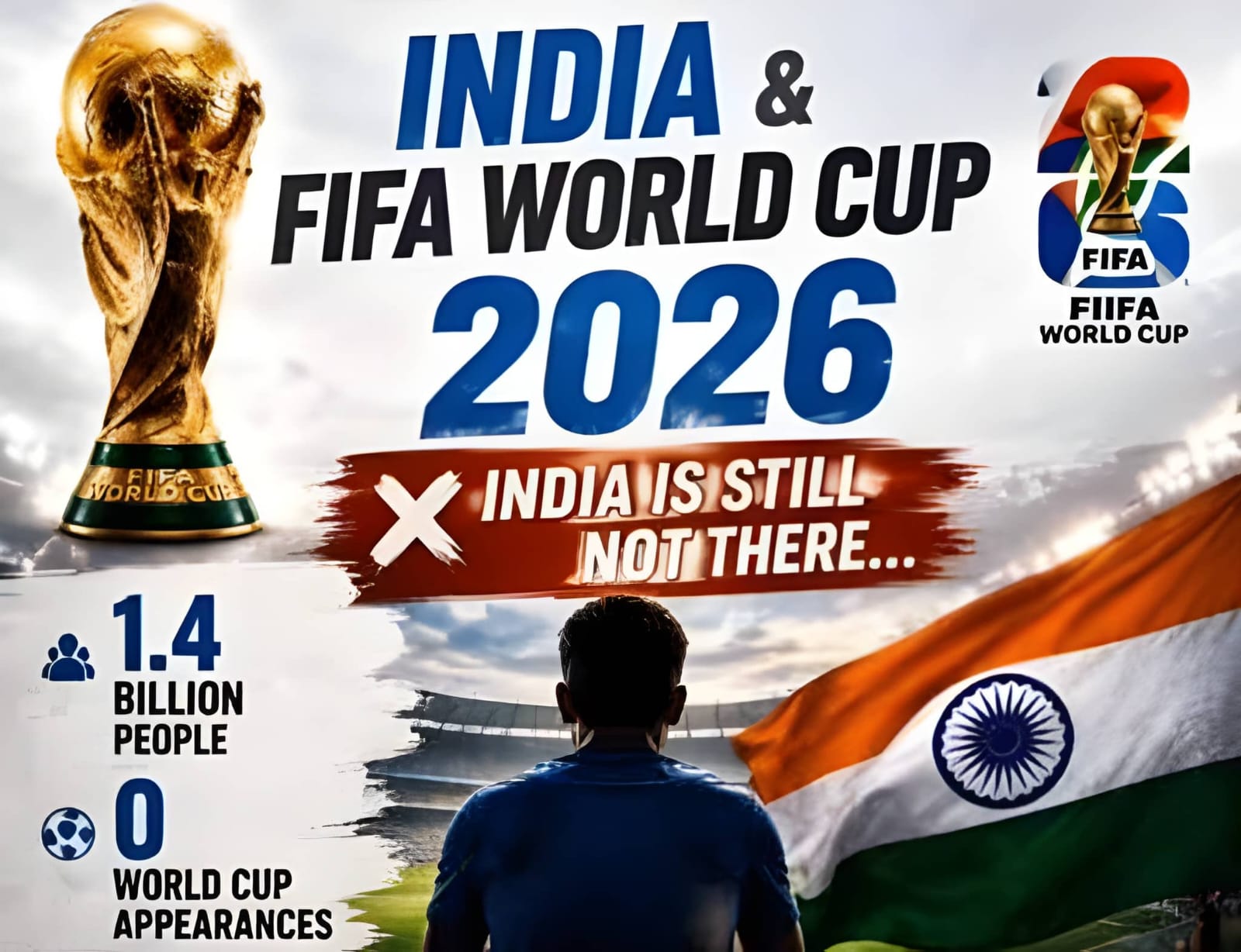
Despite FIFA expanding the FIFA World Cup 2026 to a 48-team format, India missed out on qualification following an early Second Round exit in the AFC qualifiers. The national team’s absence highlights deep systemic challenges, including limited grassroots infrastructure, administrative coordination issues, and strict selection policies regarding overseas talent.
NEW DELHI — As the expanded 48-team FIFA World Cup 2026 dominates global sports headlines across North America, the India national football team remains a notable absentee from the world’s biggest sporting stage. Despite FIFA expanding the tournament format to allow a record eight direct qualification spots for the Asian Football Confederation (AFC), India's qualification campaign collapsed early in the second round of continental qualifiers. The absence of the Blue Tigers highlights deep-rooted administrative, structural, and grassroots challenges that continue to impede the growth of football within the country.
Early Exit in the AFC Qualifying Stages
The road to the FIFA World Cup 2026 presented an unprecedented opportunity for emerging football nations, yet India failed to capitalised on the relaxed entry barriers. According to official match data published by FIFA, India's competitive run ended prematurely in 2024 during the Second Round of the AFC qualifiers.
Placed in Group A alongside Qatar, Kuwait, and Afghanistan, the national squad failed to secure a top-two finish necessary to progress into the decisive third round.
AFC Qualification — Group A Final Standings
India managed only a single victory throughout the six group matches—a 1-0 away win against Kuwait. A subsequent dip in form, including an unexpected draw and a defeat against lower-ranked Afghanistan, sealed the team's elimination and contributed to a continuous drop in the global FIFA world rankings, where India slid to 139th globally.
Structural Deficiencies in Domestic Football
Analyses from regional sports bodies indicate that India’s football failure stems from architectural flaws within its domestic ecosystem rather than a simple lack of player talent. The All India Football Federation (AIFF) has faced consistent criticism from stakeholders for its disjointed handling of the professional league hierarchy.
While the top-tier Indian Super League (ISL) has succeeded in generating commercial interest and high player salaries for select athletes since its inception in 2013, the broader domestic pyramid remains weak. Unlike European leagues backed by integrated academy pipelines, the links between the ISL, the I-League, and lower state divisions are fragile. Independent clubs retain strict control over player contracts, which often causes scheduling friction when coordinating national team training camps before critical international matches.
Furthermore, financial disparity creates an unequal landscape. Elite ISL players command substantial domestic valuations, yet the lack of integration with overseas football networks means very few Indian players transition to competitive leagues abroad to test their skills against diverse international tactical setups.
Grassroots Development and Socio-Cultural Roadblocks
A primary factor keeping India away from the FIFA World Cup 2026 is the historically low investment in grassroots infrastructure. For decades, state funding for physical recreation was highly localized, leaving quality training centers and coaching networks confined to specific traditional football strongholds like West Bengal, Goa, Kerala, and the Northeast.
Socio-cultural dynamics also dictate athletic participation across the country:
Academic Pressures: The highly competitive nature of the Indian educational system forces young students to prioritize intensive examinations over recreational sports, leading to a steep drop-off in athletic participation during critical developmental teenage years.
Cricket Hegemony: Following India's historic 1983 Cricket World Cup victory, domestic corporate sponsorship, media coverage, and public imagination turned decisively toward cricket, pushing football to the financial periphery.
Diaspora Restrictions: Current Ministry of Youth Affairs and Sports regulations state that Overseas Citizens of India (OCIs) are ineligible to represent the country internationally, preventing India from leveraging elite dual-nationality talent trained in foreign academies—a strategy used successfully by debutants like Cape Verde.
Official Sources Section
The performance metrics, qualification statistics, and administrative policies outlined in this report are based directly on official data issued by FIFA, the Asian Football Confederation (AFC), statistical releases from the All India Football Federation (AIFF), and international policy directives compiled by the Union Ministry of Youth Affairs and Sports.
Quote Section
"There are established governmental rules under which teams are cleared for international competitions. In football, our continental ranking reflects the reality that our structural foundations require fundamental reinforcement. To build a stronger national team, we must decisively strengthen our grassroots pyramid and ensure the domestic leagues operate with greater administrative alignment."
— M Satyanarayan, AIFF Deputy Secretary General
Why It Matters
India's failure to qualify for the FIFA World Cup 2026 highlights that population size alone does not translate into international sporting success. For corporate investors, sports broadcasters, and millions of local fans, India's absence delays the country's integration into the lucrative global football economy. Resolving these systemic bottlenecks is vital if the nation intends to utilize future tournament expansions to claim its space on the global sports stage.
Key Facts at a Glance
Early Exit: India was mathematically eliminated from the FIFA World Cup 2026 during the second qualifying round in 2024, finishing third in Group A.
Format Expansion Missed: The team failed to qualify despite FIFA increasing the tournament pool to 48 teams and doubling Asia's direct qualifying slots to eight.
Ranking Decline: India’s official FIFA world ranking has slipped from 102 in 2023 down to 139th.
Regulatory Barriers: National selection rules prohibit foreign-based Overseas Citizens of India (OCIs) from playing for the national team, cutting off access to global academy talent.
Domestic Friction: Coordination issues between independent ISL clubs and the AIFF routinely limit training camp windows for international fixtures.
FAQ Section
Why didn't India qualify for the 2026 FIFA World Cup?
India was eliminated during the second round of the AFC joint qualifiers after finishing third in Group A behind Qatar and Kuwait, failing to advance to the decisive third round.
Did the tournament expansion help India's chances?
While FIFA expanded the tournament to 48 teams and granted Asia eight direct slots, India's premature exit in the second qualification round meant the team was eliminated long before those extra slots came into play.
Can players of Indian origin living abroad play for the national team?
No. Under current Indian government passport regulations, dual citizenship is not recognized, and Overseas Citizens of India (OCIs) are barred from representing the national team in international competitions.
What is the highest FIFA ranking India has ever achieved?
India reached its peak FIFA ranking of 94 in 1996 under the captaincy of Bhaichung Bhutia, and later hit 96 in 2017 when hosting the FIFA U-17 World Cup.
Source: FIFA Official Tournament Portal, Asian Football Confederation (AFC), All India Football Federation (AIFF).