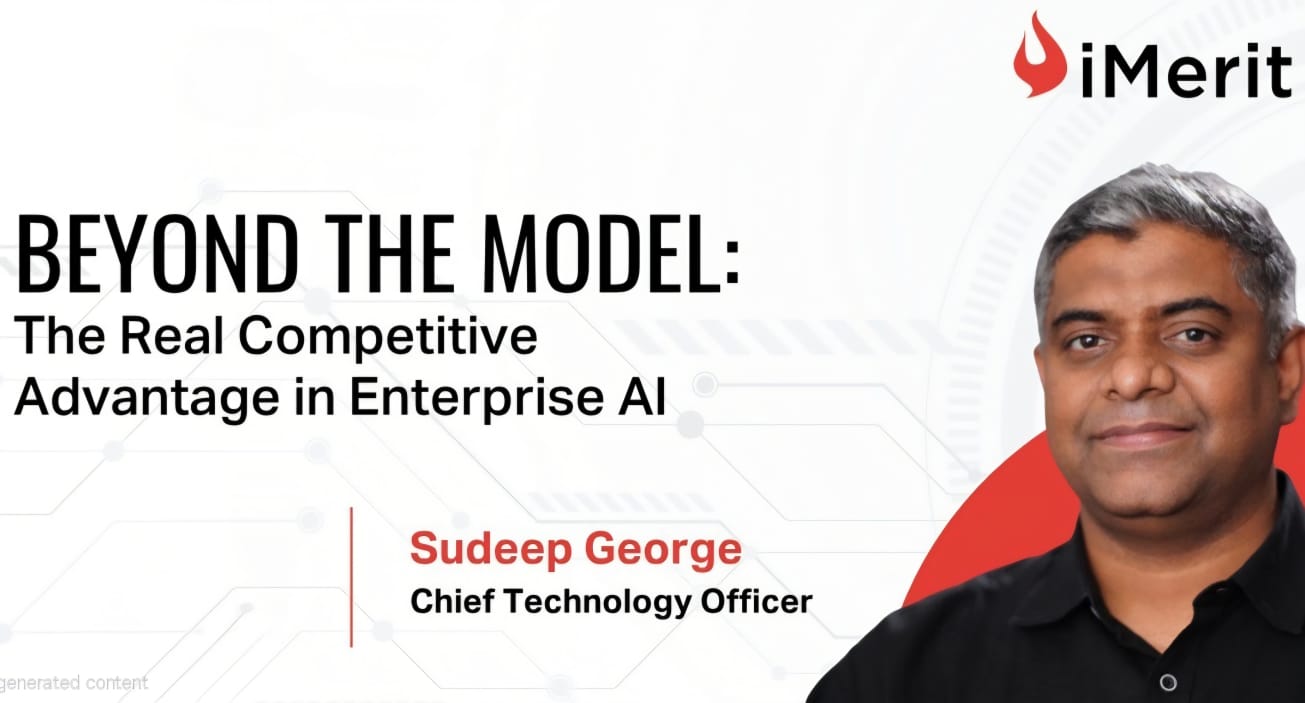
In an exclusive interview, iMerit Technology's newly appointed CTO, Sudeep George, discussed the company's focus on spatial intelligence, world models, and advanced data pipelines. George detailed how iMerit functions as a data refinery, turning complex, multimodal datasets into high-fidelity training assets for autonomous vehicles and robotics.
BENGALURU — As enterprise artificial intelligence shifts from standard text-based applications to complex physical reasoning, the underlying data architecture is undergoing a major transformation. In an exclusive interview detailing the company's technical roadmap, Sudeep George, the newly appointed Chief Technology Officer (CTO) of iMerit Technology, broke down the engineering challenges and milestones defining the next generation of software-delivered AI data solutions.
With over two decades of deep-tech experience spanning computer vision, computational imaging, and defense systems at Samsung R&D, Sarnoff Corporation, and Tonbo Imaging, George’s transition to the CTO role comes at a critical juncture. As artificial intelligence models expand to comprehend three-dimensional spaces, motion, and real-time environment variations, the demand for high-precision data operations has become paramount for global automakers, robotics companies, and agricultural technology enterprises.
The Shift to Spatial Intelligence and World Models
A major point of focus in the technical evolution of the company involves the industry-wide migration toward spatial intelligence and neural network-driven world models. Spatial intelligence enables artificial intelligence to reason about the physical world by synthesizing 3D scenes, tracking motion parameters, and calculating object proximity.
"Spatial intelligence models are AI systems that reason about the physical world by combining vision, sensor data, and contextual cues to understand space, motion, and object relationships," George stated during the interview. "The value of spatial intelligence models lies not just in perceiving an environment, but in enabling machines to act within it safely and in real time. That is especially important in robotics and autonomous systems, where decisions must be made in complex, multimodal, fast-changing settings."
Developing these systems presents unique engineering hurdles. Unlike traditional Large Language Models (LLMs) that process structured text strings, spatial intelligence models require highly complex, multimodal data pipelines capable of managing infinite variables found in the physical world.
Managing Data as an "Oil Refinery" for Enterprise AI
Reflecting on his journey since initially joining iMerit Technology as Vice President of Engineering in 2021, George shared his perspective on the critical value of data quality. He emphasized that while commercial attention often centers on raw algorithmic compute power, the true differentiator for enterprise deployment remains high-fidelity data.
"If data is the new oil, iMerit is the oil refinery," George noted, outlining the core business strategy. "The chance to build and deploy advanced computer vision and multi-sensor fusion solutions for a company with an established and sophisticated client base was incredibly appealing. I thrive on creating cutting-edge technology that makes a real-world impact."
As CTO, George’s directive includes managing resource priorities to address immediate commercial delivery schedules while concurrently incubating long-term technical innovation. This balance is crucial given the weekly influx of disruptive open-source model updates and architectural shifts that continuously challenge enterprise engineering teams.
Key Corporate Milestones and Customer-First Engineering
During the discussion, George highlighted several definitive operational milestones achieved by iMerit Technology, including celebrating the company's 10-year operational anniversary and securing its first single-client account valued at over $10 million. A particular area of success has been the design of proprietary synthetic data solutions specifically tailored for the agritech sector.
To maintain this growth trajectory, George explained that engineering mindsets must evolve beyond simply focusing on internal code bases.
"It is always a change in mindset for engineering teams, from being motivated only by one's own technology stack, to considering all aspects of the customer end-use," George emphasized. "I don't think this can be left only to the product managers. In such a technical field, engineers themselves have to be customer focused."
Official Sources Section
The corporate histories, executive designations, and technology roadmaps mentioned in this news dispatch conform to official press disclosures released by iMerit Technology, verified organizational profiles tracking executive appointments, and technical industry publications detailing spatial computing infrastructure.
Quote Section
"At iMerit, I balance immediate business needs with future innovations in an extremely dynamic AI landscape. We serve large clients who are also responding to these changes. We are also simultaneously navigating a constant influx of cutting-edge projects. This requires deep technical expertise in high-performance systems design and novel ML development."
— Sudeep George, CTO of iMerit Technology
Why It Matters
As industries like autonomous driving, drone logistics, and automated manufacturing move closer to full commercial deployment, standard public datasets are no longer sufficient to train secure models. Under George’s technical leadership, iMerit Technology's focus on structured spatial reasoning data pipelines provides enterprises with the precise edge-case training material needed to minimize real-world failures, reduce structural alignment risks, and safely accelerate time-to-market for autonomous systems.
Key Facts at a Glance
Executive Transition: Sudeep George has transitioned from VP of Engineering to Chief Technology Officer (CTO) at iMerit Technology.
Core Technological Focus: The engineering strategy prioritizes spatial intelligence, multi-sensor data fusion, and world models to support physical AI systems like robotics and autonomous vehicles.
Scale of Operations: iMerit supports global enterprise clients by leveraging a large network of active annotation professionals working alongside proprietary ML DataOps software platforms.
Commercial Thresholds: Key corporate milestones include celebrating 10 years of operation and successfully onboarding major accounts valued above $10 million.
FAQ Section
Who is Sudeep George?
Sudeep George is the Chief Technology Officer (CTO) of iMerit Technology. He has over 20 years of engineering experience in computer vision, edge computing, and electro-optics systems.
What is spatial intelligence in AI?
Spatial intelligence is an AI capability that allows machine learning models to perceive, map, and reason about three-dimensional spaces, motion dynamics, and physical object relationships in real time.
What industries do iMerit Technology's data solutions support?
iMerit provides end-to-end data pipelines for Fortune 500 enterprises spanning autonomous mobility, agritech, geospatial mapping, medical AI, and generative AI applications.
Source: iMerit Technology Official Press Room, Pulse 2.0 Interview Insights.