A newly published economic report reveals that the recently concluded India-EU Free Trade Agreement will enable India to redirect between $10 billion and $11 billion in exports from the US to Europe. The deal lowers tariffs on textiles, engineering, and chemicals, diversifying India's trade dependencies.
NEW DELHI — The proposed India-European Union Free Trade Agreement (FTA) is projected to reshape global supply chains by enabling India to redirect an estimated $10 billion to $11 billion worth of exports from the United States to the European Union (EU). According to an economic analysis released on July 14, 2026, the sweeping pact will allow Indian businesses to drastically reduce their dependence on a single Western market while substantially expanding their commercial footprint across Europe.
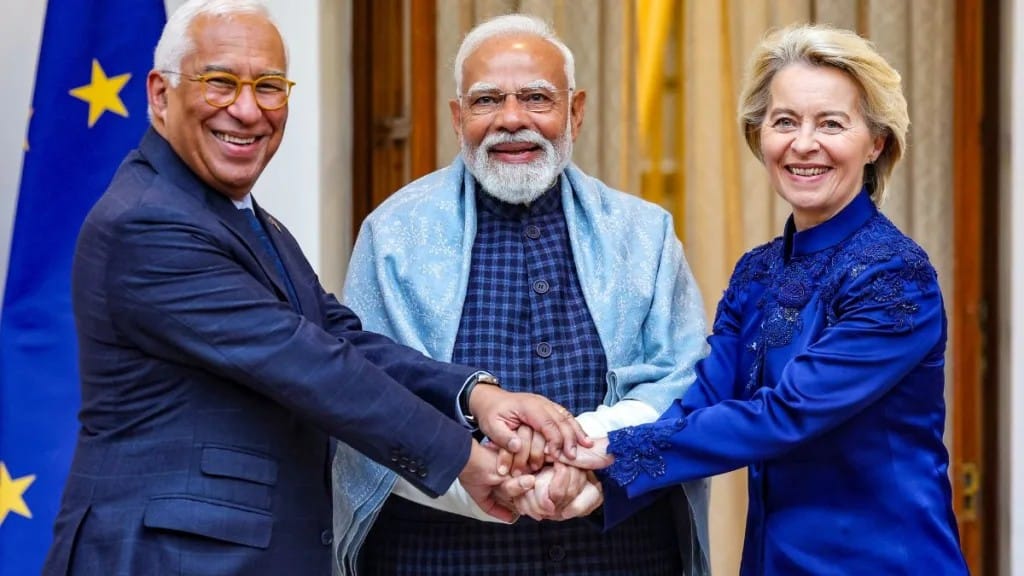
This trade shift comes at a critical time as Union Commerce and Industry Minister Piyush Goyal leads a high-level Indian business delegation across Spain, Belgium, and Finland from July 13 to 17. The European tour is focused on solidifying bilateral partnerships and maximizing commercial opportunities arising from the historic trade agreement, which was formally concluded during the 16th India-EU Summit on January 27, 2026.
Reducing Market Reliance and Boosting Competitiveness
A central finding of the research highlights that the structural shift will strengthen India's overall export resilience. By streamlining complex customs procedures and minimizing technical and regulatory barriers, the trade pact is set to reinvigorate bilateral goods trade beyond traditional European hubs.
The phased elimination of tariffs under the agreement will directly enhance India’s international competitiveness in several key labor-intensive and high-value sectors. Industrial sectors poised for the highest growth include:
Furthermore, the preferential market access restored by the agreement will compensate for the tariff advantages India previously lost following the withdrawal of the Generalised Scheme of Preferences (GSP). This allows Indian manufacturers to compete on a level playing field against rival global suppliers in European markets.
Services Sector Expansion and Inbound FDI Shifts
Beyond tangible goods, the pact establishes stable and highly predictable market access for India’s globally competitive services sector. Trade experts note that the integration will create significant avenues for service providers operating in information technology (IT), professional consulting, education, financial services, and construction.
Historically, the EU has served as an economic cornerstone for the South Asian nation, accounting for approximately 16.5% of India’s total Foreign Direct Investment (FDI) equity. Regulatory filings indicate that with the new agreement finalized, inbound investment flows are expected to diversify rapidly into India's green energy, advanced manufacturing, and tech infrastructure corridors.
Official data tracking the 2024–25 fiscal period shows that bilateral trade in goods between India and the EU reached $136.54 billion, with Indian exports leading at $75.85 billion. Concurrently, trade in services accounted for an additional $83.10 billion. Analysts project these figures could double over the next decade as legal scrubbing finishes ahead of formal implementation.
Official Sources Section
The economic projections, bilateral trade statistics, and delegation timelines cited in this dispatch are compiled from official statements issued by the Ministry of Commerce and Industry, public research documentation from Rubix Data Science, and official trade policy briefs published by the European Commission.
Quote Section
"Export diversification efforts could also help India redirect a portion of exports currently bound for the United States, with an estimated USD 10-11 billion potential shift into the EU market, strengthening India's export resilience amid changing global trade dynamics."
— Rubix Data Science Analytical Report
Why It Matters
For domestic manufacturers and corporate exporters, this trade deal marks a fundamental pivot away from over-reliance on US consumer demand. By securing lower tariffs and smoother customs clearance across the EU's affluent member states, Indian enterprises can insulate themselves from unilateral tariff shifts in North America while lowering transaction costs for European buyers.
Key Facts at a Glance
Export Re-routing: The India-EU FTA will facilitate the reallocation of $10 billion to $11 billion in Indian goods from the US to European markets.
Bilateral Volume: Prior to the agreement, annual bilateral trade in goods stood at $136.54 billion, alongside $83.10 billion in services.
Strategic Reversal: The pact effectively restores critical tariff advantages that vanished after the expiration of India’s GSP status.
Investment Boost: The EU currently holds a 16.5% share of India's total FDI equity, a figure forecast to rise via fresh green energy and manufacturing partnerships.
FAQ Section
How much export volume will shift due to the India-EU FTA?
An estimated $10 billion to $11 billion worth of Indian exports are projected to be redirected from the United States to the European Union.
Which industries will benefit the most from this trade agreement?
The primary beneficiaries include labor-intensive and high-value export sectors such as textiles, leather, engineering goods, chemicals, and IT services.
When was the India-EU FTA finalized?
The conclusion of the landmark trade negotiations was jointly announced by Indian and EU leadership on January 27, 2026.
Source: Ministry of Commerce and Industry, European Commission Trade Policy Division, Rubix Data Science Economic Report.