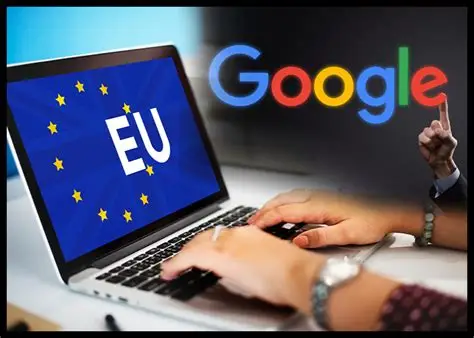
The European Union has ordered Google to share its proprietary search data and open up its Android operating system to rival AI developers by 2027. This binding decision under the Digital Markets Act aims to prevent Google's Gemini from monopolizing mobile AI, despite Google's warnings about user privacy risks.
BRUSSELS — In a major regulatory blow to Alphabet Inc., the European Union on Thursday, July 16, 2026, issued two legally binding directives requiring Google to share its proprietary search data and open its Android operating system to rival artificial intelligence (AI) developers.
This decision, handed down under the EU's landmark Digital Markets Act (DMA), aims to break Google's decades-long dominance in online search and prevent it from leveraging its mobile ecosystem to establish an exclusive monopoly for its Gemini AI assistant.
Under the new mandates, Google must grant eligible search engine and AI competitors access to its search data starting in January 2027, while complete interoperability for third-party AI assistants on the Android platform must be implemented by July 2027.
Dismantling Google’s Android Advantage for AI Assistants
The European Commission’s first directive targets how AI services interact with the Android operating system, which runs on roughly 60% of all smartphones in the European Union. Regulators found that Google currently restricts third-party AI developers from utilizing deep system capabilities, giving its in-house Gemini chatbot an unfair operational advantage.
To level the playing field, the EU has ordered Google to open up 11 core Android features—described by officials as vital "building blocks" for mobile assistant usability. By July 2027, a software update must enable competing AI assistants to:
Launch seamlessly via standard system voice prompts.
Deeply integrate with other third-party applications installed on the user's device.
Access necessary hardware permissions and device capabilities on equal footing with Gemini.
European officials intervened early to ensure that Google's Gemini does not become the default choice for millions of mobile users, fostering an environment where consumers can easily select their preferred virtual assistants.
Sharing Raw Search Data to Boost Engine and Chatbot Rivals
The second directive forces Google to share its prized raw search data—including query, click, ranking, and view data—with eligible competing search engines and AI chatbots that feature web-search capabilities. Google currently controls roughly 90% of the internet search market in Europe, leaving rivals with insufficient data to train competitive models.
The European Commission believes that opening access to this data pool will help emerging search alternatives and AI-based information platforms improve their accuracy and performance. Eligible platforms must be granted access to this data by January 2027.
Failure to comply with these binding DMA obligations carries severe penalties. The EU can impose fines of up to 10% of a gatekeeper's global annual turnover, with repeat offenses drawing penalties of up to 20%.
Corporate Resistance and Concerns Over User Privacy
The sweeping directives have met with sharp resistance from Google and other industry heavyweights. Kent Walker, president of global affairs for Google and its parent company Alphabet, warned that the mandates could compromise European citizens' privacy.
In an official statement, Google argued that forcing the company to hand over search query data and bypass security vetting protocols for third-party mobile assistants risks exposing private information to unfamiliar entities without adequate anonymization or user consent.
Additionally, tech giants like Apple have expressed solidarity with Google's security concerns, submitting warnings to regulators that forcing deep-system integration for highly unpredictable, rapidly evolving AI models introduces severe device integrity and safety risks.
Official Sources Section
The facts, regulatory timelines, and corporate positions outlined in this article are sourced from:
Official press announcements and binding regulatory decisions published by the European Commission under the Digital Markets Act on July 16, 2026.
Public statements issued by Henna Virkkunen, Executive Vice President of the European Commission overseeing digital technology.
Official corporate statements from Kent Walker, President of Global Affairs for Alphabet Inc. and Google.
Public submissions and legal filings associated with the European Commission's DMA specification proceedings.
Quote Section
"Thanks to these measures, we hope to see emerging alternatives to Google Search and Google's AI services, such as Gemini, and that users in the EU can enjoy greater choice of services," said Henna Virkkunen, Executive Vice President of the European Commission.
Why It Matters
This landmark antitrust decision fundamentally shifts how consumers interact with mobile operating systems and how artificial intelligence startups compete in Europe. By stripping Google of its structural advantages, the EU is paving the way for a more diverse digital market where users are not funneled into a single, pre-installed AI ecosystem.
For the tech sector, this sets a precedent that will likely force other major platforms to redesign their software architectures to support interoperability, reshaping the competitive landscape for consumer-facing AI.
Key Facts at a Glance
Dual Directives Issued: The EU has ordered Google to share raw search data and open up Android's system architecture to competitors.
Data Sharing Deadline: Google must begin sharing search query and ranking data with eligible rivals by January 2027.
Android Openness Deadline: Competing AI assistants must gain full system-level integration on Android by July 2027.
11 Core Features Unlocked: The ruling forces Google to grant third-party AI models equal access to voice prompts and app integration.
Strict Penalty Risks: Non-compliance under the Digital Markets Act can result in fines of up to 10% of Google's global annual revenue.
FAQ Section
Q1: Why is the EU requiring Google to share its search data?
The European Commission wants to boost competition in the digital sector. By sharing raw search query and click data, competing search engines and AI search assistants can better train their models to compete with Google’s 90% market dominance in Europe.
Q2: How does this ruling change the Android user experience?
By July 2027, Android users in the EU will be able to set a third-party AI assistant (such as OpenAI's ChatGPT or Microsoft Copilot) as their default assistant, letting it respond to voice commands and launch system-level actions just like Google's Gemini.
Q3: What are Google's main objections to these rules?
Google argues that the EU's mandates undermine user privacy and device security. The company claims that sharing search data and opening deep Android permissions could expose private user data to third parties without sufficient vetting or protection.
Source: European Commission Press Office, Alphabet Inc. Corporate Communications, Digital Markets Act Statutory Database.