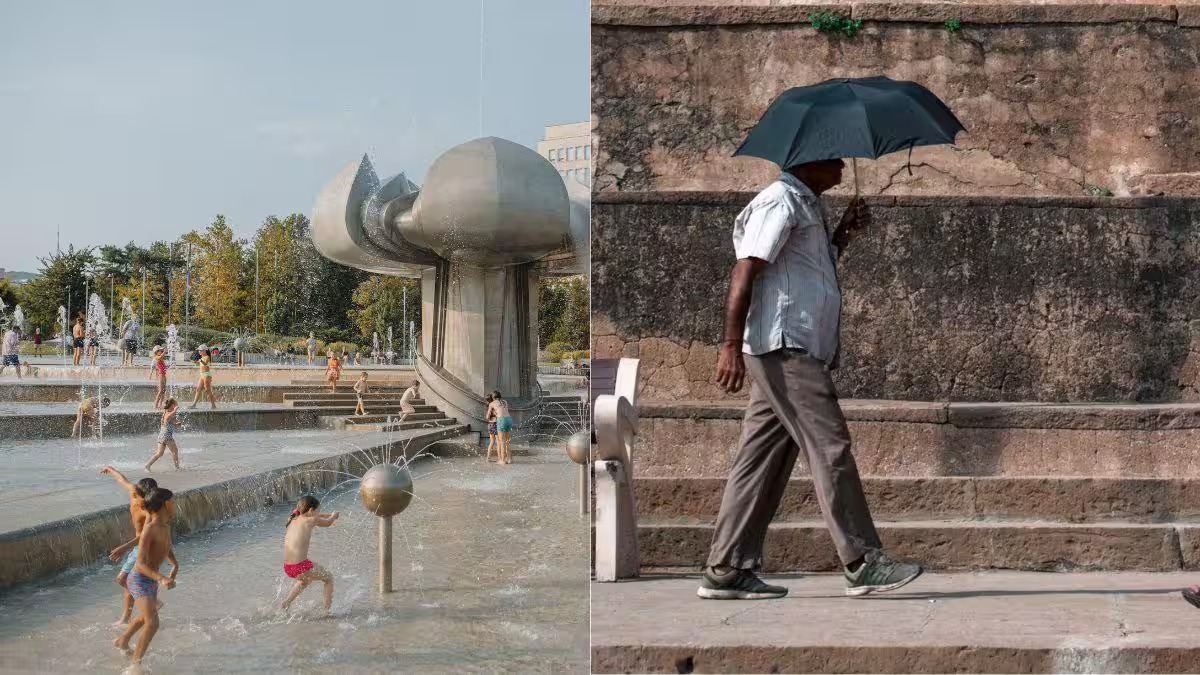
As recurring heatwaves challenge European public health frameworks and municipal infrastructure, climate experts advise adopting adaptation strategies from India's Heat Action Plans. Key lessons emphasize localized early warnings, passive cool-roof installations, mandatory mid-day work pauses, and targeted urban vulnerability mapping to mitigate systemic extreme weather disruptions.
GENEVA — With summer temperatures across Western and Southern Europe consistently breaking historic thresholds, international meteorological agencies are urging European municipal authorities to look toward South Asian adaptation frameworks. The World Meteorological Organization (WMO) has reported that recurring heat dome anomalies are straining regional power grids, warping railway infrastructure, and causing thousands of heat-attributable fatalities annually across nations traditionally unequipped for extreme thermal stress. As local governments scramble to implement emergency protocols, climate adaptation experts point to India’s long-standing, community-driven "Heat Action Plans" (HAPs) as a scalable blueprint for institutional resilience.
1. Decentralized Heat Action Plans (HAPs)
The primary pillar of India’s extreme weather defense is the localized Heat Action Plan, a structural system pioneered in Ahmedabad, Gujarat, following a severe heatwave event. According to the National Disaster Management Authority (NDMA), these plans do not rely on centralized national directives. Instead, they empower individual municipal corporations to activate color-coded early warning alerts based on highly localized humidity and temperature indexes.
2. Early Warning Communication Systems
European nations often rely on generic app-based weather alerts that fail to reach vulnerable or transient demographics. In contrast, Indian state disaster management portals utilize a multi-channel dissemination framework. This includes inter-agency WhatsApp broadcast loops, localized SMS blasts, community radio networks, and physical billboards at transit hubs to ensure warning systems reach field laborers and elderly residents who lack digital access.
3. Structural Retrofitting and Cool Roofs
A significant vulnerability within European housing lies in insulation designed exclusively to retain heat during winter, which creates an oven-like effect during summer. India’s Climate Resilience Program actively integrates passive cooling techniques into urban housing policies. Initiatives led by municipal bodies include applying solar-reflective white paint or broken china mosaics to rooftops, which can reduce indoor ambient temperatures by up to $5^\circ\text{C}$ without drawing power from grid systems.
4. Rebuilding Urban Hydration Networks
To protect pedestrians and outdoor workers, municipal plans across cities like Hyderabad and Nagpur mandate the establishment of public water booths (pyaus) and temporary shade canopies at high-traffic intersections. These distribution points are often run through public-private partnerships, ensuring that water scarcity does not exacerbate thermal shock among outdoor workers.
5. Reconfiguring Working Hours and Labor Laws
As extreme heat shifts from a seasonal anomaly to a structural predictability, regulatory adaptation becomes necessary. Under regional Indian labor directives, construction firms, delivery networks, and agricultural sectors enforce a mandatory mid-day operational pause between 12:00 PM and 4:00 PM during peak summer months. This systemic rescheduling limits worker exposure during periods of peak ultraviolet radiation.
6. Nature-Based Urban Cooling Corridors
Rapid concrete expansion across Europe has accelerated the "Urban Heat Island" effect. Indian city planning models are increasingly prioritizing nature-based interventions, such as planting dense, urban micro-forests utilizing the Miyawaki technique. These dense green barriers help absorb solar radiation and foster natural evapotranspiration, mitigating heat retention on concrete roadways.
7. Targeted Vulnerability Mapping
Rather than applying uniform emergency measures, Indian municipal medical teams utilize granular vulnerability maps to identify high-risk zones, such as congested low-income pockets and areas with dense elderly populations. This allows emergency medical response teams to pre-position rehydration salts and intravenous fluids at neighborhood clinics before a heatwave reaches peak intensity.
Official Sources Section
The meteorological metrics, municipal strategies, and structural adaptations discussed in this report are compiled from official field disclosures published by the World Meteorological Organization (WMO) and technical guidelines distributed by the National Disaster Management Authority (NDMA) of India.
Quote Section
"According to officials from the Intergovernmental Panel on Climate Change (IPCC), extreme weather adaptation can no longer be treated as a localized issue. Developed economies must systematically study and integrate long-standing urban cooling protocols implemented across the Global South to prevent escalating public health crises."
Why It Matters
For European city planners and citizens, transitioning toward proactive thermal management is a matter of critical infrastructure safety. Unprecedented heatwaves cause massive financial damage through rail bucklings, airport runway damage, and hydro-electric generation constraints. Adopting low-cost, community-centered defense mechanisms can significantly reduce hospital admission rates, preserve energy grid stability, and safeguard the well-being of outdoor workers and vulnerable demographics without requiring trillions in immediate structural overhauls.
Key Facts at a Glance
Origin Blueprint: India’s structured Heat Action Plans (HAPs) have been refined systematically since their initial 2013 implementation in Ahmedabad.
Passive Cooling: Cool-roof technologies can decrease interior residential heat loads by up to 5 degrees Celsius.
Economic Defense: Shifting outdoor operational schedules mitigates worker productivity losses and limits heat-stroke liabilities.
Infrastructure Strain: European railway and energy grids face rising operational vulnerabilities due to structural configurations built for cooler climates.
FAQ Section
Q1: Why is Europe more vulnerable to heatwaves than India if absolute temperatures are lower?
A: Much of Western and Northern Europe's infrastructure is optimized for heat retention rather than ventilation. Additionally, the lack of widespread air conditioning and low historical exposure means population behavioral patterns are less adapted to extreme heat safety protocols.
Q2: Can cool-roof applications work effectively in cooler European winters?
A: Yes, modern thermochromic coatings and smart building materials are designed to optimize solar reflectance during high-angle summer light conditions while minimizing heat loss during lower-angle winter seasons.
Q3: How do municipal bodies fund public hydration and cooling corridors?
A: Many successful models rely on localized public-private partnerships, where corporate social responsibility allocations fund water distribution networks managed by civic volunteer groups.
Source: