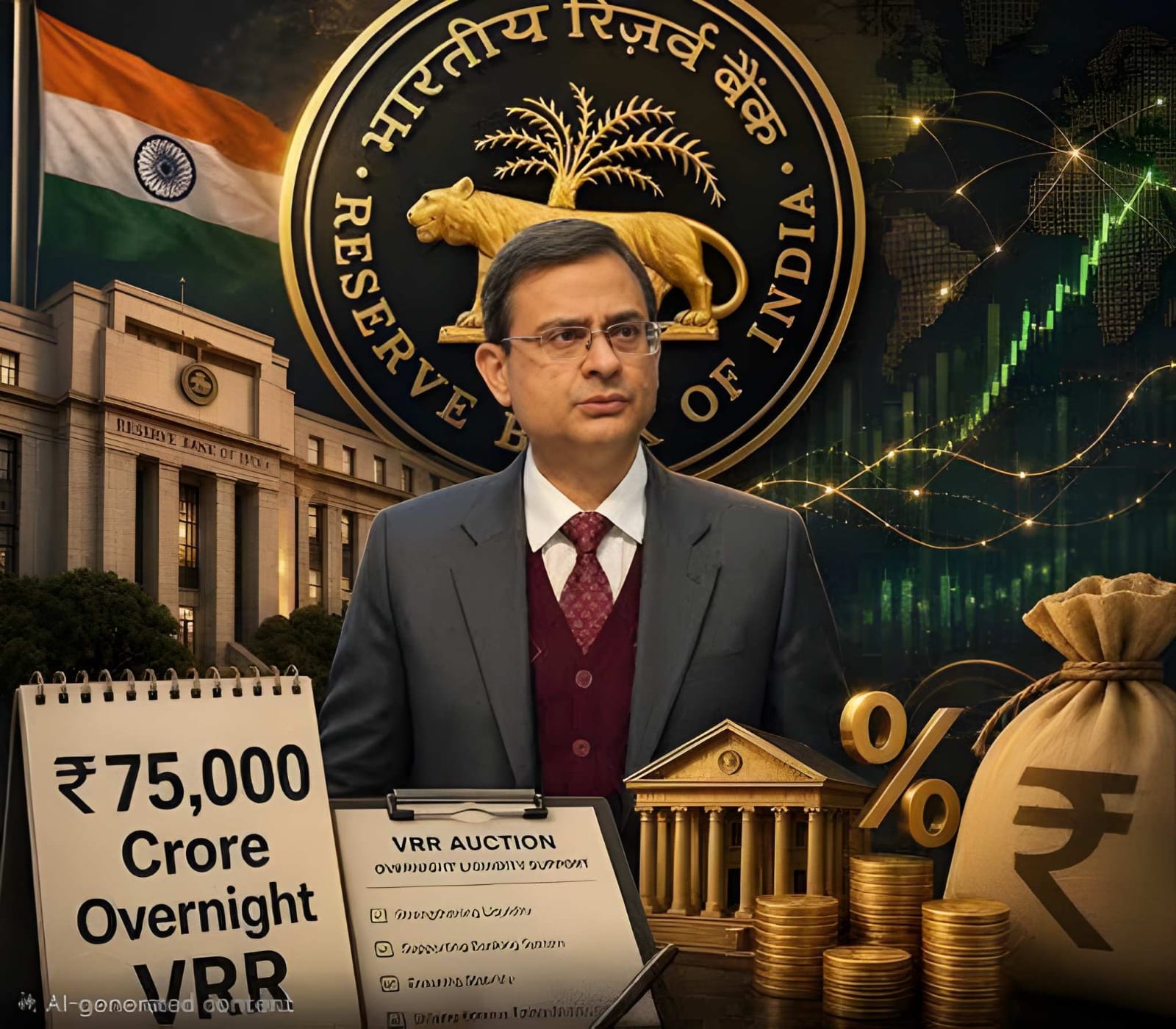
The Reserve Bank of India will conduct an overnight Variable Rate Repo (VRR) auction under LAF on June 30, 2026, to inject 750 billion rupees into the banking sector. The 1-day operation aims to address tightening liquidity conditions, with reversal scheduled for July 01, 2026.
MUMBAI — The Reserve Bank of India (RBI) announced on Monday that it will conduct an overnight Variable Rate Repo (VRR) auction on Tuesday, June 30, 2026, to inject 750 billion rupees (Rs 75,000 crore) into the domestic banking system. The short-term liquidity infusion, executed under the central bank's Liquidity Adjustment Facility (LAF), comes after a comprehensive review of current and evolving liquidity pressures within the financial sector. This systematic central bank intervention ensures that scheduled commercial lenders maintain adequate liquid reserves to satisfy end-of-quarter financial requirements and short-term credit obligations.
Technical Scope and Operational Framework of the VRR Auction
According to an official press release issued by Ajit Prasad, Deputy General Manager of Communications at the Reserve Bank of India, the central bank has established a structured operational window for market participants.
The technical parameters of the transaction are outlined below:
Notified Amount: The total liquidity pool allocated for the auction is exactly Rs 75,000 crore (750 billion rupees).
Tenor Duration: The financial arrangement is an overnight facility spanning a 1-day maturity period.
Window Timing: Bidding will open precisely at 9:30 AM IST and conclude at 10:00 AM IST on Tuesday, June 30, 2026.
Date of Reversal: The repurchase agreement will reverse on Wednesday, July 01, 2026, requiring borrowing banks to return the cash capital.
The central bank confirmed that the standard operational guidelines for this overnight intervention will remain fully aligned with the permanent regulations originally detailed in the Reserve Bank's baseline press release dated January 20, 2022. Participating commercial banks must submit their competitive yield bids through the RBI's electronic e-Kuber core banking portal within the allocated 30-minute window.
Contextual Drivers Behind Banking Liquidity Pressures
The reserve management decision by the RBI reflects typical tightening pressures observed in Indian financial markets toward the end of June. During this phase, banking liquidity experiences increased stress due to statutory quarterly advance tax outflows from commercial bank corporate accounts into the government treasury. Furthermore, the final days of the month require commercial banks to manage strict capital requirements to maintain their statutory liquidity ratio (SLR) and cash reserve ratio (CRR) metrics under central bank standards.
By deploying a Variable Rate Repo auction, the RBI chooses a market-driven approach over a rigid, fixed-rate fund injection. The competitive bidding model allows participating banks to secure necessary funding at rates that accurately mirror the true market demand for overnight capital.
Direct Impact on Commercial Banks, Businesses, and Retail Consumers
For commercial banking institutions, the 750 billion rupee pool provides an immediate buffer to manage transient deficits, preventing call money rates from rising significantly above the policy repo rate. Banks holding eligible government securities can seamlessly exchange them for overnight cash liquidity to stabilize their short-term balance sheets.
For corporate enterprises, small businesses, and industrial borrowers, the proactive intervention prevents unexpected increases in daily working capital loans. When the interbank market experiences severe cash deficits, the costs can pass through to borrowers via higher short-term commercial paper rates. The RBI's auction directly minimizes this risk.
For retail consumers, steady interbank liquidity supports stable lending conditions, ensuring that consumer credit lines, home loan processing, and digital payment clearance mechanisms operate without disruption during high-volume month-end transaction periods.
Official Sources Section
The financial parameters, regulatory codes, and operational timelines presented in this report were verified against official corporate press release No. 2026-2027/565, distributed directly by the Central Office Communication Department of the Reserve Bank of India on June 29, 2026. The regulatory parameters are anchored to the permanent electronic banking guidelines monitored by the RBI's Financial Markets Operations Department.
Quote Section
"On a review of current and evolving liquidity conditions, it has been decided to conduct a Variable Rate Repo (VRR) auction on Tuesday, June 30, 2026 [...] The operational guidelines for the auction will be same as given in Reserve Bank's Press Release 2021-2022/1572 dated January 20, 2022."
— Official Statement from Ajit Prasad, Deputy General Manager, Reserve Bank of India
Why It Matters
The implementation of the Variable Rate Repo auction shows how the RBI actively manages the interbank corridor to maintain monetary policy alignment. By fine-tuning liquidity availability through tactical 750 billion rupee operations, the central bank prevents minor market frictions from escalating into broader systemic volatility. This proactive oversight supports orderly trading conditions across domestic debt markets and keeps short-term money market rates closely tied to the official policy target.
Key Facts at a Glance
Massive Capital Injection: The RBI will offer 750 billion rupees (Rs 75,000 crore) to commercial banks.
Overnight Tenor Window: The liquidity allocation operates on a 1-day tenor with reversal scheduled for July 01, 2026.
Market-Based Execution: The auction utilizes a variable rate mechanism, allowing banks to bid based on their real-time capital needs.
Strict Operating Window: Bidding is restricted to a 30-minute period between 9:30 AM and 10:00 AM IST on June 30.
Regulatory Continuity: The operation adheres to the baseline framework established in the RBI's January 2022 guidelines.
FAQ Section
What is a Variable Rate Repo (VRR) auction?
A Variable Rate Repo auction is a monetary policy tool used by the RBI to inject short-term liquidity into the banking system. Commercial banks borrow cash by pledging government securities as collateral, with the interest rate determined through competitive market bidding.
Why did the RBI announce this 750 billion rupee injection now?
The auction was announced following an official review of current and evolving liquidity conditions within the financial markets, typically influenced by quarter-end tax outflows and statutory reporting requirements.
When will the capital from this auction be returned to the RBI?
Since this is an overnight transaction with a 1-day maturity tenor, the reversal of the funds will take place on Wednesday, July 01, 2026.
Sources: Market Operations Bulletin via Reserve Bank of India, Financial Regulation Database via Ministry of Finance, Central Banking Press Release Record