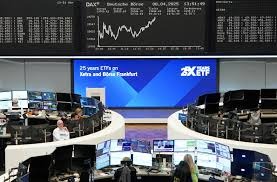
European stock futures pointed to a defensive and lower market opening on Thursday, June 4, 2026, as international financial participants reacted to escalating transatlantic trade uncertainties and renewed geopolitical conflict. Equity derivatives tied to the Eurozone’s largest corporate entities edged downward in premarket trading, following a negative Wall Street close that snapped a multi-day winning streak. The broad downward pressure today reflects growing corporate concerns over immediate corporate profit margins and volatile raw material input costs.
Key Equity Derivatives Track Pre-Market Losses Across Exchanges
According to early morning transaction data compiled from the Eurex Exchange, the benchmark Euro Stoxx 50 futures dropped 0.40 percent to 6,042.00 points. Concurrently, regional underlying instruments mirrored this downward trajectory. Germany's DAX futures slid 0.30 percent to open at 25,179.77, while the United Kingdom's FTSE 100 futures fell by 0.40 percent, highlighting a generalized retreat from risk-heavy equity classes across major European financial capitals.
The contract pricing data indicates that institutional investors are actively pricing in defensive risk premiums. Financial sectors, automobile manufacturing firms, and energy-dependent retail providers are experiencing the most pronounced shifts as electronic order books register a net building of short positions ahead of the standard cash trading session.
Washington Trade Policies and Energy Spikes Stifle Sentiment
The immediate catalyst driving the downturn in European stock futures stems from recent policy statements issued by the Office of the United States Trade Representative. The US administration announced proposed plans to levy additional import tariffs ranging between 10 percent and 12.5 percent on roughly 60 major global trading partners, including the European Union, citing non-compliance with international labor sourcing regulations. This protective trade friction threatens to disrupt multi-billion-dollar export channels for European industrial giants.
Compounding the economic headwinds, institutional energy desks reported a sharp increase in global crude oil benchmarks overnight. The sudden spike followed reports of fresh military exchanges in the Middle East that threatened vital sea lanes, causing the Eurozone volatility benchmark (VSTOXX) to climb 5.33 percent to 20.346. High oil prices historically strain European corporate operations by driving logistics expenses higher and keeping inflation expectations stubbornly elevated.
Official Sources Section
The financial index metrics, contract percentage changes, and regulatory policy impacts highlighted in this report are sourced from formal electronic market disclosures distributed by the Eurex Derivatives Platform, the commercial data portals of Deutsche Börse Group, and the official trade register documentation of the United States Trade Representative.
Quote Section
"According to officials tracking regional derivatives volumes, the initial pre-market decline across the Euro Stoxx 50 and underlying indexes demonstrates an immediate structural repositioning by institutional asset managers looking to hedge against a compounding mix of trade constraints and elevated energy overhead."
Why It Matters
The early drop in European stock futures has direct practical implications for global investment funds and corporate boardrooms adjusting their mid-year capital allocations. For retail consumers, a prolonged stock market dip driven by escalating tariffs and rising fuel prices translates into increased retail goods pricing and tighter local employment markets. For institutional investors managing retirement portfolios, the current downswing underscores the necessity of moving capital out of cyclical industrial shares and into protective, defensive assets until stable global trade policies resume.
Key Facts at a Glance
Derivatives Drop: Euro Stoxx 50 futures fell 0.40 percent in early premarket trading, signaling a weaker cash market open.
Regional Declines: Germany's DAX futures and the United Kingdom's FTSE futures both slipped by approximately 0.30 to 0.40 percent.
Tariff Threat: The US proposed new tariffs up to 12.5 percent on European Union imports, disrupting global automotive and industrial outlooks.
Volatility Surge: The VSTOXX volatility index jumped over 5 percent as renewed Middle East clashes drove crude oil prices higher.
FAQ Section
What are stock futures and why do they affect the regular market open?
Stock futures are legally binding financial derivatives that allow investors to speculate on the future value of an index. Because they trade overnight and before the market opens, they serve as a leading indicator of general investor sentiment before physical stock exchanges begin trading.
How do US tariff announcements directly impact companies inside the Euro Stoxx 50?
Many large corporations listed in the Euro Stoxx 50 rely on the United States as their primary export market. Imposing new import tariffs increases the final cost of European products for American consumers, reducing sales volumes and lowering corporate earnings.
What sectors are historically most vulnerable to sudden oil price increases?
Transportation networks, passenger airlines, commercial shipping fleets, and heavy automotive manufacturers typically face immediate pressure because fuel represents a massive percentage of their baseline operational expenditures.
Source: Pre-market transaction ledgers provided by the Eurex Derivatives Clearing House; Macroeconomic event calendars maintained by Saxo Bank Group; Volatility index reporting from STOXX Limited.