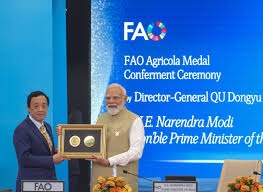
The FAO’s highest honour for Prime Minister Narendra Modi is being read very differently in India’s hinterland than in Delhi’s policy circles. For many small entrepreneurs under schemes like PMFME, it is less about global prestige and more about a sense that the world has noticed India’s long, uneven push on food security and farm-sector reforms.
PMFME (Prime Minister Formalisation of Micro Food Processing Enterprises) beneficiaries, in particular, are framing the FAO recognition as an endorsement of the broader agricultural ecosystem they operate in: from crop diversification and millet promotion to food processing, storage and rural entrepreneurship. For them, the award is not abstract diplomacy, but part of a story that runs through FPOs, self-help groups, small processing units and local markets.
From Global Citation To Local Kitchens
International awards often feel distant to farmers and micro-entrepreneurs. Here, though, the framing matters. When a PMFME beneficiary says FAO’s highest honour is a recognition of India’s agricultural policies, they are connecting global applause to very local changes: easier credit, training support, cold-chain links, branding help and a push towards value addition instead of just selling raw produce.
Millets, Processing And Policy Continuity
Over the past few years, policy has leaned heavily into millets, oilseeds, pulses and food processing, moving away from a narrow paddy wheat story. That has opened space for home-scale and micro units to package flours, ready-to-eat mixes, traditional snacks and local specialties. PMFME sits on this seam, helping informal units formalise, access schemes and tap demand beyond their districts. The FAO honour is being read as a nod to that wider strategy.
Why Entrepreneurs See Themselves In The Award
For a PMFME beneficiary, every incremental gain matters: a new sealing machine, a better label, a supermarket tie-up in the nearest town. When they say the FAO recognition belongs to India’s agricultural policies, they are also subtly claiming a share in it. Their argument is that policy has finally moved to see farmers and micro processors as part of the same value chain, and that this is what global institutions are now rewarding.
What To Watch Next In Agri Policy
The real test will be whether this moment translates into deeper reforms: more investment in storage and logistics, simpler compliance for micro units, better market access and continued focus on climate-resilient crops. If that happens, the FAO honour will feel less like a one-day headline and more like a milestone in a longer shift in how India thinks about agriculture and food processing.
Agri Policy Recognition Highlights
- FAO’s highest honour for PM Modi framed as a nod to India’s farm policies
- PMFME beneficiaries see global recognition as linked to their own journeys
- Focus on millets, processing and value addition becomes part of the narrative
- Next phase hinges on infrastructure, markets and climate-resilient agriculture
Sources: Government Statements, Scheme Beneficiary Feedback, Agriculture And Food Policy Commentary